|
|
His
idea was to issue recordings in a series of special editions named "Remington
Series". There were real finds like an unissued Dohnanyi Sonata, the
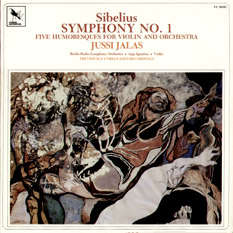
First Symphony of Sibelius conducted by Jussi Jalas which had never been
released on Remington before, and the stereo recordings of the Cincinnati
Symphony made in the fall of 1953. Of the latter recordings only the Sibelius
and Dvorak performances were in tact. |
| |
The
recordings of Prokofiev's Second Concerto with Jorge Bolet, Gerswin's
Concerto in F with Alec Templeton and Tchaikovsky's Symphony No. 2, all
conducted by Thor Johnson, could have veen recorded in stereo as well.
But the tapes of these performances were either not found or were in bad
shape and could not be used.
The
recordings eligible for a reissue had to be equalized in accordance with
the latest RIAA frequency characteristic adopted by the record industry
in the second half of the nineteen seventies.
|
|
The
first record was released in February 1978. And there were many to follow.
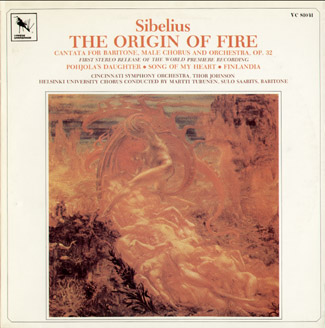
One issue was of the performances by the Helsinki University Chorus, the
Cincinnati Symphony Orchestra, baritone Sulo Saarits and conductor Thor
Johnson, of the cantata The Origin Of Fire, the symphonic poem Pohjola's
Daughter (both works by Jean Sibelius), and 8 songs performed a
capella by the Helsinki University Chorus.
|
|
| |
These
performances of the Cincinnati Symphony and the  Helsinki University Male Chorus were originally
made in stereo in November 1953. The recordings were supervised by
Don Gabor and
Laszlo Halasz. The technician was Robert
Blake. In 1955 the performances were released in mono on Remington R-199-167
and R-199-191 respectively. Tom Null issued these recordings for the first
time in stereo on Varèse-Sarabande VC 81941.
Helsinki University Male Chorus were originally
made in stereo in November 1953. The recordings were supervised by
Don Gabor and
Laszlo Halasz. The technician was Robert
Blake. In 1955 the performances were released in mono on Remington R-199-167
and R-199-191 respectively. Tom Null issued these recordings for the first
time in stereo on Varèse-Sarabande VC 81941. |
|
|
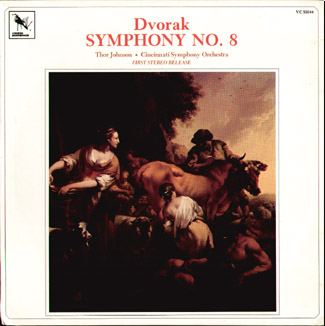
Another
recording was of Dvorak's Symphony No. 8 (at the time numbered as No.
4), again with the Cincinnati Symphony conducted by Thor Johnson and originally
released on R-199-168. The Varèse-Sarabande release has reference
number VC 81044. This also was a recording done in stereo. Sound
engineer was Robert Blake. Producers were Don Gabor and Laszlo Halasz.
 Listen
to the Second Movement.
Listen
to the Second Movement.
|
|
|
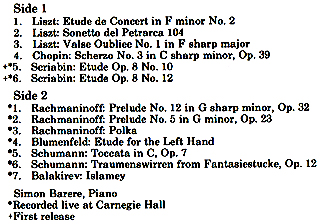
Legendary
Simon Barere can be found on VC 81045.
Some of the live performances were recorded on acetates in Carnegie Hall
by Simon Barere's son Boris and show the disadvantage of not being able
to splice, yet the advantage of the live performance. The studio recordings
for Remington Records bear all the technical benefits of the tape recorder.
There were recordings of two Etudes from Scriabin's Op. 8 (Nos. 10 and 12)
which had never been released on record before.
|
|
|
VC
81045 of Barere is in fact an original Don Gabor
Production prepared for a re-release by Tom Null, Dub Taylor, and Chris
Kuchler. Remastered by Bruce Leek. Duplication engineer was John Arici.
Regrettably
Barere's most famous interpretation of the Sonata of Franz Liszt
did not find a place in The Remington Series, probably because of copyright
which was owned by Simon Barere's son Boris. The Sonata in B was later issued
by APR. |
|
|
Simon Barere
often emphasized the virtuosity of the compositions, and it is obvious that
speed is generally a major ingredient of his interpretations and to opt
for speed means at times a restriction resulting in untidy playing. Nevertheless
there have been outstanding renderings recorded, for example Chopin's Scherzo
No. 3 and Blumenfeld's Etude for the Left Hand. |
|
|
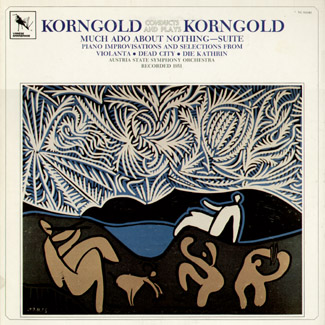
Varèse-Sarabande
issued VC 81040 with the tapes from which the very early, original
Masterseal MW 46 was cut. It is likely that the recordings of the
Masterseal LP were produced for the Austrian Broadcasting Services (ORF)
by
Marcel Prawy together with Erich Wolfgang
von Korngold himself as the luxurious Masterseal bears the emblem "A
Marcel Prawy Production", and copyright remained with Korngold.
|
|
|
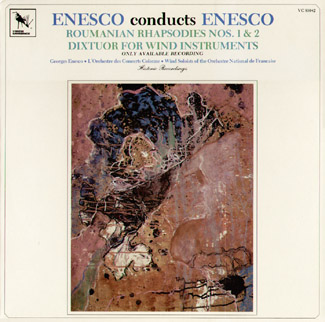
Three
compositions by
Georges Enesco conducted by the maestro
himself: Rumanian Rhapsodies Nos. 1 and 2, and Dixtuor recorded in 1951
with the Colonne Orchestra from Paris. Varèse-Sarabande VC 81042.
The recordings of the two Romanian Rhapsodies and of Dixtuor are the only
taped Remington recordings of George Enesco as a conductor. |
|
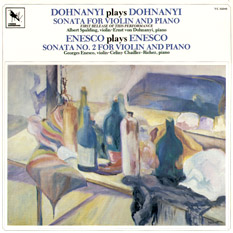
Georges Enesco is accompanied
by pianist Céliny Chaillez-Richez (should read Chailley-Richez) while
performing his Sonata No. 2, the famous recording originally pressed on
R-149-42. Violinist Albert Spalding is accompanied by
Ernst von Dohnanyi in Dohnanyi's Sonata Op.
1, a recording which never was issued on a Remington disc before, now issued
on Varèse-Sarabande VC 81048. |
|
|
|
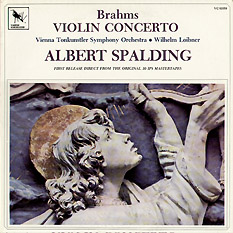
From
1950 on
Albert Spalding was contracted by Don
Gabor starting with the recordings made with Ernst von Dohnanyi and culminating
in the recordings of the Beethoven en Brahms Violin Concertos.
The Brahms was originally issued on Remington R-199-145 and now had found
its release on VC 81059. Spalding recorded this Concerto with the
Austrian Symphony Orchestra,
Wilhelm Loibner conducting. The tape of
the Beethoven concerto could obviously not be used. It is missing in the
Series. |
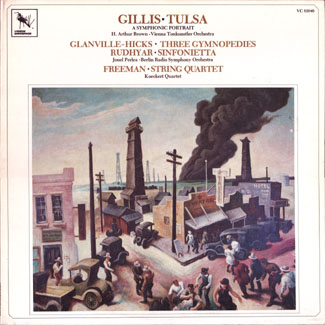
In
July 1950
H. Arthur Brown, conductor of the Tulsa
Philharmonic, traveled to Vienna to make recordings of works by Tchaikovsky,
Mendelssohn-Bartholdy, Brahms, and Rimsky-Korsakov. He also recorded a
work by American composer Don Gillis entitled Tulsa, A Portrait
In Oil which was originally pressed on R-149-13 and re-released by Null
on VC 81046.
|
|
|
On
the Varèse-Sarabande cover of the recording of John Freeman's String
Quartet performed by the Koeckert Quartett the name of Klaus Schlupp is
mentioned as First Violinist which is quite odd because the Quartett was
named after Rudolf Koeckert who was First Violinist.
Koeckert's
name was obviously not mentioned in the original documents from 1954 because
he was under contract with Deutsche Grammophon at the time. So the name
of violinist Klaus Schlupp was borrowed for the occasion. Whether Schlupp
(who can be found on the CFD, Turnabout and Nonesuch labels) really substituted
Koeckert when the recording was made is not certain.
|
On
the same disk Three Gymnopedies (Peggy Glanville-Hicks) and Sinfonietta
(Dane Rudhyar) performed by the RIAS Symphony conducted by
Jonel Perlea.
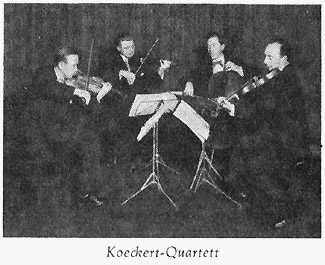
The
members of the Koeckert Quartett are Rudolf Koeckert (1st Violin),
Willi Buchner (2nd Violin), Oskar Riedl (Viola) and Josef Merz
(violoncello).
Image taken from the
back of Deutsche Grammophon 13154 LPM.
|
And
there is John Freeman's String Quartet No. 1 composed in 1950-1951,
Freeman's Quartet was recorded
in Berlin when the recordings with the
RIAS Symphony were made. The short
composition has three movements. It was never issued on a Remington disc.
|
|
Donald
Gabor and Laszlo Halasz produced several recordings in cooperation with
the American Composers Association. The liner notes give recording dates,
equipment used and if LP records were the basis of the transfer. The recorded
works:
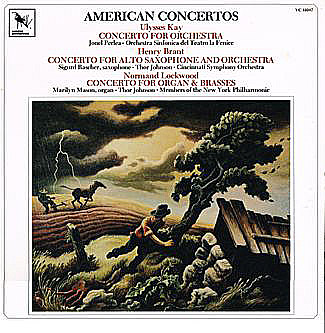
Concerto
for Orchestra (Ulysses Kay) by 'Orchestra Sinfonica del Teatro la Fenice',
conducted by Jonel Perlea, recorded in Venice in July of 1953.
|
|
| Concerto
for Alto Saxophone and Orchestra (Henry Brant), with Sigurd Rascher and
the Cincinnati Symphony Orchestra conducted by Thor Johnson. Concerto for
Organ and Brasses (Normand Lockwood) performed by Marilyn Mason and members
of the New York Philharmonic: John Ware and Nathan Prager (Trumpets) and
Gordon Pulis and Lewis Hancy (Trombones). |
Brant's
Concerto was recorded in December 1953 in Cincinnati. Recording engineer
was Robert Blake. The Lockwood Concerto was recorded in 1953 in Saint
Paul's Chapel at Columbia University. The Brant and Lockwood pieces were
remastered straight from the original Remington tapes. The Kay Concerto
was copied from a Near Mint LP pressing. VC 81047.
|
|
|
Jussi
Jalas, son in law of Jean Sibelius, conducted Symphony No. 5 of Sibelius
on R-199-201. He also recorded Symphony No. 1 but this recording never
was released by Donald Gabor on Remington as the contract with Bertelsmann
had prematurely ended.
|
|
|
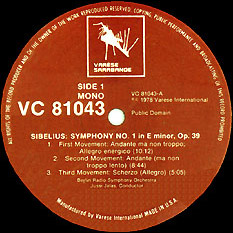
Violinist
Anja Ignatius is the soloist in Five Humoresques (Sibelius). The label and
cover of VC 81043 mention Berlin Radio Symphony Orchestra instead
of
RIAS Symphony as the release in Germany
by Bertelsmann did. |
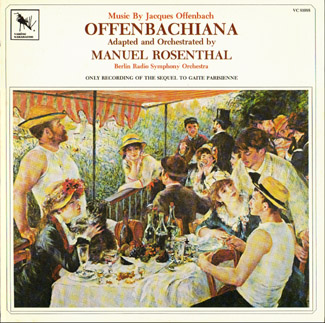
Offenbachiana,
which was arranged and orchestrated by conductor Manuel Rosenthal, was
a commission from Remington Records. It was a sequel to "Gaieté
Parisienne".
The
cover of VC-81088 gives ample information about the recording.
|
|
|
It is the first release from the 30 ips full-track monaural master tapes,
as it was Remington's practice to cut from 15 ips copies of their masters.
The original issue (R-199-183) was available in the Spring of 1955 but mentioned
in Schwann in September of 1955. (See the Dutch
Advertisement). The issue was officially
deleted in 1957, though it also appeared briefly reincarnated on the Webster,
Paris and Masterseal labels. |
For
this issue on Varèse-Sarabande some sonic improvements have been
achieved through the use of modern equalization and mastering techniques.
The
Varèse-Sarabande cover says Berlin Radio Symphony Orchestra. But
at the time of the recording the orchestra was still named RIAS Symphony.
|
Except
for the releases of the Brahms Violin Concerto and Dvorak's 4th (8th)
Symphony, all covers were adorned with work by modern painters:
Klaske Zeilstra (Barere, Sibelius Symphony, Dohnanyi, Enesco
conducts)
Thomas Hart Benton (Gillis, American Concertos)
Jean Delville (Sibelius Origin of Fire)
Pablo Picasso (Korngold).
The Offenbachinana issue bears the painting of Pierre-August Renoir
with the title "At the Moulin de la Galette".
|
|
All
images of covers from records in my personal collection.

|
|