|

Before
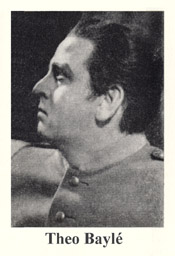
Theo Baylé started singing in Vienna he already recorded with
the Residency Orchestra (The Hague) under Willem van Otterloo as is
evident on this 78 RPM disc, reference X 10034, of the Dutch Decca Distribution
Company with Prologue from
I Pagliacci (Leoncavallo), recorded in the Amsterdam Concertgebouw (where
most of Willem Van Otterloo's recordings took place).




|
He
may have been considered a talent with a great future in Vienna and
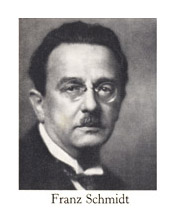
possibly in Salzburg as well. After all he had studied under Clemens
Krauss and Franz Schmidt and was appointed conductor at the Vienna
State Opera already at age 28, in 1937.
|
|
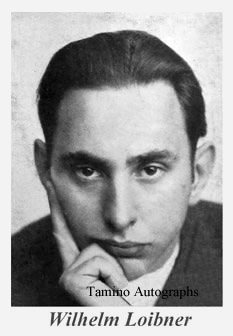
Wilhelm
Loibner in 1946, about four years before he started recording.
Edited image of the original signed photograph, courtesy of
 Tamino
Autographs.
Tamino
Autographs.
|
Maybe
times were not in favor in the years just before World War Two. "Austria
is one of the poorest countries of Europe. The streets are filled
with cripples and beggars and Vienna is considerably run down", young
American conductor
Thor
Johnson wrote in a letter to his parents when he was following
courses in Europe in 1937. There was an economic crisis going on and
the cards were being reshuffled. A large scale war was at hand.
Even
in 1945, after World War Two had ended, an important factor for succeeding
was "luck". Both Vienna and Salzburg were filled with talent
wanting a stage to perform on. There were regulations and restrictions
because of Austria's role in World War II. Austria was still occupied
by the Allied Forces: United States, Great Britain, France and the
Soviet Union. A free, independant and democratic Austria was established
in 1955.
Wilhelm
Loibner had luck and continued to conduct the Staatsoper. Whether
he had the aspiration and the desire to pursue a career outside of
the Vienna State Opera is not very clear. Yet he became a convenient
solution for several record companies that were to hire a conductor
for the occasion. And thus his name became known in Europe as well
as in the United States. Was he considered a commodity? A convenience?
Could well be.
Listening
to his performance of Hungarian Rhapsody No. 2 by Franz Liszt, a fill
out on a Van Otterloo-Liszt Philips disc, the first impression is
that there is some lack of power that would be needed to mold the
orchestra, and there is not enough authority to make an impact on
the listener. The Philips recording of that Hungarian Rhapsody also
shows that he is not the conductor who wants to impress his audience,
in any case not right away. One has to listen for a second, even for
a third time. He is not a story teller. His conducting is correct.
As correct as in the recording of the Beethoven Concerto with Albert
Spalding. After hearing more of Loibner it is evident that the Hungarian
Rhapsody was probably not the best pick to comment on his conducting.
When
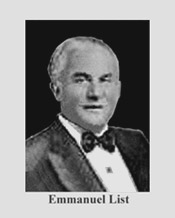
accompanying Emmanuel List (former bass of the Metropolitan
Opera New York) and contralto Else Schurhoff, in the Finale
to Act II of "Der Rosenkavalier", he conducts with good
timing, Viennese timing.
In lyrical music he is at home and knows exactly how to present drama
and captivate the listener as is profusely illustrated by his conducting
operas of Puccini which appeared on Remington. His HMV recording "Opern
Ball", from 1962, was "a first-class record presenting
charming music with affection and in true Viennese style", as
music critic W.A. Chislett of The Gramophone put it.
Before
Wilhelm Loibner was "appointed a resident conductor at the Vienna
State Opera" - as is mentioned in John L. Holmes's book "Conductors
on Record" - he had already been with that Opera since 1931 starting
as a repetiteur. And that indicated already that first of all his
forte was in opera. That is why the Compact Discs with historic material,
that feature him, contain mostly arias with famous Viennese singers
(and a few from abroad), and there are recordings of more than a few
opera choruses available as well.

Taking all this into account, it is clear that among the most important
recordings Wilhelm Loibner made are certainly those of the Violin
Concertos of Beethoven and Brahms with Albert Spalding, the works
by Bruch with violinist Michèle Auclair, the Mozart Concerto
with pianist Sari Biro, and the two complete operas of Puccini, all
published on the Remington label. Plus there are a few recital disks.
The recordings were made in 1950, 1951 and 1952. The recording of
Madama Butterfly (Puccini) was released in June 1952. A complete La
Bohème was available in the spring of the following year. It
was also included in Schwann Artists Listing of 1953.
The
performances by Albert Spalding were recorded in November 1952 and
issued one year later. Since Kurt Wöss had left for Japan to
take up the post of principal conductor of the NHK (Japanese Radio)
Symphony Orchestra
Hans
Wolf planned to return to the US, and
Hine Arthur Brown had stopped recording
(for whatever reason), Wilhelm Loibner continued to make recordings
produced by Marcel Prawy.
It
is rather strange that there is not much known about this conductor,
except for the few data in the book of Holmes and the entry in the
Austrian Music Lexicon (Austrian Academy of Sciences) stating that
Wilhelm Loibner was born in Vienna on January 1, 1909 and died in
Bad Hall, Upper Austria, on April 23, 1971 at the age of 62. There
is no Wikipedia page about Wilhelm Loibner at the time I publish this
text on January 16, 2012.
On
the back of the cover of the Spalding-Beethoven disc is printed: "The
orchestra is the Austrian Symphony Orchestra conducted by Wilhelm
Loibner, youngest of the leading conductors of the Vienna State Opera,
who has already become recognized in other European capitals".
There are no details mentioned in liner notes on other Remington
covers of his other recordings.
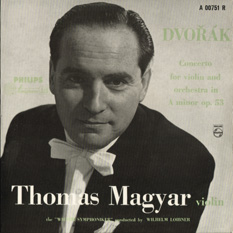
Liner
notes written for the Philips recording of Antonin Dvorak's
Violin Concerto, with violinist Thomas Magyar, have this somewhat
awkward paragraph:
"The
soloist is supported by the well-known, deeply-musical conductor,
Wilhelm Loibner, whose receptive, sensitive ear invariably detects
the slightest rubato and tempo nuances, almost as if he possessed
a sixth sense. He had one of the greatest orchestral instruments
at his disposal for this recording, the Wiener Symphoniker,
rendering under his baton, every one of the soloist's slightest
nuances in glorious music"
|
This
is - except for the annotation found elsewhere that he was Principal
Conductor of the NHK Symphony Orchestra from March 1957 till February
1959, and that he was married to soprano Ruthilde Boesch - as far
as the record collector gets.
|
|
Marcel
Prawy produced many recordings on his own account like 'Rêve
de valse' (Ein Walzertraum, Dreamwaltz) by Oscar Srauss, released
in France on Counterpoint CMC 120.001, the composer conducting
the 'Tonkünstlerorchester', listed in 1955. The actual
conductor in this recording is not Oscar Strauss who was already
very old, yet very satisfied with the way
Max
Schönherr conducted the music.
|
 On
Remington R-199-122, which is Mona Paulee's Gershwin and Porter disk,
we find Ruthilde Boesch on the B-Side singing the Musette Waltz from
La Bohème, conducted by Wilhelm Loibner. This excerpt was taken
from the complete recording of La Bohème on R-199-80/3. On
R-199-41 she sings with Emmy Funk (soprano), Rosette Anday (contralto),
Hugo Meyer-Welfing (tenor) and Georg Oeggl (bass) in selections (Vocal
Highlights) of Die Fledermaus (The Bat), with the Austrian Symphony
Orchestra conducted by Max Schönherr. She also sang in "Rêve
de valse" (Ein Walzertraum - A Dreamwaltz) of Oscar Strauss who
himself conducts the Tonkünstler Choir and Orchestra. Other soloists
of the Viennese Opera in this recording were Georg Oeggl (baritone),
Karl Wagner (tenor), Martha Rohs (contralto), Rudolf Christ (tenor),
Gerhard Engel (baritone), Margit Opawsky (soprano), and Franz Boeheim
(tenor). This production was not bought by Don Gabor. Marcel Prawy
arranged for the release on other labels, for example Counterpoint
in France.
On
Remington R-199-122, which is Mona Paulee's Gershwin and Porter disk,
we find Ruthilde Boesch on the B-Side singing the Musette Waltz from
La Bohème, conducted by Wilhelm Loibner. This excerpt was taken
from the complete recording of La Bohème on R-199-80/3. On
R-199-41 she sings with Emmy Funk (soprano), Rosette Anday (contralto),
Hugo Meyer-Welfing (tenor) and Georg Oeggl (bass) in selections (Vocal
Highlights) of Die Fledermaus (The Bat), with the Austrian Symphony
Orchestra conducted by Max Schönherr. She also sang in "Rêve
de valse" (Ein Walzertraum - A Dreamwaltz) of Oscar Strauss who
himself conducts the Tonkünstler Choir and Orchestra. Other soloists
of the Viennese Opera in this recording were Georg Oeggl (baritone),
Karl Wagner (tenor), Martha Rohs (contralto), Rudolf Christ (tenor),
Gerhard Engel (baritone), Margit Opawsky (soprano), and Franz Boeheim
(tenor). This production was not bought by Don Gabor. Marcel Prawy
arranged for the release on other labels, for example Counterpoint
in France.
Remington
Recordings of Wilhelm Loibner
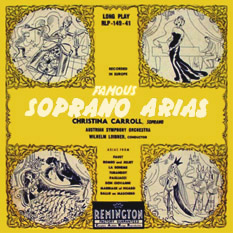
R-149-41
Christina Carroll sings Famous Soprano
Arias
Jewel Song (Faust - Gounod)
"Ah, Je veux vivre (Romeo and Juliet - Gounod)
"Donde lietas" (La Boheme - Puccini)
"Tu che di gel sei cinta" (Turandot - Puccini)
Aria of the Page Boy (Ballo in Maschera - Verdi)
Bird Song (Pagliacci - Leoncavallo)
"Batti, batti, o bel Masetto" (Don Giovanni - Mozart)
"Guinse alfin momento" (The Marriage of Figaro - Mozart)
Christina Carroll (soprano) with the Austrian Symphony Orchestra,
Wilhelm Loibner conducting.
R-199-70
Mozart: Piano concerto No. 24, performed by Sari Biro. The
recording was coupled with Overture to "The Marriage of Figaro" performed
by the Austrian Symphony Orchestra, Robert Heger conducting. The record
was released in June 1952.
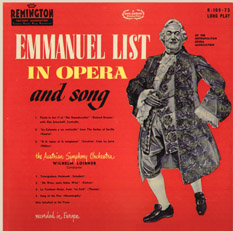
R/199-73
Emmanuel List in Opera and Song
SIDE 1:
- Finale to Act II of "Der Rosenkavalier" (Richard Strauss)
- with Else Schurhoff, (contralto)
- La Calumnia e un venticello, from "The Barber of Seville"
- Si la rigeur et la vengeance" (Cavatine) from "La juive"
(Halevy)
Wilhelm Loibner conducting the Austrian Symphony Orchestra.
SIDE 2:
With Otto Schulhoff at the piano:
Totengrabers Heimweh (Franz Schubert); O Wien, mein liebes Wien (Karl
Ziehrer); Le tambour-major (from Le Caïd - Ambroise Thomas);
Song of The Flee (Modest Mussorgsky).
|
|
|
|

Click here
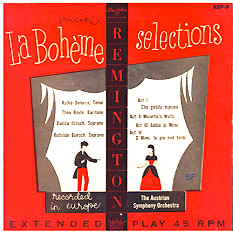
for a Sound Clip of Ratko Delorco/Delorko singing 'Che gelida
manina' from La Bohème with the Austrian Symphony Orchestra
conducted by Wilhelm Loibner, taken from the 45 RPM EP with
selections.
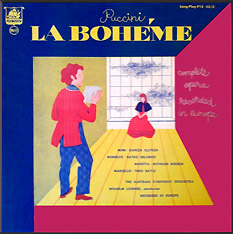
La Bohème was also issued on the Plymouth label, P-12-42/3.
|
|
|
|
|
|
|
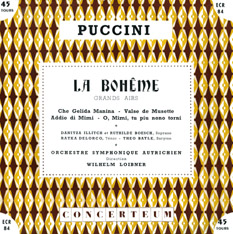
Concerteum
also pressed a 45 RPM disc of excerpts from La Bohème
wirh Danitza Illitch and Ruthilde Boesch (Soprano), Ratko Delorco
(Tenor) and Theo Baylé (Baritone).
|
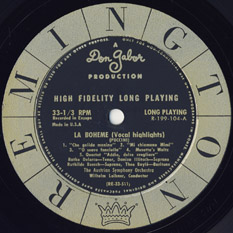
R/199-80/3
Puccini: La Bohème
Daniza Illitsch, Ratko Delorco, Hildegarde Rössel-Majdan, Ruthilde
Boesch, Theo Baylé, Marion Rus, Georg Oeggl, and Emil Siegerth.
Austrian Symphony and Chorus, Wilhelm Loibner.
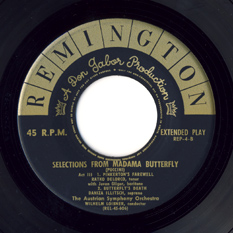
R-199-81/3
Giacomo Puccini: Madame Butterfly
Daniza Illitsch, Ratko Delorco, Hildegarde Rössel-Majdan, August
Jaresch, Jovan Gligor, Emil Siegerth. Austrian Symphony and Chorus,
Wilhelm Loibner.
Selections from Act 1, 2 and 3 were issued on Remington Extended Play
REP-4 (45 RPM, 7").
R-199-123
Contemporary Opera
Emmnuel List (bass) and Else Schurhoff (contralto): Finale to Act
II of "Der Rosenkavalier" (Richard Strauss)
Hilde Zadek and Anton Dermota: Gluck das mir verblieb from "Die
Tote Stadt" (Erich Wolfgang Korngold)
Kurt Baum: Nessun dorma (Turandot - Puccini)
Coupled with Overture to "I vespri siciliani" (Giuseppe
Verdi), conducted by Vittorio Gui.
At
right the cover of the disc with Contemporary Opera, of which
the Korngold selection with Hilde Zadek and Anton Dermota was
in fact the only contemporary selection. That same duet was later
issued by Tom Null on
Varèse-Sarabande.
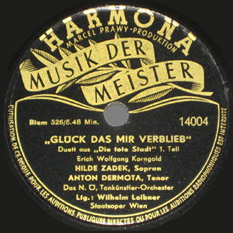
Producer Marcel Prawy also issued several recordings on 78 RPM
shellac discs in Austria of recordings he had originally produced
for Remington. Below at right Harmona "Marcel Prawy Production"
14004 with "Glück das mir verblieb". (Image courtesy
Nikolaus Kühböck, Vienna.)
|
|
|
|
|
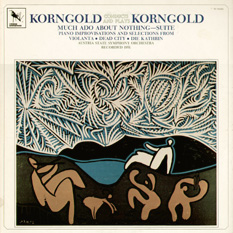
At
right:
Korngold
by Korngold
Masterseal
MW 46:
"A
Marcel Prawy Production".
|
|
| |
Wilhelm
Loibner conducts Opera Scenes of Ludwig van Beethoven (Fidelio)
and Richard Wagner (Flying Dutchman/Fliegende Hollander) on Masterseal
MW 51. The disc also contains Serge Saxe's Keats & Shelley
Songs sung by Paul Schöffler (bass) accompanied by Ignace
Strasfogel at the piano.
|
R-199-127
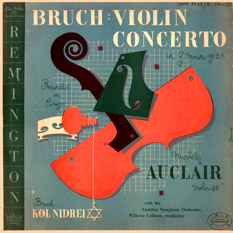 Max
Bruch: Violin Concerto No. 1 Op. 26
and Kol Nidrei of Max Bruch on Remington R-199-127,
with Michelle Auclair. It misses the fire and passion of the
Tchaikovsky performance. Both soloist and conductor remain in calm
waters. Max
Bruch: Violin Concerto No. 1 Op. 26
and Kol Nidrei of Max Bruch on Remington R-199-127,
with Michelle Auclair. It misses the fire and passion of the
Tchaikovsky performance. Both soloist and conductor remain in calm
waters.
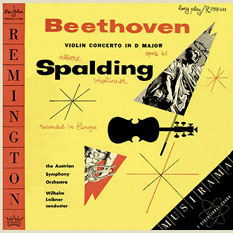
R-199-144
Ludwig van Beethoven:
Violin Concerto in D major, Op. 61, performed by Albert Spalding and
the Austrian Symphony Orchestra, Wilhelm Loibner conducting.
R-199-145
Johannes Brahms:
Violin Concerto in D major Op. 77, with Albert Spalding and the Austrian
Symphony Orchestra Wilhelm Loibner conducting.
A
few LP recordings of Wilhelm Loibner on other labels
Lyrichord
36
Haydn: Symphonies - Nos. 12, 23, 29
& 30.
Vienna
State Academy of Music Chamber Orchestra.
Decca
LX 3126
(London LS 861)
Verdi:
Un ballo in maschera (excerpts) in German
Carla
Martinis (soprano), Helge Roswaenge (tenor) and Theo Baylé
(baritone) with the Chorus and Orchestra of the Vienna Volksoper,
Wilhelm Loibner conducting
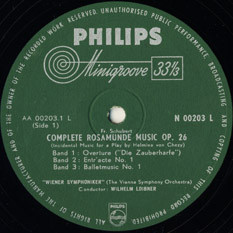
Philips
N 00203 L
(NBL 5007)
Schubert: Complete Rosamunde Music
Vienna Symphony Orchestra - "Wiener Symphoniker" - conducted
by Wilhelm Loibner
Philips
A 00751 R
Dvorak: Violin Concerto Op. 53
Thomas Magyar and the Vienna Symphony Orchestra conducted by Wilhelm
Loibner
Philips
N 00712 R
Verdi: Highlights from Aida, Un
ballo in maschera, Otello
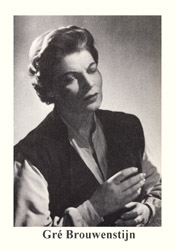
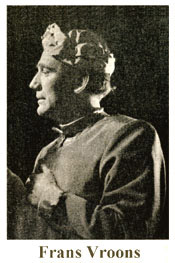
Gré Brouwenstijn (soprano), Frans Vroons (tenor), the Vienna
Symphony Orchestra conducted by Wilhelm Loibner
Philips
NBL 5024 (GB)
Smetena: Die verkaufte Braut - The Bartered bride
Hilde Zadek (soprano), Hans
Hopf (tenor), Otto Edelmann (bass), Vienna Symphony Orchestra, Loibner
His
Master's Voice ASD 471
The Opera Ball - Various excerpts from Operettas
(Chambre separée, Wenn es Abend wird, Hör ich Zigeunergeigen,
Meine Lippen, Wer hatd ie liebe uns ins Herz gesenkt, Wie eine Rosenknospe,
Einer wird kommen, Alle maskiert, Komm' in die Gondel.
Emmy Loose (soprano), Lotte Rysanek (soprano), Murray Dickie (tenor),
Karl Terkal (tenor), Vienna Volksoper Chorus, Vienna Philharmonic
Orchestra conducted by Wilhelm Loibner
Most
recordings were made in the years 1950 to 1955, except for the His
Master's Voice recording "The Opern Ball" which was released
in 1962 and likely to have been recorded a year earlier.
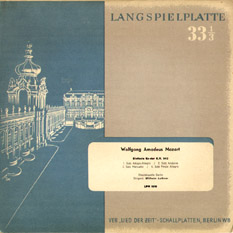
An oddity (if that is not a too unfriendly qaulification) is the Eterna
LP on which he conducts a Mozart Symphony. This means that he traveled
to other music centers to conduct.
Eterna
LPM 1010 (Series "Lied der Zeit")
Mozart Symphony K 563
Wilhelm Loiber conducting the Staatskapelle Berlin.
Philips
312 5-01 AF
Waldemar Kmentt sings Hindu Song from Sadko, Nicolai Rimsky-Korsakov,
and Lensky's Aria from Yevgeny Onegin, Tchaikovsky, with the Wiener
Symphoniker conducted by Wilhelm Loiber.

In
this era of the convenient digital medium there are many CD's available
on which Wilhelm Loibner conducts.
There
is a studio recording from 1951 of Wilhelm Kienzl's opera "Der
Kuhreigen" with a host of Viennese singers, among these Walter
Berry, Otto Wiener, Anny Felbermayer, Kurt Equiluz, and Ruthilde Boesch.
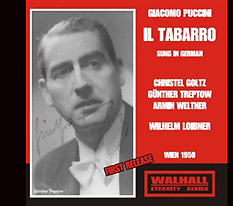
And
there is a recording of "Il tabarro" (Puccini) from 1950 with Christl
Goltz, Günter Treptow and Armin Weltner. This performance was
probably also offered to Don Gabor when he traveled to Europe in the
early 1950s looking for recordings.
Rudolf
A Bruil - Research and text.
Page first published January 16, 2012
American
soprano Lynn Amos, who had performed with Wilhelm Loibner and
had studied extensively with Loibner's wife Kammersängerin Ruthilde
Boesch, in Vienna, pointed out to me that four days after I had published
this page about the conductor, soprano Ruthilde Boesch had died. About
Wilhelm Loibner she said:
Professor
Loibner was a gentle, extremely sweet, kind man. I have fond memories
of him. (The) really sharpest "musical" memory of him
I retain (other than watching/hearing him conduct at the Staatsoper)
was his observation of how to conduct the Viennese Waltz: "It
isn't enough to go 'One, two, three; One, two, three' over and
over; you have to remember that to be truly Viennese, the rhythm
must be, 'One, two, three; One two....maybe three.'" And
then he'd smile. - Lynn Amos, soprano
(USA)
|
Ruthilde
Boesch.
was born on January 9, 1918 in Braunau (Austria), studied with Joseph
Krips at the Vienna Music Academy and made her debut in 1945 as Susanna
in The Marriage of Figaro. She sang in Wiener Staatsoper-productions
as Papagena ("Die Zauberflöte"), Olympia ("Les
Contes d'Hoffmann"), Despina ("Così fan tutte"),
Blondchen ("Die Entführung aus dem Serail"), Lola ("Cavalleria
rusticana") oder Barbarina ("Le nozze di Figaro").
She travelled to London, Sydney, Paris, Rio de Janeiro, Berlin und
Barcelona. She was also praised as a Lied singer and as a pedagogue.
January,
2012.
|