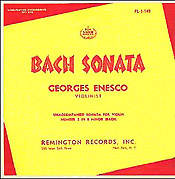
An
early release of Georges Enesco's recording
of Bach's Sonata No. 2
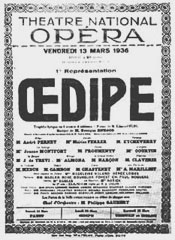
The
billboard of the first performance of OEDIPE in 1936 in Paris, France. (Image
taken from the documentation accompanying the Electrecord 4 Lp set of the 1964
recording from Romania.)
Bach's Sonatas
for Violin Solo were recorded in 1949 and appeared on the Continental label. The
Sonata No. 2 was released on the Remington label.
Georges
Enesco and pianist Céliny Chailley-Richez performing Schumann's Sonata
Op. 121 on a 10" Remington, R-149-50. Available in May 1952.
Enesco,
Lipatti and Radulesco on Electrecord.
Enesco's
own performance of his Sonata No. 2 with pianist Céliny Chailley-Richez on R-149-42
(reissued at the end of the nineteen seventies on Varèse Sarabande VC 81048)
Sonata
No. 2 and String Quartet No. 2 on Monitor
Donald
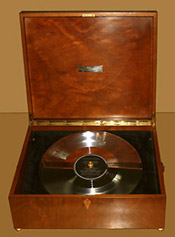
Gabor had a wooden
box made. It contained a one sided shiny, silvery matrix with Enesco's
two Romanian Rhapsodies engraved and adorned with the Continental label to honor
Georges Enesco and to commemorate the cooperation and the importance of the great
Romanian artist.
Sonata
No. 2 on Electrecord ECD61
Liszt's
Les Preludes conducted by George Singer were coupled on R-149-47 with Georges
Enesco performing his Romanian Rhapsody No. 1 with l'Orchestre des Concerts Colonne.
The Romanian Rhapsody No. 2 was available on R-149-52, also conducted by Enesco
and had as coupling The Moldau (Smetena) conducted by Georges Singer. The two
rhapsodies were later released again on a Musirama disc while they were not real
Musirama recordings.
Below
the French release of the same coupling on Concerteum 269.
Electrola
STE 80749: Christian Ferras and Pierre Barbizet play Enesco's Sonata No. 3.
This sonata was also recorded in 1936 by Yehudi Menuhin and Hepzibah Menuhin,
piano (Victor Set M-318)
"Perfection,
which is the passion of so many people, does not interest me. What is important
in art is to vibrate oneself and make others vibrate."- Georges Enescu.
"La
perfection, qui passionne tant de gens, ne m'intéresse pas. Ce qui importe,
en art, c'est de vibrer soi-même et de faire vibrer les autres."
George
Enescu around 1950 when he had already recorded the Sonatas and Partitas for Violin
Solo by Bach for Don Gabor's Continental label in New York.
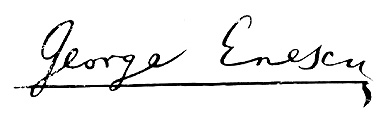
(The
well known photograph of Georges Enesco, but this time taken from the listing
on the back of an original Remington cover, edited and restored. His Romanian
signature was taken from the Electrecord cover of Poème roumain.)
To
most people Georges Enescu is mainly known for his Romanian Rhapsody No. 1
composed at the age of 20. The less popular No. 2 was conceived one
year later, in 1902, and is foreboding his later, more personal style.
Click here
for a Sound Clip of Romanian Rhapsody No. 1 conducted by Georges Enesco.
Older generations and knowledgeable music lovers remember him not just as a composer
or a conductor but as the great violinist who concertized in many countries and
who educated Arthur Grumiaux, Ivry Gitlis, Ida Haendel and Christian
Ferras, but most of all the name of Yehudi Menuhin is linked to the
famous Romanian. And also Serge Blanc, when in his 20s, received valuable
instruction from the maestro which he penned down. A book can be ordered or can
be downloaded as a pdf on the site of Serge
Blanc (1929-2011).
Georges
Enesco composed more than just the Romanian Rhapsodies (the arrangement for two
pianos of No. 1 was also played by the maestro himself; it is said that Enesco
was a gifted pianist and a cellist as well). He composed 'Romanian Poem'
(Poème roumain - Paris, 1897) which was his first opus, and also Suites for
orchestra; Symphonies (3); Concertante Symphony; Sonatas for
violin (3; that show the influence of his teacher Gabriel Fauré); Sonatas
for cello and piano (2); Octuor for Strings (Octet for Strings,
Octet à cordes); Dixtuor for Wind Instruments; a Chamber symphony.
And he composed an opera: 'Oedip' (Oedipe, Oedipus) on a libretto by Edmond
Fleg after Sophocles. Igor Strawinsky's expressive "Oedipus Rex"
- which was first performed nine years earlier in Paris - stands in stark contrast
to Enesco's "Oedip".
The
front of the box of the Electrecord 4 LP Set, ST ECE 0676, with the recording
of Oedip (Oedipe. Edipe) made in the period of April till June, 1964, in Bucarest.
The Orchestra and Chorus of the Romanian Opera of Bucarest was conducted by Mihai
Brediceanu. Singers were David Ohanesian (baritone), Ioan Hvorov (bass), Dan Iordachescu
(baritone), Valentin Teodorian (tenor), Viorel Ban (bass), Valentin Loghin (bass),
Constantin Gabor (bass), Ladislau Konya (baritone), Constantin Iliescu (tenor),
Elena Cernei (mezzo-soprano), Zenaida Pally (mezzo-soprano), Maria Sindilaru (soprano),
and Maria Sandulescu (mezzo-soprano).
(From
the SoundFountain Archive)
Oedip
was premiered on March 13, 1936, in Paris, and was well received. During some
ten years off and on George Enescu was occupied with composing, editing and arranging
this opera. This 'lyrical tragedy in four acts' can well be labeled as Enesco's
most important work as a composer. Far more than his sonatas, his chamber music
and other compositions for chamber ensembles and orchestra, Oedipe can be considered
as the man's pinnacle of the expression of ideas, of drama, of humanity. It shows
that for a long time he put most if not all of his creative energy in this work
which - as individualistic as it may be - breathes in its themes and orchestration
the era it was composed in. It has a specific flavor and at instances reminds
one of the style of Zoltán Kodály, and of the late romantic, Viennese
school, of the new expressionism as well, and also a French influence is undeniable.
But it is above all Central European in character. Symphonist Ion Dumitrescu
- in an article written in 1961 on Georges Enesco, his compositions and the
significance of the famous Romanian - said:
"In
the opera 'Oedipous' the links with Romanian music are clearly noticeable, by
the turning to account - sometimes in a discreet way, at other times obviously
enough - of its modal, rhythmical, and intonational forms."
On
March 13, 1936, Henri Malherbes - author of 'La flamme au poing' (The Flame
in the Fist, The Flame That Is France), and winner of the Prix Concourt - said
that Romania now ranks from the spiritual point of view with the most advanced
countries. About the structure of the opera he noted:
"For
any expert who examines the score it clearly appears that the four acts of 'Oidipous'
constitute the four movements of a vast symphony with its Allegro, Andante, Scherzo
and Finale. On every page one discovers new timbre effects, valuable harmony innovations,
an instrumentation of extreme subtlety, a complete renewal of the musical patterns
that have been in use up to our days."
Arthur
Honegger,
creator of the expressive oratorios 'Le roi David' and 'Jeanne d'Arc au bûcher'
said in an article in Le Figaro Littéraire (1955):
"This
opera is as far from any Wagnerite succedanea as it is from any Debussyan or Puccinian
pastiches (...). It is highly original and possesses a dramatic force that is
simply formidable."
Of
Georges Enesco himself is the following comment:
"It is not up
to me to state whether Oidipus is or is not the most accomplished of my works.
But I am fully entitled to say that it is the one I cherished most... I have put
in it everything that was mine, up to the point of becoming almost identified
with my hero."
George
Enescu loved the music of Richard Wagner, admired the music of Claude Debussy
and of Giacomo Puccini. The accompanying documentation of the 1964 Electrecord
recording gives ample information about the opera, the nature of the music, and
how the various performances were received. Plus the libretto in Romanian, French
and English. In 1956, one year after Enesco had died, the opera was performed
again in Paris.
Georges Enescu
can not be categorized as a protagonist of a specific style or school. For that
he was too individualistic in character and his compositions do not have a common
signature. Nevertheless he is considered to be the founder of the first national
music movement in Romania after it came into existence in 1861 and was officially
recognized as a country by foreign powers in 1878.
A
few of Enesco's works do have a popular nature and are loved by many as they fall
into the category of music for millions. His opera Oedipe is a masterpiece, but
much of his music, specifically his chamber music, often has a gloomy character
and is not easily accessible and understandable. Its nature indicates a contradictory
personality, a searching soul, but most of all it shows a vulnerable sensitivity.
Though
the variety in his oeuvre shows that the man was a many faceted artist, it is
difficult to grasp the complex nature of this talented musician, of the disciplined,
hard working man who divided his energy between conducting, teaching, performing
as a soloist, and composing. He must have put a spell on his audience when
performing in the concert hall, when teaching at the conservatory and when conducting
a master class. Only those who did meet the maestro, and those who worked with
him, did experience this and often gave testimony of the impact.
Were
it not for Donald Gabor's Continental recordings, it would all be hearsay and
being the teacher of great talents would have been Enesco's major and great significance.
Despite the many articles, biographies, references and his own recordings (many
are of historical significance only), Georges Enesco, as a composer and as an
interpreter, has a relatively small audience of musicians, scholars and admiring
music lovers who - after more than 50 years - adhere a great significance to his
artistry and try to understand the outcome of his creativity. - R.A.B. 2002
Georges
Enescu
was born on August 19, 1881 in Liveni-Virnay, a small town in the district of
Dorhoiû (Dorohoi), in the very North of Romania, in the middle of the province
of Moldavia (Moldova), close to the Ukrainian border. His great grandfather was
a church singer. Other ancestors were musicians. Enesco's father was the son of
an orthodox priest and had considered to follow a religious vocation as well,
but chose to be a farmer. He and his wife had seven children. Two died at a very
young age and when a diphtheric angina struck the region, the five remaining children
also died. The couple prayed and prayed for a new child and finally George was
born, the eighth child, the only child they could give all their love to. This
fact is of course of significance for the development of the child.
In certain
publications Cordareni is mentioned as Enesco's birth place, and 1882 is mentioned
as year of birth. Enesco himself mentioned in his conversations with Bernard
Gavoty - Les souvenirs de Georges Enesco (Ed. Flammarion, Paris 1955 - 2006)
- that 1881 was the year and his place of birth was Liveni (today called George
Enescu).
At
the age of three he accidently heard music played by gipsies which awoke the seed
of love for music - although gypsy music differs from Romanian popular music completely.
At five he received his first musical instruction from his local teacher and two
years later his father sent him, accompanied by his mother, to Vienna to study
at the Conservatory. His violin teacher was Joseph Hellmesberger Jr. (1855-1907)
who had founded the Helmersberger String Quartet. Young Enesco studied composition
and harmony with Robert Fuchs (1847-1925), lessons he liked very much.
Four years later, Enescu was awarded the Grand Medal of Honor (Silver Medal).
It
was Helmesberger who suggested that Enesco would go to Paris. Vienna had nothing
more to offer to the development of the young student as it was no longer the
music centre of Europe and had been replaced in importance by Paris. At the age
of 14, the age when a young boy is impressed most by events and cultural experiences
which will mark him for his entire life, Enesco went to Paris to study at the
'Conservatoire national' with composer Jules Massenet (1842-1912), with
composer and scholar André Gédalge (1856-1925), with composer Gabriel
Fauré (1845-1924), and with Belgian violinist Armand Marsick (Marsieck)
(1877-1959). These important figures, as well as the vast possibilities and atmosphere
of musical and cultural Paris, have influenced Georges Enesco's musical development
and maturation. In 1899 - at the age of 17 - he won first prize for violin at
the Paris Conservatory.
During
World War I Enesco stayed in Romania. Before and after that war he made numerous
concert tours in Europe. On May 8, 1911, he performed Beethoven's Violin Concerto
in D, Op. 61, with Felix Weingartner (1863-1942). Enesco traveled to the
United States where he conducted the Philadelphia Orchestra and the Orchestra
of the New York Philharmonic Society. He also appeared together with Béla
Bartók.
From
1927 on he choose France as his second home and his Christian name was written
the French way with an 's' as is shown on all the publications, books, record
labels and covers. He appeared with many musicians. He conducted the Paris Symphony
Orchestra and the 'Orchestre de l'association des concerts Colonne'. He also performed
and conducted in other European countries.
In those years Enesco taught both in Romania and in France. He again traveled
to North America to appear in front of the New York Philharmonic Orchestra
in the 1936-37 season, not long after the premiere of Oedipe, the opera
on which Enesco worked for more than ten years, leaving hardly any time to write
other music, except for a Symphony (No. 2).
After
child prodigy Yehudi Menuhin had been studying in San Francisco with Louis Persinger
for two years he found his next, even more important teacher in Paris were he
had come to live with his family. It was Georges Enesco. When French pianist,
composer and teacher, Maurice Dumesnil (who had been accompanying Enesco
on several occasions), traveled to the US, he prepared an article on Enesco for
The Etude Music Magazine (published in Philadelphia), to be printed as
an aftermath to Enesco's stay.
The
article was published in the February 1937 issue. Dumesnil tells how in 1917 a
box with Enesco's manuscripts was sent out of Romania to Moscow to safety, but
was lost for almost ten years and was finally discovered in the basement of the
Kremlin.
In the article Dumesnil also mentions the importance of the maestro as a pedagogue
and describes how Yehudi Menuhin (1916-1999) met with Georges Enesco in
Paris.
"One evening of January, 1927, Enesco had given a recital in the Salle Gaveau
in Paris, previous to his departure of a two-month tour of his native Romania.
The customary crowd of friends and admirers surrounded him in the artists' room.
A young boy, with light brown hair, made his way to him, shook his hand and simply
said, "I want to see you." Enesco instinctively sensed a personality
and gave the boy an appointment for the next morning. Menuhin - it was he - went
to the apartment of the rue de Clichy, with his violin. Enesco had just concluded
a rehearsal with Gerard Hekking, the violoncellist. "I want to study with
you," the boy said this time. "All right, will you play something for
me?" When Menuhin did play, Enesco and Hekking looked at each other in amazement,
and the former immediately accepted him as a pupil." - Maurice Dumesnil
- Etude Music Magazin, February 1937.
Gérard
(Gerard) Hekking was a French-Dutch violoncellist (August 22, 1879, Nancy - June
5, 1942, Paris). He studied at the Paris Conservatoire. He often performed in
the Netherlands. For ten years (1904-1914) he was first cello player of the Concertgebouw
Orchestra under Willem Mengelberg. From 1927 on he was a professor at the Paris
Conservatory (Conservatoire national supérieur) and a well known pedagogue.
His most famous pupils were Maurice Gendron (1920-1990), Paul Tortelier (1914-1990),
and Reine Flachot (1922-1998).
In addition to violin lessons Enesco advised the study of harmony, fugue and
counterpoint - as he himself had done and had benefited from it. Yehudy should
have a strict regime in order not to be distracted by the temptations a city like
Paris has to offer, especially to a growing up boy. In "Les souvenirs
de Georges Enesco" (Recollections of Georges Enesco), written by Bernard
Gavoty (Editions Flamarion, 1955 / Editions Kryos, 2006) Enesco said about
being Yehudi Menuhin's teacher:
"I would like
to say that I molded him. But I would lie, he already was marvelous when I took
him in hand."
"J'aimerai
pouvoir dire que je l'ai formé. Mais je mentirais, car
il était déjà merveilleux lorsque je l'ai pris en mains ".
The
friendship between Enesco and Menuhin resulted in a collaboration that can be
witnessed on many (historical) shellac recordings.
J.S.
Bach's Concerto for Two Violins and Strings with Yehudi Menuhin and Georges Enesco,
with Pierre Monteux conducting, was recorded in the 78 RPM era before World War
Two (1933) and issued on Victor 7732/33. The records were re-released in 1944
in an album with reference Victor 932 (His Master's Voice D.B.1718/19).
Together
they played Bach's Concerto for Two Violins with Pierre Monteux conducting,
a recording from January 1933 and later issued on Lp (Victor LCT 1120, HMV FJLP
5018). Critics remarked that their playing was "spirited" and that the
performance was "immaculate". Critic Irving Kolodin however finds the
recording "a delusion" and prefers the Joseph Szigeti-Carl Flesch shellac
recording with Walther Goehr conducting (Columbia X90), or the Lp recording with
Adolf Busch and Frances Magnes and the Busch Chamber Orchestra (Columbia ML-4002).
Enesco
and Menuhin also performed Bach's Violin Concerto in A minor, issued in
1937 on H.M.V. DB29U-2 (6x 12 inch discs).
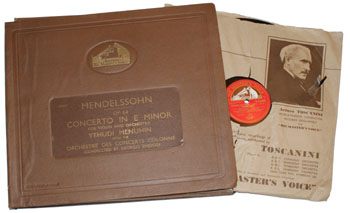
On
Victor VM 531 they perform Mendelssohn's Concerto for Violin and Orchestra
in E minor, Op. 64, also recorded before World War II. Although Mernuhin masters
the score well, one critic says, it is Georges Enesco who renders the best orchestral
part if compared to the other available recordings with conductors Bruno Walter,
Sir Malcolm Sargent, Désiré Defauw, and Sir Landon Ronald. This
recording was also available in Great Britain, but then Preludium of Bach's Sonata
No. 6 was added on a fifth disc, leaving Side 6 blank. The reference: DB 6012/5S.
Later the 4 disc edition was available as DB 3556.
Menuhin
performed Dvorak's Violin Concerto with Enesco conducting the "Orchestre
symphonique de Paris" (Columbia GM-254). As I do not own this set personally,
we have to rely again on Irving Kolodin, who notes the softer dynamics due to
a different way of cutting of the lacquer from which the plates are made. Kolodin:
"As in some other recordings made by him in Paris, Menuhin's tone speaks
with a softer accent, in French, than it does in disks originating elsewhere.
(...) While Dvorak's is not one of the fundaments of the violin literature, it
is a welcome replacement for some of those heard too often. Enesco's conducting
is sympathetic, the recording - as noted - of favorable tone quality, though not
well defined." Kolodin prefers the American Victor pressings.
With
"L'Orchestre des concerts Colonne" they recorded Lalo's Symphony
Espagnol (Victor VM-136; His Master's Voice DB1999/2002).
Again
with the Paris Symphony they did Mozart's Violin Concertos Nos. 3 and 7 (Victor
VM-485; HMV DB2729/31).
Ottokar
Novacek's Perpetuum Mobilé was
also recorded with George Enesco conducting the Paris Symphony Orchestra (Victor
V-8383; HMV DB2283), and Poème by Chausson with the same orchestra,
Enesco conducting, on Victor 7913/4.
With
Enesco at the piano Menuhin performed Paganini's 'Tremolo' (Caprice No.
6) (HMV DB2841).
Georges
Enesco and young Yehudi Menuhin.
(Photo
taken from an old Dutch encyclopedia.)
In
his late fifties, in 1939, George Enesco married Maria Rosetti (Princess
Maria Cantacuzino), and he lived in Romania during World War II. On April
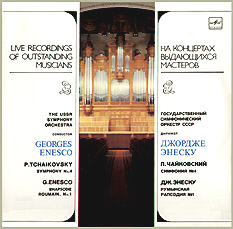
21, 1946, he conducted Tchaikovsky's Symphony No. 4 in the Peter Tchaikovsky
Hall (Great Hall) of the Moscow Conservatory. Many years later this live performance
was released on Melodiya M10-49209 004. Enesco returned to Paris in
that same year. In 1947 he gave a noteworthy
performance of the Three (3) Sonatas and Three (3) Partitas for Violin
Solo of Johann Sebastian Bach.
An
article on the Romanian Enesco web site Madalina Margaritescu mentions in her
article In 1948, two great artists, George Enescu
and Irving Penn, met in New York an earlier source and writes,
"(...) from 1948 until 1950 Enesco taught at the Mannes
School of Music in New York. Every Wednesday afternoon, between 3:30 pm
and 8:30 pm, from November to April 1948-1949, and from November 14 until January
1950-1951, Enescu held violinist interpretation courses." Shown in the article
are the two photographs by Irving Pen of Georges Enesco and Yehudi Menuhin respectively,
made in 1948.
For
a brief period Enesco also joined
the faculty of the University of Illinois. In these years he conducted several
concerts with the National Symphony Orchestra in Washington. On the program
works by Beethoven, Brahms, Mozart, Enesco and Chopin. With various soloists,
among others pianist Menahem Pressler in Chopin's Concerto No. 2 (as is well documented
on Muzica
Clasica - a blog in Romanian written by an American who was born in Bucharest).
It
was during this stay in the US that he - on the instigation of violinist Helen Airoff, also a pupil of his - recorded
Bach's Sonatas and Partitas for Violin Solo for Don Gabor's Continental Records
label. Although the tape recorder had been introduced as the new and important
recording medium, the Sonatas & Partitas were recorded on acetates.
On
January 21st, 1950, Georges Enesco gave a farewell-concert in New York,
performing as a violinist, as a pianist and as a conductor. After that his health
did not allow him to play the violin any longer, but he still was able to conduct
from time to time. There is a BBC radio broadcast of Bach's Hohe Messe (Mass in
B minor), BWV 232, George Enesco conducting the Boyd Neel Orchestra, the BBC Chorus,
and singers Suzanne Danco (soprano), Kathleen Ferrier (contralto), Peter Pears
(tenor) and Norman Walker (bass). The broadcast took place on July 15th, 1951.
In 1952 the recording with the Violin Concerto (Concerto d' été)
of Joaquin Rodrigo with Christian Ferras, L'orchestre de la société
des concerts du conservatoire de Paris, was conducted by Georges Enesco. The recording
was released on Decca LXT 2678 in Europe and on London LL 546 in the US.
Céliny
Chailley-Richez and Georges Enesco at the time when they did the recordings of
the Concertos of Johann Sebastian Bach in the early nineteen fifties. Image courtesy Musica et Memoria/The Chailley Family
(Edited by R.A.B.).
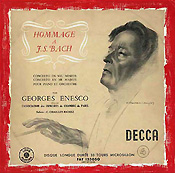
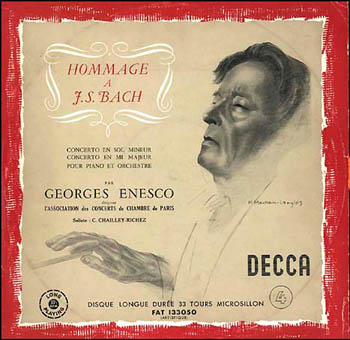
After
he had returned to Paris he recorded the Concertos for Clavier ("für
Klavier") of Johann Sebastian Bach for French Decca, with Céliny
Chailley-Richez as principal pianist and "L'Orchestre de l’association
des concerts de chambre de Paris":
Decca
FAT-173053 - Bach: Concertos for Piano and Orchestra No. 1 & 5 Decca
FAT-173050 - Bach: Concertos for Piano and Orchestra No. 2 & 7
Decca
FAT-173119
- Bach: Concerto for Piano and Orchestra No. 3 and Concerto for Two Pianos and
Orchestra No. 3 with Françoise Le Gonidec Decca FAT-173068 - Bach:
Concertos for Piano and Orchestra No. 4 & 6 Decca FAT-173530 - Bach:
Concerto for Piano and Orchestra No. 8 coupled with Brandenburg Concerto No. 5
with Jean-Pierre Rampal, flute, and Christian Ferras, violin Decca FAT-173094
- Bach: Concertos for Two Pianos and Orchestra Nos. 1 & 2 Decca FAT-173097
- Bach: Concertos for Three Pianos and Orchestra No. 1 & 2 with Françoise
Le Gonidec and Jean-Jacques Painchaud Decca FAT-143.538 - Bach: Concerto
for Four Pianos and Orchestra with Françoise Le Gonidec, Jean-Jacques Painchaud
and Yvette Grimaud; a 10" record. See also Baroquemusic.org
for the complete Concertos on CD.
In the last years of his life it was only with great pain that Enesco could play
the violin. In 1954 he suffered a stroke. Georges Enesco died on May 4th, 1955
in Paris.
Georges
Enesco made various recordings for the Remington label. This
collaboration could have helped in the distribution of Remington recordings on
the French
Concerteum label. On Remington Records Enesco not only plays Bach and
conducts own orchestral compositions, but he also plays his own Sonata No. 2 with
pianist Céliny
Chailley-Richez with whom he recorded J.S. Bach's Concertos for Clavier
and Orchestra for French Decca. The recordings of the two Romanian
Rhapsodies, Dixtuor and Octet for Strings are the only taped Remington recordings
of Georges Enesco the conductor.
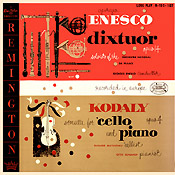
Enesco:
Dixtuor. Winds
of the National French Orchestra/Georges Enesco. (coupled with Kodaly's Cello
Sonata Op. 4 performed by Richard Matuschka and pianist Otto Schulhof) - Remington
R-199-107 (later reissued in 1978 by Tom Null on Varèse Sarabande VC
81042. See also Varèse-Sarabande
The Remington Series.)
Enesco:
Octet for Strings. String Ensemble/George Enesco - Remington R-199-52
Enesco:
Romanian (Romanian) Rhapsody No. 1. Orchestre des Concerts Colonne/George
Enesco (coupled with Liszt: Les préludes) - Remington R-199-47 (later reissued
by Tom Null on Varèse Sarabande VC 81042 -1978)
Enesco:
Romanian (Roumanian) Rhapsody No. 2. Orchestre des Concerts Colonne/George
Enesco. (coupled with Smetena: The Moldau) - Remington R-199-52 (released
in September 1951, later reissued by Tom Null on Varèse Sarabande VC 81042
-1978)
Enesco:
Sonata No. 2 in F minor.
With Celiny Chailley-Richez, piano - Remington R-149-42 (the name of the
pianist wrongly spelled as Chaillez-Riches). This performance was reissued on
Varèse Sarabande VC 81048 (The Remington Series, 1978) coupled with Dohnányi's
Sonata for Violin and Piano, Op. 21 (written in 1912 in Berlin), which was recorded
in 1952 with violinist Albert Spalding and Ernö Dohnányi at the piano,
never released on Remington records.
Schumann:
Sonata No. 2 in D minor Op. 121. With Celiny Chailley-Richez, pianist - Remington
R-149-50.
Enesco:
Romanian Rhapsody Nos. 1 and 2. Orchestre des Concerts Colonne/George Enesco
(coupled with Villa Lobos conducting the RIAS Symphony Orchestra in his Choros
No. 6) - Remington R-199-207 (later reissued by Tom Null on Varèse
Sarabande VC 81042 -1978)
Bach:
Sonata No. 2 in B minor for Violin Solo -
Georges Enesco - . Remington PL-1-149. In the early nineteen fifties Bach's
Sonata No. 2 appeared in various disguises: in a yellow and red cover, a gray
and red cover, and as a single record in a box.
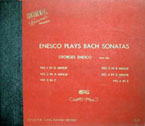
Enesco's Continental Recordings of The Sonatas and Partitas for Violin Alone
(6), all indicated as Sonatas:
Sonata
No. 1 for Solo Violin in G minor BWV 1001 Partita No. 1 for Solo Violin
in B minor BWV 1002 Sonata No. 2 for Solo Violin in A minor BWV 1003
Partita No. 2 for Solo Violin in D minor BWV 1004 Sonata No. 3 for Solo
Violin in C Major BWV 1005 Partita No. 3 for Solo Violin in E Major
BWV 1006 Recorded in 1949, in New York, originally released by Don Gabor on
his Continental label - Continental CLP 104/105/106.
Click here
for a Sound Clip of Fugue from Sonata No. 2 for Solo Violin in A minor BWV 1003.
Images
of the original box and the label of the third record courtesy Chuck Miller, writer
and columnist ("Goldmine" and "Warman's American Records 1950-2000").
In
Billboard Magazine of
August 26, 1950, the
Continental CLP-104 release (the first record of the set with Sonatas Nos. 1 and
2) was reviewed:
"With
the load of competition on LP of this limited-sale material, these Enesco
cuttings may have tough pulling to get representation outside the few big longhair
tenters. Many connoisseurs will prefer them, however, for their rugged, warm
and human quality. The noted virtuoso and teacher may not be the last word in
technique, but he can offer most fidlers a lesson in broad style. In certain bright
passages he manages to infuse an almost gypsy like fervor. Pressing and surfaces
are very good."
The
reviewer refers to Bach's Sonatas and Partitas as "limited sale material".
In the 78 RPM shellac era the popularity of these works was even less prominent
than at the time of the evaluation by the reviewer in Billboard Magazine in the
"Bach Year".
In
the shellac era there were recordings of individual Sonatas by Joseph Szigeti
(Sonatas Nos. 1 and 2), Nathan Milstein (Partita No. 2), and Adolf Busch (Partita
No. 2). The only set which could be considered as "most complete" was
the one of George Enesco's pupil Yehudi Menuhin. He played Sonata No.1,
Partita No. 1, Sonata No. 2 - 3rd movement only, Partita No. 2, Sonata No. 3,
Partita Nr. 3. These data are given in The Gramophone Shop Encyclopedia of
Recorded Music, 1948.
Irving
Kolodin evaluated the Menuhin recordings in The New Guide To Recorded Music
(Doubleday, New York, 1950). The recordings were made over a period of several
years and varied in quality of performance and in sound recording technique. Various
dates are given in various publications. For the earliest recording 1931 is given,
but generally discographers mention 1934 as the year of the first recording. The
last year he recorded on 78 RPM was 1944. Some of his playing was considered to
be "outstanding and even unchallengeable" at the time.
Enesco's
complete 3 LP set was also made available in Romania by Don Gabor. The records
were pressed in the US but had a different design for the label. No reference
numbers were printed on the label. The plates were numbered TA-016 to TA-021 in
the dead wax. The name CONTINENTAL was not printed on the label. They were stored
in a simple, plain box. The only printed part of it were the liner notes, the
same as in the US edition.
It
is interesting to discover some historical facts regarding availability, appreciation
and artistic merit, and ranking of Bach's Sonatas and Partitas in the early days
of the Long Playing record.
Available
recordings in the 1950's of
Johann Sebastian Bach's Complete Sonatas and Partitas for Unaccompanied Violin
(BWV 1001-1006).
The
September 1950 edition of Schwann Long Playing Record Catalog lists two complete
sets. One set is by violinist Alexander Schneider on Mercury MGL-1 (4x 12"
LP discs, individually numbered MG 10017/10018/10019/10020) recorded in 1949 by
C. Robert Fine (engineer) and Mitchell Miller (recording director) at Reeves Sound
Studios, New York City. The other available set was the one performed by Georges
Enescu on Don Gabor's Continental Records label with references CLP 104-105-106,
also recorded in 1949. Obviously these recordings were made for release in 1950,
the 200th anniversary of Johann Sebastian Bach's death.
Saterday
Review of Literature wrote bluntly about Schneider's recording: "Complete
but Surpassable". Warren Demotte however said about the Schneider 4
Lp set five years later in his Long Playing Record Guide (1955): "Alexander
Schneider plays with understanding and sincerety, but he has neither the equipment
nor the temperament to make his interpretations exciting. Nor should his album
consist of four records when others manage with three." Quite an anticlimax,
if not a contradiction.
Indeed Schneider was a good chamber musician when playing in a quartet and he
appeared also as a conductor. There are instances where his Bach Sonatas &
Partitas show indeed understanding when playing in a grand manner. Some parts
however are played in a more scholarly, academic fashion as if they were just
studies for practicing the instrument - what these pieces in fact are - lacking
the passion or a clearer personal concept which he nevertheless shows in his best
moments.
The
excellent sound recording of C. Robert Fine adds much to the quality of these
performances. These recordings were released in 1950 (as were the Enesco Continental
recordings), the anniversary of the death of J.S. Bach. The availability of Schneider's
recordings in European countries is not traceable. It was found however that the
Schneider discs became available for the first time in France in the autumn of
1955, not on Mercury but on three discs of the Classic label (CLP 6286/87/88/89).
The
arrival of the tape recorder - the German invention brought to the U.S.A. by Jack
Mullin after World War Two and built by Ampex in 1947 - furthered the development
of the Long Playing record which was introduced in 1948 by Columbia. Now recordings
of complete works could easily be made and fit on the new 12 inch plastic disks.
Tape was the medium used by Bob Fine of Mercury Records.
The
Enesco Continental performances however were recorded on acetates. An acetate
is an aluminum disc of 10, 12 or 16 inches in diameter, coated with a layer of
wax or lacquer in which the signal is engraved. (Because of the scarcity of aluminum
during World War II the aluminum was often replaced by glass.) Enesco's performances
were recorded in 1949. From these acetates the signal was transferred to the actual
lacquer on the cutting lathe from which the matrices and plates were made to press
the LPs from. See New England Webster Record Manufacturing
Plant .
The
acetates initially served as the source for the Continental 3 LP set and were
only later transferred to tape. On the back of the reissue on the Olympic 3 LP
set from 1974, it is mentioned that the acetates were transferred to tape by the
Everest engineers and were edited and filtered in order to eliminate pops and
hiss. That could have been the best option while transfers to tape by the Gabor
people may also have shown the technique of tape recording in the early 1950s.
Enesco's
Continental Set was still available in January 1952, but was deleted from
the Schwann catalog by March of that year. A reason to discontinue the set could
have been that sales were not very high since the technically better sound recording
done by Mercury of Alexander Schneider's playing was obviously preferred
by many, despite the fact that the three Continental records were cheaper than
the four Mercuries (though at the time a single Continental record had the same
price tag as a Mercury LP).
Another
reason could have been the criticism on the technical aspects of Enesco's playing
from a few reviewers who adhere a greater significance to the technique of the
artist than to the musicality, the intrinsic value of the performance. When reviewing
Sonata No. 2, the only Sonata which was released on the Remington label in the
early 1950s,Cecil Smith wrote in New Republic
in April of 1951: "George Enesco's playing of Bach's E minor Sonata for unaccompanied
violin offers, like Enesco's appearences in public, painful proof that even a
fine musician cannot play an instrument effectively without adequate technique."
Smith
obviously forgot that this is Enesco at 67, suffering from arthritis, and that
his ability was only a shadow of his powers when he was a young man. However there
is more greatness in these performances shining through than is technically performed
and is recorded in the groove. From March 1952 on only Enesco's playing of
Sonata No. 2 on the 10 inch Remington (PL1-149) remained in the catalog,
probably to please a few admirers and maybe to please Enesco as well. From then
on the Mercury set with Alexander Schneider (MG 1017/18/19/20) was the
only complete issue available at that moment.
About
one year later - in January 1953, according to Schwann - the complete set
played by violinist José Pepito Figueroa was released on four twelve
inch discs on the New A'A'O Records Inc. label with reference NRLP 408
/409 /410 /411. New A'A'O Records had a mail box at Grand Central Station, New
York 17. This indicates that it was a small firm as no street address was mentioned
on the covers. These recordings by Figueroa were not listed
in the other record catalog, 'The Long Player'. New Records Inc. ceased to exist
in 1959. José
Figueroa (1905-1998) was born in San Sebastian (Puerto Rico), studied
in Madrid and later in France. He went to live for some time in the United States
and finally settled in Puerto Rico on the instigation of Pablo Casals.
For
one year his Sonatas and Partitas competed with Alexander Schneider's. Figueroa's
box was listed for the last time in Schwann of December 1955. The exact reason
for the deletion is not known. But it is suspected that also José Figueroa's
performances could not change the fact that the Sonatas & Partitas had "tough
pulling to get representation outside the few big longhair tenters", the
phrase used in an earlier Billboard review of the Remington disc. Whether Figueroa's
playing may have met the desired standard is yet an unsolved riddle.
In
the autumn of 1951Jerome Hill and C. Robert Fine - known
from the Mercury
Recordings - went to Germany to make recordings of the Sonatas and Partitas
with violinist Rolph Schröder (Schroeder) in the Church of Günsbach,
for Columbia Records. These were later issued in a box with reference SL-189,
containing the individual records ML 4743/44/45. The Schröder
recordings were financed by Dr. Albert Schweitzer who also wrote the introduction
to the set. Schröder plays with the curved bow (arched bow / archery bow,
Rundbogen), most certainly inspired by Tossy Spivakovsky's considerations
of methods described in the book ''The Spivakovsky Way of Bowing'' by Gaylord
Yost, published by Volkwein Bros in Pittsburg ca. 1949.
Strange
fact is that the Schröder recordings were not immeditaly issued but became
for the first time available in the spring of 1954. As the recordings were made
by Bob Fine, a condition in the contract may have been that a release would be
scheduled much later in order not to hamper the sales of the Alexander Schneider
set on Mercury for some time. In High Fidelity Magazine of May, 1954, David
Randolph ended his review of the Schröder performances with these words:
"...this recording could be the beginning of what later music
history books will call 'new era in the conception of Bach' ". But contrary
to what David Randolph expected, the arched bow was only seldom used since. The
only recordings known where by Emil Telmanyi and a single disc by Otto Büchner.
Warren DeMotte said about Schröder's performance: "Schroeder has an
unattractive tone and not much spirit."
In
September of 1953 the performances of Jascha Heifetz (recorded in
October, 1952) became available on Victor LM 6105 (3 x 12") in the US and
by April 1957 in Great Brittain and several European countries on His Master's
Voice ALP 1449/50/51. The Heifetz performances are considered to be the top, both
technical and interpretive. Warren DeMotte: "Heifetz stands almost alone
among violinists as a technician. As an interpreter, he has peers and sometimes
surperiors. However, when he is at the top of his form, as he is in this album,
it is almost impossible to imagine a better performance."
In
November 1954Emil Telmanyi's complete recordings made in 1953 were
added to the catalog. In Great Brittain in 1954 on LXT 2951-3 and in the the USA
in 1955 on 3 x 12" London LPs (LLA 20). Like Schröder also Telmanyi
uses the archery bow. Some critics found his playing not structured enough.
Maybe caused by using the Rundbogen? These mono Decca / London recordings were
released anew in 1984, reduced to 2 discs, on the Danacord label (DACO 147-148).
By
December 1954 the complete set of Henryk Szeryng was issued in France
on Odéon ODX-122/123/124. This set became available in other European countries
in the spring of 1955, however not in Great Britain. Initially this set was available
in Europe only until it was made available in the USA as Schwann Artist Listings
of 1960 mentions. The Odeon Set introduced Henryk Szeryng to the American record
collector and the availability most certainly must have resulted in Szeryng's
contract with RCA a few years later and his subsequent liaison with Mercury (and
Philips).
In
the early 1960s Columbia Records (CBS) bought labels in various European countries
in order to cover European soil by themselves and no longer by licensing to European
record labels. In the Netherlands Columbia bought Artone, in France Odéon.
Now the original Odeon recordings were issued in France and other European countries
(except Great Britain) as CBS 51068/69/70. American record collectors had to wait
until the fall of 1968 for the French CBS LPs to be issued in the USA on Columbia's
Odyssee label as a 3 LP set with reference 32 36 0013. The reissue was opportune
because of the release in October 1968 of Szeryng's new recordings made in stereo
for Deutsche Grammophon, reference SLPM 139270/1/2.
The
recordings of Johanna Martzy became available as three different releases
in November 1955, March 1956 and October 1956 respectively: Columbia 33CX
1286/87/88 in Great Brittain, and Angel D-35280/81/82 in the USA. They had been
recorded in 1954 and 1955. But by 1960 the Martzy recordings were deleted from
the listings in the catalogs while the earlier mono sets of Heifetz and of Milstein
remained available in the first years of the stereo era.
In
Schwan of May 1957 the Capitol Three 12-in. Set with reference PCR 8370
of Nathan Milstein was listed for the first time. Reviewer Nathan Broder
evaluated and described these recordings in High Fidelity Magazine of July 1957
as "A powerful rival to the Heifetz set, in my opinion, the pre-eminent performance
on records". Partita No. 1 and Sonata No. 2 were available separately
on a single disc with reference P-8298. The recordings were made at random over
several years in the Capitol Recording Studios, 151 W. 46th Street, New York City.
Sonata No. 1 was recorded in March 1954. Partita
No. 1 on 6 February 1956. Sonata No. 2 on 27 December 1956. Partita No. 2 in March
1954. Sonata No. 3 in May 1956. Partita No. 3 in December 1955. Much later
the complete set became available in April of 1957. Warren DeMotte in The LP/STEREO
RECORD GUIDE & TAPE REVIEW from 1962: "Milstein's pure tone, scintillating technique
and patrician style are fully displeayed by the very good recording."
In
June of 1957 it was announced that the Rolph Schröder CBS recordings
were to be discontinued and would be deleted from Schwann Long Playing Record
Catalog.
The
performances by Georges Enesco became available again for a short period.
They were now issued on the red/gold Remington MUSIRAMA label without being
listed in both Schwann and Long Player. The labels did not have the original reference
numbers but only the numbers of the 6 plates: TA-16/17/18/19/20/21. Although Don
Gabor announced the MUSIRAMA black-gold label series in the September 1953 Schwann
catalog, the later variation of the label in red/gold was first used around
1957. The Remington edition of the Sonatas and Partitas was issued when, by
the end of 1957, the recordings of Enesco's pupil Yehudi Menuhin
became available on Electrola 90897/98/99 in the USA (His Master's Voice ALP 1512/1531/1532
in Great Brittain). Obviously a valid reason to re-release the performances of
Menuhin's teacher.
Producing
recordings of specific works - be it operas, concertos, symphonies or rather peculiar
titles - and having these performed by popular artists or new talents, and releasing
the ready products at well chosen dates, has always been the marketing strategy
of most record companies. The strategy is determined for a large part by what
the competiton does and what the competition does not. - R.A.B.
Reissues
of Enesco's Bach Sonatas & Partitas on LP and CD
The
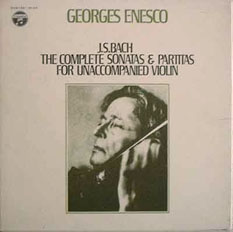
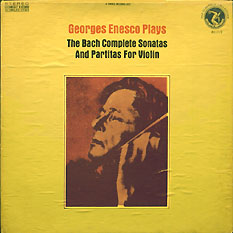
reissue of the Sonatas and Partitas performed by Georges Enesco on 3 modern discs
after the old recordings had been re-recorded digitally and edited in the digital
domain.
From
Japan there is the look alike Continental-reissue of the 3 LP Box with
the reference numbers CLP 104/105/106 of the original issue. The look alike
with red velvet covered box is smaller in width and the labels are differently
styled. Modern technology has made it possible to restore the sound of the original
recordings to such an extent that the sound is far better than the Everest-Olympia
records which were so elaborately cleaned up in the days of the tape recorder
and analog filters.
It is possible that a modern 180 gr. pressing - of whatever performance or label
- may be encountered of which the vinyl is rather vulnerable. This is not caused
by the chosen type of vinyl which is of a different recipe than used by Philips,
Decca, Deutsche Grammophon, CBS, or Nippon Columbia in the 1970s and 1980s. The
cause may be that during the pressing the vinyl was not heated through and through.
For
this reissue the notes of the original 1950 Continental release were reproduced
on an inlay containing a short biography of Enesco and an explanation of the Sonatas
and Partitas. From these notes - which were probably written with some "advertising"
in mind - I quote the following paragraphs showing that the author (and producer
Don Gabor) sensed the historical value of these interpretations at the time:
"Georges
Enesco ranks today as one of the greatest living musicians and there are many
who will claim for him the top rung as the world's foremost living musician. (...)
His masterful interpretations and playing of the six Bach unaccompanied violin
sonatas, presented by Continental Records in this series, not only fill a much
needed requirement for the master compositions, but provide an achievement which
will go down in recorded history as one of the most unique presentations of all
time. This series presents the works as one of the greatest of music's past immortals
played and interpreted by the most important living figure capable of doing justice
to Bach's music. Enesco's approach to Bach shows technical mastery, but it also
reveals a deep humility and reverence toward his subject matter which he has studied
so well over many decades. As such, it approaches the millennium in the art of
preservation of these masterworks." (Original
Liner Notes)
The
3 LP set of Olympic Records (8117/3) from 1974 also contain the complete
performances of Bach's Three Sonatas and Three Partitas but after the transfer
to tape they were electronically re-recorded to simulate stereo which was the
fashion in the beginning of the stereo era of the LP when companies were afraid
that the public would not buy mono recordings any longer. Despite this electronic
manipulation, the engineers, who literally spent hundreds of hours, did a remarkable
job. They did not loose too much of the character of the violin but filtered out
a lot of the hiss and surface noise somewhat to the detriment of the violin tone.
The liner notes say: "This recording was made before the advent of modern
tape technology". It is regrettable that the sound of the Everest release
is not too clear if compared to the much better Continental reissue.
Nippon
Columbia DXM-128-30-AX.
Olympic
Records OL-8117/3 (distributed by Eeverest): Bach Sonatas and Partitas in electronic
stereo.
These
transfers were released in Japan by Nippon Columbia as a 3 Lp set with reference
DXM-128-30-AX. The accompanying book was in Japanese only. The
Sonatas and Partitas for Violin Solo also have been released on CD by Philips
in Japan. And these performances have also been released on a 2-CD set labeled
Continental CCD104-105.
The
Continental recordings were made when George Enesco was of age and suffered from
arthritis. When evaluating a batch of Remington Records Music-Critic Cecil Smith
commented on the Enesco performance: "George Enesco's playing of Bach's E
minor Sonata for unaccompanied violin, offers, like Enesco's appearances in public,
painful proof that even a fine musician cannot play an instrument effectively
without adequate technique."
It
is true, his style sometimes lacks precise intonation. If a firm bow touch is
missing it is because of the work he is playing or it is caused by the recording
technique, although his style of playing the violin shows similarities with his
treatment of the violin in his Sonata No. 3 as exemplified by Christian
Ferras (accompanied by Pierre Barbizet, piano) on His Master's Voice
ASD 531 / Electrola STE 80749.
The
re-recording of the Sonatas and Partitas on the recent Continental set are most
revealing of the strength of his playing because of the improved dynamics. Enesco
did not say "perfection does not interest me" to provide an alibi for
himself. His performance of the Sonatas & Partitas do show his adagium. Today
many a music-lover is in the position to listen in a different manner to Enesco's
legacy on Continental and the Remington issues and reissues, different from the
way critic Cecil Smith did. Naturally collectors do cherish these performances
and may collect other original and rare recordings of Georges Enesco as a violinist.
He made many recordings of works by various composers: Ambrosio, Bach, Beethoven,
Chausson, Corelli, Handel, Kreisler, Mendelssohn, Mozart, Pugnani, Ravel, Schumann
and also Wagner. And he recorded works of his own.
Despite
Enesco's failing health, his performances on the Gabor recordings bring the music
close to the listener. And the listener can go to the heart of the score. Enesco's
timing and phrasing are exceptional and above all very natural. And even Enesco's
technique still has a remarkable ease and is never an obstacle for the full enjoyment
of these works.
When
checking the 1942 and 1948 editions of The Gramophone Shop Encyclopedia of
Recorded Music it is amazing that there is no recording of a Sonata and/or
Partita listed with Georges Enesco performing. And Irving Kolodin does
not mention the Continental recordings in his "The New Guide to Recorded
Music" (New York, 1950) obviously because his guide was printed before the
records were released. The performances on whatever medium available today (and
affordable!) are the sole recordings of these works ever recorded by Enesco. The
CD issue of the Sonatas and Partitas BWV 1001-1003 were reviewed by Pierre-E.
Barbier in the French monthly Diapason of October 1989. He wrote:
"Certainly
one can be astonished by the manifold liberties, above all rhythmic, Enesco permitted
himself, while nowadays the text comes well before the spirit of this music. The
violinist Enesco proposed an astonishing mixture of virtuoso gypsy style and severity,
but possessed above all an incomparable sonority, the imprint of an infallible
melancholy and at the same time a muted rudeness. This recording, historical because
of the resulting frequency band, permits finding the spirituality, the haughty
and generous freedom of this artist, whose eloquence has never been equaled."
-
Pierre-E. Barbier.
There
are other recordings of the master. From about 1963 is Monitor 2049 with
Georges Enesco playing his Second Sonata accompanied by Dinu Lipatti (originally
recorded on 78 RPM shellac discs, very well transferred to LP) together with Enesco's
String Quartet No. 2 performed by the Romanian Radio String Quartet (in a more
modern recording technique). It is an original Electrecord recording from
Romania. That same recording of the Second Sonata for Violin and Piano with Enesco
and Dinu Lipatti was originally released on Electrecord ECD 61 in
1958. On Electrecord FCD-95, a 10" LP from Romania, Georges Enesco
and Dinu Lipatti perform Enesco's Sonata No. 3, coupled with 'Pièce
de concert pour alto et piano' played by Alexandru Radulesco (alto) and
Georges Enesco at the piano (also dubbings from 78 RPM recordings).
An
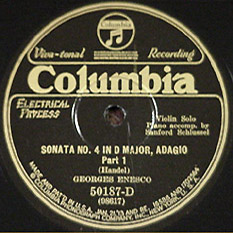
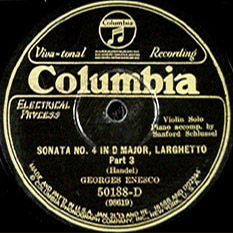
extremely rare set of 2x 78 RPM records on the Columbia label contains the Sonata
No. 4 in D major by Georg Friedrich Handel performed by Georges Enesco
accompanied by pianist Stanford Schlussel, recorded in 1929 in New
York. Columbia 50187-D and Columbia 50188-D electrical recording. (Images courtesy
Takeshi Miura.)
Takeshi
Miura, who
owns this performance, says: "The impeccable simplicity in his performance
of the Handel Sonata No.4, together with La Folia (Corelli) and Poème (Chausson),
makes us forefeel his performance of Bach's Sonatas and Partitas in the later
stages."
There
is another rare recording of Enesco and Chailley-Richez performing Beethoven's
Sonata for Piano and Violin No. 9, 'Kreutzer', made in 1952 and released
in France on Columbia FC1058 in 1957.
Text
and research: Rudolf A.Bruil. Page first published on June 5th, 2002 and
updated since.
Famous pianist Lory Wallfisch,
who formed a duo with her late husband, violinist/violist Ernst Wallfisch, is
President of the George
Enescu Society of the United States, Inc. She is also "Iva Dee Hiatt
Professor Emeritus of Music", an honorary title of the Smith College in Northampton,
Massachusetts. The year 2005 marked the 50th anniversary of the death of George
Enesco. On the occasion Mrs. Lory Wallfisch (also from Romania) wrote to me:
"I
have known personally George Enescu (in Romania, then in Paris) as did my late
husband, the great violinist Ernst Wallfisch. We made music with and for Enescu.
In Paris we visited him several times and once - at his own invitation - we witnessed
one of his masterclasses, at the home of Madame Yvonne Astruc, one of his former
students. Besides Ivry Gitlis, Arthur Grumiaux, he also taught Ida Haendel - great
American violinist, still performing! Of course, the relationship with Yehudi
Menuhin is legendary... Together with my husband, we ("Wallfisch Duo")
participated many, many times, in the Menuhin Music Festival in Gstaad, Switzerland.
In 1981, and on the occasion of Enescu's centennial birth-anniversary, I
performed an all-Enescu concert, at the invitation of Menuhin: 3rd piano &
violin sonata, 2nd piano quartet, and the string octet (great reviews in the Swiss
newspapers!). The last time we visited Enescu in Paris, was in January 1955;
he was already bedridden. I have recently returned from a European trip which
took me first to Berlin ("Berlin-Enescu Days"), lecturing and performing
Enescu. For the same purpose, I went also to the "Yehudy Menuhin School"
in Surrey, England, and to the "International Menuhin Music Academy"
in Switzerland. All in connection with the observance of 50 years since Enescu's
death (1955)."






 Donald
Gabor had a
Donald
Gabor had a




 In certain
publications Cordareni is mentioned as Enesco's birth place, and 1882 is mentioned
as year of birth. Enesco himself mentioned in his conversations with Bernard
Gavoty - Les souvenirs de Georges Enesco (Ed. Flammarion, Paris 1955 - 2006)
- that 1881 was the year and his place of birth was Liveni (today called George
Enescu).
In certain
publications Cordareni is mentioned as Enesco's birth place, and 1882 is mentioned
as year of birth. Enesco himself mentioned in his conversations with Bernard
Gavoty - Les souvenirs de Georges Enesco (Ed. Flammarion, Paris 1955 - 2006)
- that 1881 was the year and his place of birth was Liveni (today called George
Enescu).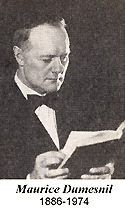 After
child prodigy Yehudi Menuhin had been studying in San Francisco with Louis Persinger
for two years he found his next, even more important teacher in Paris were he
had come to live with his family. It was Georges Enesco. When French pianist,
composer and teacher, Maurice Dumesnil (who had been accompanying Enesco
on several occasions), traveled to the US, he prepared an article on Enesco for
The Etude Music Magazine (published in Philadelphia), to be printed as
an aftermath to Enesco's stay.
After
child prodigy Yehudi Menuhin had been studying in San Francisco with Louis Persinger
for two years he found his next, even more important teacher in Paris were he
had come to live with his family. It was Georges Enesco. When French pianist,
composer and teacher, Maurice Dumesnil (who had been accompanying Enesco
on several occasions), traveled to the US, he prepared an article on Enesco for
The Etude Music Magazine (published in Philadelphia), to be printed as
an aftermath to Enesco's stay. 






 The
September 1950 edition of Schwann Long Playing Record Catalog lists two complete
sets. One set is by violinist Alexander Schneider on Mercury MGL-1 (4x 12"
LP discs, individually numbered MG 10017/10018/10019/10020) recorded in 1949 by
C. Robert Fine (engineer) and Mitchell Miller (recording director) at Reeves Sound
Studios, New York City. The other available set was the one performed by Georges
Enescu on Don Gabor's Continental Records label with references CLP 104-105-106,
also recorded in 1949. Obviously these recordings were made for release in 1950,
the 200th anniversary of Johann Sebastian Bach's death.
The
September 1950 edition of Schwann Long Playing Record Catalog lists two complete
sets. One set is by violinist Alexander Schneider on Mercury MGL-1 (4x 12"
LP discs, individually numbered MG 10017/10018/10019/10020) recorded in 1949 by
C. Robert Fine (engineer) and Mitchell Miller (recording director) at Reeves Sound
Studios, New York City. The other available set was the one performed by Georges
Enescu on Don Gabor's Continental Records label with references CLP 104-105-106,
also recorded in 1949. Obviously these recordings were made for release in 1950,
the 200th anniversary of Johann Sebastian Bach's death.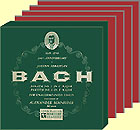 Saterday
Review of Literature wrote bluntly about Schneider's recording: "Complete
but Surpassable".
Saterday
Review of Literature wrote bluntly about Schneider's recording: "Complete
but Surpassable". 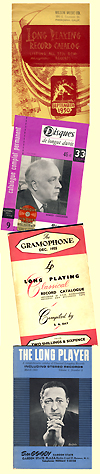 The
arrival of the tape recorder - the German invention brought to the U.S.A. by Jack
Mullin after World War Two and built by Ampex in 1947 - furthered the development
of the Long Playing record which was introduced in 1948 by Columbia. Now recordings
of complete works could easily be made and fit on the new 12 inch plastic disks.
Tape was the medium used by Bob Fine of Mercury Records.
The
arrival of the tape recorder - the German invention brought to the U.S.A. by Jack
Mullin after World War Two and built by Ampex in 1947 - furthered the development
of the Long Playing record which was introduced in 1948 by Columbia. Now recordings
of complete works could easily be made and fit on the new 12 inch plastic disks.
Tape was the medium used by Bob Fine of Mercury Records.  About
one year later - in January 1953, according to Schwann - the complete set
played by violinist José Pepito Figueroa was released on four twelve
inch discs on the New A'A'O Records Inc. label with reference NRLP 408
/409 /410 /411. New A'A'O Records had a mail box at Grand Central Station, New
York 17. This indicates that it was a small firm as no street address was mentioned
on the covers. These recordings by Figueroa were not
About
one year later - in January 1953, according to Schwann - the complete set
played by violinist José Pepito Figueroa was released on four twelve
inch discs on the New A'A'O Records Inc. label with reference NRLP 408
/409 /410 /411. New A'A'O Records had a mail box at Grand Central Station, New
York 17. This indicates that it was a small firm as no street address was mentioned
on the covers. These recordings by Figueroa were not  listed
in the other record catalog, 'The Long Player'. New Records Inc. ceased to exist
in 1959.
listed
in the other record catalog, 'The Long Player'. New Records Inc. ceased to exist
in 1959.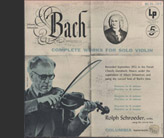 In
the autumn of 1951 Jerome Hill and C. Robert Fine - known
from the
In
the autumn of 1951 Jerome Hill and C. Robert Fine - known
from the 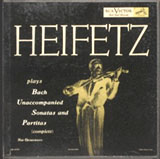 In
September of 1953 the performances of Jascha Heifetz (recorded in
October, 1952) became available on Victor LM 6105 (3 x 12") in the US and
by April 1957 in Great Brittain and several European countries on His Master's
Voice ALP 1449/50/51. The Heifetz performances are considered to be the top, both
technical and interpretive. Warren DeMotte: "Heifetz stands almost alone
among violinists as a technician. As an interpreter, he has peers and sometimes
surperiors. However, when he is at the top of his form, as he is in this album,
it is almost impossible to imagine a better performance."
In
September of 1953 the performances of Jascha Heifetz (recorded in
October, 1952) became available on Victor LM 6105 (3 x 12") in the US and
by April 1957 in Great Brittain and several European countries on His Master's
Voice ALP 1449/50/51. The Heifetz performances are considered to be the top, both
technical and interpretive. Warren DeMotte: "Heifetz stands almost alone
among violinists as a technician. As an interpreter, he has peers and sometimes
surperiors. However, when he is at the top of his form, as he is in this album,
it is almost impossible to imagine a better performance."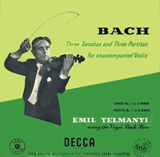 In
November 1954 Emil Telmanyi's complete recordings made in 1953 were
added to the catalog. In Great Brittain in 1954 on LXT 2951-3 and in the the USA
in 1955 on 3 x 12" London LPs (LLA 20). Like Schröder also Telmanyi
uses the archery bow. Some critics found his playing not structured enough.
Maybe caused by using the Rundbogen? These mono Decca / London recordings were
released anew in 1984, reduced to 2 discs, on the Danacord label (DACO 147-148).
In
November 1954 Emil Telmanyi's complete recordings made in 1953 were
added to the catalog. In Great Brittain in 1954 on LXT 2951-3 and in the the USA
in 1955 on 3 x 12" London LPs (LLA 20). Like Schröder also Telmanyi
uses the archery bow. Some critics found his playing not structured enough.
Maybe caused by using the Rundbogen? These mono Decca / London recordings were
released anew in 1984, reduced to 2 discs, on the Danacord label (DACO 147-148).
 By
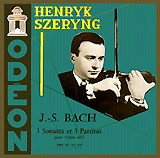
December 1954 the complete set of Henryk Szeryng was issued in France
on Odéon ODX-122/123/124. This set became available in other European countries
in the spring of 1955, however not in Great Britain. Initially this set was available
in Europe only until it was made available in the USA as Schwann Artist Listings
of 1960 mentions. The Odeon Set introduced Henryk Szeryng to the American record
collector and the availability most certainly must have resulted in Szeryng's
contract with RCA a few years later and his subsequent liaison with Mercury (and
Philips).
By
December 1954 the complete set of Henryk Szeryng was issued in France
on Odéon ODX-122/123/124. This set became available in other European countries
in the spring of 1955, however not in Great Britain. Initially this set was available
in Europe only until it was made available in the USA as Schwann Artist Listings
of 1960 mentions. The Odeon Set introduced Henryk Szeryng to the American record
collector and the availability most certainly must have resulted in Szeryng's
contract with RCA a few years later and his subsequent liaison with Mercury (and
Philips).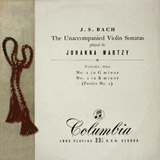 The
recordings of Johanna Martzy became available as three different releases
in November 1955, March 1956 and October 1956 respectively: Columbia 33CX
1286/87/88 in Great Brittain, and Angel D-35280/81/82 in the USA. They had been
recorded in 1954 and 1955. But by 1960 the Martzy recordings were deleted from
the listings in the catalogs while the earlier mono sets of Heifetz and of Milstein
remained available in the first years of the stereo era.
The
recordings of Johanna Martzy became available as three different releases
in November 1955, March 1956 and October 1956 respectively: Columbia 33CX
1286/87/88 in Great Brittain, and Angel D-35280/81/82 in the USA. They had been
recorded in 1954 and 1955. But by 1960 the Martzy recordings were deleted from
the listings in the catalogs while the earlier mono sets of Heifetz and of Milstein
remained available in the first years of the stereo era. In
Schwan of May 1957 the Capitol Three 12-in. Set with reference PCR 8370
of Nathan Milstein was listed for the first time. Reviewer Nathan Broder
evaluated and described these recordings in High Fidelity Magazine of July 1957
as "A powerful rival to the Heifetz set, in my opinion, the pre-eminent performance
on records".
In
Schwan of May 1957 the Capitol Three 12-in. Set with reference PCR 8370
of Nathan Milstein was listed for the first time. Reviewer Nathan Broder
evaluated and described these recordings in High Fidelity Magazine of July 1957
as "A powerful rival to the Heifetz set, in my opinion, the pre-eminent performance
on records". 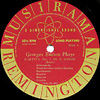 The
performances by Georges Enesco became available again for a short period.
They were now issued on the red/gold Remington MUSIRAMA label without being
listed in both Schwann and Long Player. The labels did not have the original reference
numbers but only the numbers of the 6 plates: TA-16/17/18/19/20/21. Although Don
Gabor announced the MUSIRAMA black-gold label series in the September 1953 Schwann
catalog, the later variation of the label in red/gold was first used around
1957.
The
performances by Georges Enesco became available again for a short period.
They were now issued on the red/gold Remington MUSIRAMA label without being
listed in both Schwann and Long Player. The labels did not have the original reference
numbers but only the numbers of the 6 plates: TA-16/17/18/19/20/21. Although Don
Gabor announced the MUSIRAMA black-gold label series in the September 1953 Schwann
catalog, the later variation of the label in red/gold was first used around
1957.