|



The
cover of the reissue of the Grieg Concerto on the Masterseal label. The
picture is not of pianist Felicitas Karrer. The picture was supplied by
the Baldwin Piano Company.


The
original cover of Schubert's Tragic Symphony.

Tchaikovsky's
1812 Festival Overture (Ouverture solennelle).

Tchaikovsky's
1812 Festival Overture (Overture solennelle) was issued on 2 x 45 RPM
7" discs with Smetena's Moldau (reference RB-4-003).
By mistake the box mentions George Singer as the conductor for the Tchaikovsky
piece, whereas the factual conductor was Kurt Wöss. Singer conducted
The Moldau.

Tchaikovsky's
Romeo and Juliet from R-199-88 conducted by Kurt Wöss was later released
on Palace M-601. But the conductor was then named Kurt Baumann.


Dvorak's
Cello Concerto with Gaspar Cassado.


|
For
Austria, the Second World War ended on April 27, 1945. In the years
to come an entire nation had to face what the Third Reich and its followers
had done to Austria and Austrian culture. The atmosphere looked really
grim and though many young Austrians had plans for a brighter future,
many had to wait to do what they really wanted to. Also 30 year old
Kurt Wöss. During the War he had been teaching at the Musik-Akademie
and at the Musik-Schule in Vienna.
Now,
after the war, he had to start all over again. He took up the idea of
reassembling and training the Niederösterreichisches Tonkünstler
Orchestra (Niederösterreichisches Sinfonieorchester - Symphony
Orchestra of Lower Austria) of which he became principal conductor in
1948.
Kurt
Wöss was born in Linz in Upper Austria on May 2nd, 1914. His formal
musical education took place at the 'State Academy of Music and the
Performing Arts' in Vienna were he studied under the university professors
Egon Joseph Wellesz (Austrian-English musicologist and composer
who himself had studied under Arnold Schönberg and Guido Adler),
Robert Lach (musicologist-composer), Alfred Orel (who,
like Wellesz, studied under Guido Adler), and he studied with musicologist
Robert-Maria Haas (who is famous for the restoration of the Bruckner
Symphonies). Robert-Maria Haas must have influenced Woss to a great
extend.

Kurt
Wöss at 36 (around 1950).
Picture taken from the cover of REMINGTON R-199-97,
edited and restored by R.A.B.
The
emphasis on musicology in Wöss's studies is not without significance.
It heightened his desire in giving a performance true to the composer's
intentions. This education laid the foundation that made him later a
prominent advocate of and a devoted performer of the works of Anton
Bruckner. In 1975 he conducted the first performance of the complete
Novak Edition of Symphony No. 4 with the Munich Philharmonic. This event
took place in the Bruckner Haus in Linz (Austria).
In
addition he studied as a private student under Felix Weingartner
(his subjects were violin and composition) and this is significant for
the way Wöss developed his style of conducting. Woess was not only
noted for his musical perception and exactness of interpretation, he
also had a remarkable memory and it is said that he conducted most (if
not all) classical works that were on his repertoire without a score.
His repertory was extensive and ranged from J.S. Bach to the more contemporary
Béla Bartók.
Among
the many famous orchestras which have played under his baton are: Swedish
Konsertforeningen, Augusteo Orchestra from Italy, L'Orchestre
de la Suisse Romande, Zürich Tonhalle-Orchester, the
Orchestra of the NHK (Japan; September 1951 – August 1954
Principal Conductor), the Melbourne Symphony, and the famous
Salzburg Mozarteum Orchestra.
|
|
|
A
78 RPM recording of the Tonkuenstler Orchestra from before World
War II: Polyphon Record 100030 with Fantasy from "Cavalleria
Rusticana", Mascagni. Polyphon existed from 1905 til 1922.
It is not sure when this acoustical recording was made.
(From the SoundFountain Archive)
|
From
1938 on Kurt Wöss was a professor at the Musik Akademie
in Vienna. In order to have this post he had become a member of the
National Socialist Party (NSDAP, National-sozialistische Deutsche Arbeiterpartei).
Was this step taken out of a sincere conviction? Or did he join for
"practical reasons" because, as a 24 year old, he did not
want to jeopardize his career? In 1945 he was dismissed.
In
the years after the war he got involved with the Tonkünstler Orchestra
and - apparently after he had been cleared - he became its principal
conductor from 1948 on until 1951. On
recording covers and labels the Niederösterreichisches Tonkünstler
Orchester is the same orchestra as 'Orchestra of the Viennese Symphonic
Society' and 'Austrian Symphony Orchestra'. These names were probably
used for publicity reasons.
The
original Tonkünstler-Orchester was founded in 1907 in Vienna, but
soon after World War I had ended (1918) it had a difficult time and
was forced to merge with the Wiener Konzertverein. After the Second
World War the orchestra was newly organized. At the basis was the "Niederösterreichische
Landesorchester" which was renamed Tonkuenstlerorchester.
It
was Kurt Wöss who reinstated the Sunday Afternoon Concerts (that
had been an institution before the war).
Some well known and also famous names have swung the baton in front
of the musicians of the Tonkünstler Orchestra during Wöss's
reign and many after he had left for Japan. Among those were Gustav
Koslik who also can be found on the Remington label, Heinz Wallberg,
and Walter Weller (to name a few).
|
|
|
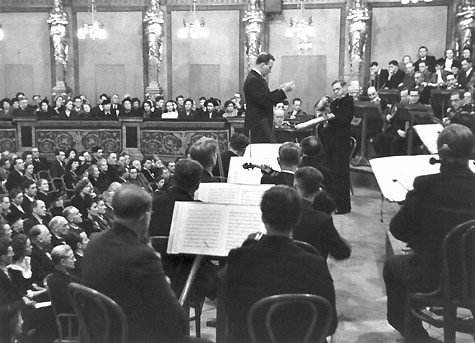
Kurt
Wöss in his mid thirties conducting his Niederösterreiches
Tonkünstler-Orchester with solo violinist Walter Schneiderhan
in the Musikvereinssaal in Vienna in early 1950.
Picture courtesy Markus Hennerfeind, researcher of the Tonkünstler
Orchester.
|
It
was during 1950 and part of 1951, that the recordings with Kurt Wöss
were made for release on the Remington label. They were produced by
 Marcel Prawy. In 1951, Kurt Wöss went
to Japan to be principal conductor of the Symphony Orchestra of the
Japanese National Broadcasting Corporation (NHK, Nippon Hoso Kyokai),
which is the most important orchestra of Japan. It was Kurt Wöss who
introduced the Japanese audience to Western (European) music, even before
Herbert von Karajan did. In Japan and also later in Australia, he often
conducted Bruckner Symphonies, he even performed twelve tone compositions
in Tasmania!
Marcel Prawy. In 1951, Kurt Wöss went
to Japan to be principal conductor of the Symphony Orchestra of the
Japanese National Broadcasting Corporation (NHK, Nippon Hoso Kyokai),
which is the most important orchestra of Japan. It was Kurt Wöss who
introduced the Japanese audience to Western (European) music, even before
Herbert von Karajan did. In Japan and also later in Australia, he often
conducted Bruckner Symphonies, he even performed twelve tone compositions
in Tasmania!
 During Wöss's
Remington period, recordings of his orchestra were also made with other
conductors: Hine Arthur Brown, Kurt Randal, Hans Wolf, George Singer,
and others. After Kurt Wöss had left Vienna, recordings were made under
the baton of Gustav Koslik, Wilhelm Loibner, a.o. By the time Wöss
left Tokyo in 1954 and returned to Vienna, Remington Records was no
longer procuring recordings made in Austria. Don Gabor had signed a
contract to make recordings in Berlin with the
RIAS Symphony Orchestra.
During Wöss's
Remington period, recordings of his orchestra were also made with other
conductors: Hine Arthur Brown, Kurt Randal, Hans Wolf, George Singer,
and others. After Kurt Wöss had left Vienna, recordings were made under
the baton of Gustav Koslik, Wilhelm Loibner, a.o. By the time Wöss
left Tokyo in 1954 and returned to Vienna, Remington Records was no
longer procuring recordings made in Austria. Don Gabor had signed a
contract to make recordings in Berlin with the
RIAS Symphony Orchestra.
Following
a period of about two years, during which Kurt Wöss conducted concerts
in the USA as well, he took up the post of conductor of the Melbourne
based Victoria Symphony Orchestra until 1960. From 1961 till 1968 he
was director of the Opera of Linz, and he was principal conductor of
the Linz Bruckner Orchestra from 1961 till 1974, while his wife, Dr.
Margarethe Wöss, was music director in Linz from 1963 until 1987,
the year her husband died.
During
his career Kurt Wöss also appeared as a guest conductor of orchestras
in other countries: L'Orchestre du Conservatoire de Paris, Seoul Philharmonic
Orchestra, Bratislava Philharmonic Orchestra, Berlin Municipal Orchestra,
Slovak Philharmonic Orchestra, and many more.
Kurt Wöss died in Dresden on December 4, 1987, when he was billed
to conduct Bruckner's Fourth Symphony.
The
Remington recordings of Kurt Wöss:
R-199-1
Beethoven: Emperor Concerto with pianist
Felicitas
Karrer (Released in 1950) (Plymouth P-12-11.)
R-199-2
Schubert: Symphony No. 1, Mozart: Fantasia
R-199-3
Grieg: Piano Concerto Op. 16 with Felicitas Karrer (Released
1950.) The Masterseal release of the same recording was pressed
from Remington plates, first with the Masterseal label and
later with the Remington Musirama label, but without a reference
number. (Plymouth P-12-10.) The cover photo is not of Felicitas
Karrer as it was a publicity photograph of the Baldwin Piano
Company.
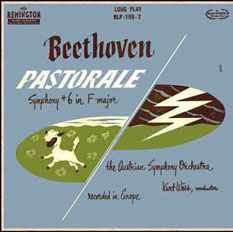
R-199-7
Beethoven: Symphony No. 6

R-199-8
Beethoven: Symphony No. 7
(Cover by Rudolph de Harak)
R-199-9
Tchaikovsky: Symphony No. 5
In his Tchaikovsky discography of the concertos and symphonies
in High Fidelity of August, 1954, reviewer J.F. Indcox wrote:
"Remington,
for some strange reason, manages to split the second movement
between sides, and to provide a screaming treble tone in the
last movement, also some hissing surface noise. Woss gives
a reasonably straightforward reading, but his orchestra is
not of the best."
R-199-18
Richard Strauss: Don Juan, Tchaikovsky: Overture 1812
R-199-20
Tchaikovsky: Violin Concerto with
Michèle Auclair (reissued on Masterseal MSLP
5004)
R-199-25
Sibelius: Finlandia, Mozart: Overture to Thamos
R-199-32
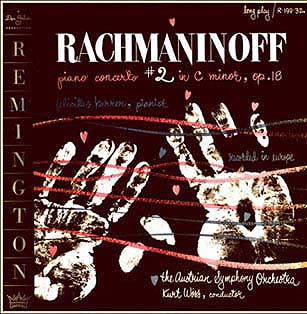
Rachmaninoff: Piano Concerto No. 2 with Felicitas Karrer.
The disc was released in 1951 and later appeared on Plymouth
P-12-12. The first movement can also be found on Twilight
Concert No. 2, catalog number R-199-115.
R-199-37
Schubert: Symphony No. 4 "Tragic"

The
second cover - by Alex Steinweiss - for the recording of Schubert's
Tragic Symphony.
RLP-199-42
Brahms: Symphony No. 4
R-199-46 Mozart: Concerto for Violin and Orchestra in
D Major with
Helen Airoff
RLP-199-48
Schubert: Symphony No. 9,
RLP-199-54
Mozart: Sinfonia Concertante for oboe, clarinet, horn, bassoon
and Orchestra. Coupled with two movements of incidental music
to "Thamos, Koenig in Aegypten", conducted by Felix
Guenther.
R-199-87
Tchaikovsky: Ouverture solennelle (re-release), Nutcracker Suite
R-199-88
Tchaikovsky: Romeo and Juliet (Overture-Fantasia) and Ippolitov-Ivanov:
Caucasian Sketches (Released November 1952)
R-199-97
Johann Strauss: Waltzes (4), coupled with Joseph Strauss "Dynamiden"
conducted by
Felix Günther.
R-149-16
Mozart: Jupiter Symphony
R-149-18
Rossini: William Tell and Barber Of Seville Overtures, Bizet:
Carmen Prelude
RLP-149-20
Paganini: Violin Concerto Op. 6 with Ivry Gitlis who plays
Fritz Kreisler's completely reorchestrated first movement
of Paganini's First Violin Concerto, which is rarely recorded;
and it is only the one movement version spread over two sides
of a 10" disc.

R-149-25
Sibelius: Finlandia, Mozart: Thamos König in Aegypten
R-149-27
Famous Polkas and Waltzes - Strauss (apparently also listed
as Famous Operetta Marches)
R-149-28
Ippolitov-Ivanov: Caucasian Sketches
R-149-30
Schubert: Symphony No. 6
R-149-31
Tchaikovsky: Fantasy Overture 'Romeo and Juliet' (also appeared
on R-199-88 coupled with Ippolotov-Ivanov's Caucasian Sketches
that appeared on R149-28. Fantasy Overture 'Romeo & Juliet'
was also released as Masque M0.017, but then coupled with
Capriccio Italien by Rimsky-Korsakov and Procession of Bacchus
by Delibes, both conducted by Ernst Mehlich)
R-149-49
Tchaikovsky: Nutcracker Suite
RLP in the reference numbers of the early releases was later
changed into R. So RLP-149-25 is the same as R-149-25.
|
On
Masterseal MSLP 5008 from around 1957, Beethoven's Symphony No.
5 and Schubert's Symphony No. 8 can be found, whereas there exists no
Remington disc with this coupling conducted by Wöss.
Beethoven's
Fifth was released on a 10" disc (R-149-9) with the Salzburg Mozarteum
Orchestra conducted by
Hans
Wolf and Schubert's Eighth was originally a recording with conductor
H. Arthur Brown (R-149-15). The name Wöss was probably a convenient
substitute, especially when Brown had fallen from grace.
As
for so many artists and conductors who appear on the Remington label,
also the performances of Kurt Wöss are "handicapped by a second
rate orchestra and mostly a poor recording quality", as Warren
DeMotte wrote in
The
Long Playing Record Guide.
There
must be other performances of Wöss recorded in Austria, Sweden,
Australia and Japan. In recent years more recordings of Kurt Wöss
have been made available, mostly from broadcasts, and have probably
been transferred to CD: Bruckner, Wagner, Mozart.
|
|
|
Kurt
Wöss at 60.
(Image taken from the Dutch record review "Luister...",
1975.)
|
There
is a technically well recorded Telefunken 'Royal Sound' Stereo LP from
the early stereo days on which Wöss conducts the Bamberg Symphony
Orchestra in popular pieces by Bizet, Tchaikovsky, Bruch (with violinist
Henri Lewkowitz), Glazunov, Weber and Grieg (Telefunken SLE 4 450-P).
 The
recording of Bruckner's Fourth Symphony by Wöss and the Munich
Philharmonic can be found on Bruckner Haus Linz LP 2/12430-315. It
is of the original version composed in 1874, edited by Leopold Nowak,
published in 1975. Robert McColley wrote that this version is quite
different from the later versions, and especially so in the case of
the scherzo which is an entirely different movement. The 1874 version
has now been recorded several times, but the recording by Woess was
the first and is still regarded as one of the best. The
recording of Bruckner's Fourth Symphony by Wöss and the Munich
Philharmonic can be found on Bruckner Haus Linz LP 2/12430-315. It
is of the original version composed in 1874, edited by Leopold Nowak,
published in 1975. Robert McColley wrote that this version is quite
different from the later versions, and especially so in the case of
the scherzo which is an entirely different movement. The 1874 version
has now been recorded several times, but the recording by Woess was
the first and is still regarded as one of the best.
There
exists a private issue on CD, Lucky Ball LB 0010 S, of Bruckner's
Symphony No. 9 with Kurt Wöss conducting the Vienna Tonkuenstler
Symphony Orchestra.
From
Slovakia is OPUS Stereo 9116 0693 with Kurt Wöss conducting the
Slovak Philharmonic Orchestra. The title is 'Operetta Overtures' - Fledermaus/
The Bat (Johann Srauss), Parisian Life/La vie parisienne (Offenbach),
Beautiful Galathea/Die schöne Galathea (Von Suppé), The
Land of Smiles/Das Lands des Lächelns (Lehar), Overture (Nedbal)
and Czardas Princess/Czardasfürstin (Kálmán). The
performances were recorded in the Slovak Philharmonic Concert Hall in
Bratislava in February, 1979.
Rudolf
A. Bruil. Page created and first published in the fall of 2000
|