W.A.
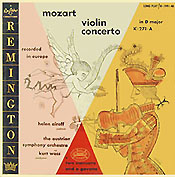
Mozart's Violin Concerto No. 7, K 271, performed by Helen Airoiff and conductor
Kurt Wöss.
The cover
of an early edition of R-199-46.
The
name of violinist Helen Airoff is known by just a few, mostly colleagues and pupils,
and a sporadic collector of rare violin recordings. But even then, why is there
so little known about violinist Helen Airoff, except for the fact that she traveled
to America on the same boat - Ile de France - as Dame Myra Hess did, on December
16, 1949, returning to the USA? And that she made recordings for the Remington
label?
Maybe
information is scarce because most colleagues, friends and pupils did take her
advice for granted. They considered her stimulating instruction and her drive
to organize whatever was beneficial for them, more or less a normalcy. She was
a caring person. It is known that she cared for ill violoncellist Maurice Gendron
at the end of his life.
Scarce
are the data and there are no recollections of live performances known to me.
The liner notes on Remington 199-95 tell that Helen Airoff made her
debut as a child prodigy at the age of nine, in San Francisco. She studied under
Adolph Busch and Georges Enesco when Enesco spend several years
in the US. She made many successful appearances as a solo violinist, and during
World War II she volunteered her services for GI concerts in Africa, Europe and
the Middle East. And that is where the short biography ends.
Teaching
the violin, that is what she mainly did. In many instances this automatically
meant giving lessons in life also, guiding the talents and prepare them for a
career as a soloist, a musician or a teacher. But above all Helen Airoff made
an imprint as a human being. It is true that people easily herald a king and a
queen, but forget about the advocate and the role of the dedicated servant. On
many occasions she must have been exactly right.
It
was Helen Airoff who suggested to producer Don Gabor and violinist Georges Enesco
to do the recordings of Bach's Sonatas and Partitas, despite the Romanian
maestro's age and state of health. She was the instigator of the valuable legacy
issued on the Continental label.
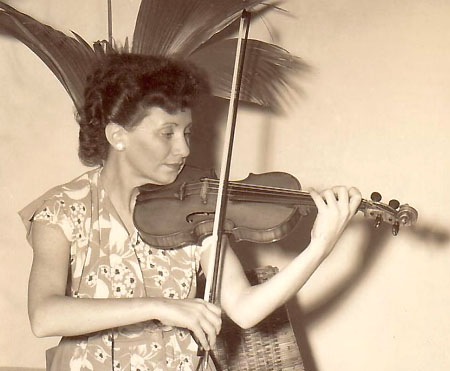
An
early picture of Helen Airoff in the mid nineteen fifties. (Private picture, courtesy
Dr. Marco J. de Vries).
Helen
Airoff's two Remington recordings are the only known recordings that witness her
talent as a performer:
-
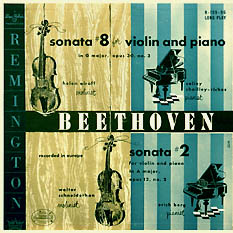
Beethoven's Sonata for Piano and Violin No. 8, performed with pianist Céliny
Chailley-Richez on R-199-95, released in 1952 and coupled with Sonata
No. 2 performed by Walter Schneiderhan - brother of famous Wolfgang- with
pianist Erich Berg;
-
Mozart's Violin Concerto No. 7, KV 271, performed with the Orchestra of
the Viennese Symphonic Society (Austrian Symphony Orchestra) and conductor Kurt
Wöss on R-199-46, released in 1953 but recorded much earlier; coupled
with orchestral pieces (Two Minuets and Gavotte).
It
could be that there are radio recordings or private recordings hidden in a vault
and nobody knows about their existence. But the known Remingtons are a posthumous
illustration of Airoff's possibilities and insight. The Beethoven Sonata is rather
well recorded considering that the recordings were made without the extra care
of a producer who wanted to make a high quality recording.
Most
Remington productions were recorded in a few takes with hardly any splicing, because
the budgets were very limited. Naturally critic Warren de Motte wrote about the
Beethoven Sonata: "Airoff and Chailley-Richez lack the polish of their fellow
artists." Nevertheless Helen Airoff does not fail to communicate with her
vivid playing. The recording also gives proof of the artistry of Céliny Chailley-Richez, whose phrasing
and subtle dynamics are simply wonderful. Helen Airoff was about 36 years of age
when the recording was made and Céliny Chailley-Richez some 20 years her
elder. It sounds like mother and daughter are making music together, the piano
taking the lead at times and providing the fundament for the violin to play -
after all, it is a Sonata for Piano and Violin, and not the other way around.
R-199-95
(Released in November 1952)
It
is reported that Helen Airoff always questioned her profession, her artistry and
the meaning of her existence. And she never failed to impress, even at the end
of her life when she was severely ill with cancer. It was then that psycho-oncologist
Professor Marco J. de Vries from the Netherlands was asked by cardiologist
Peter Nixon, from Great Britain, to visit her in her apartment in London.
When
they met, the professor noticed in an adjacent room, lying on a piano, a violin.
It was her Guarneri violin, which obviously had not been touched for a
long time because the musician was no longer able to move her right arm. De Vries
talked intensively for an hour and a half with Helen who questioned the meaning
of her life and said that she had only played the violin. But when Dr. Marco de
Vries asked her about her students, she admitted that she always cared about the
pupils she had and that many of them had won international prizes and were well
known. She often let a room to a promising student for some time. And when the
student was practicing in the room on another floor, she would listen while going
about her own business, and she would give advice, even by shouting from the floor
below.
The
conversation with Dr. Marco de Vries showed that her self-esteem was rather low,
an idea that she already had from her early youth on. That is why she did not
fully recognize the significance of having taught so many pupils.
Marco de Vries later wrote:
"When I left her London apartment, I was however so impressed by her, that
at the front door I decided that, if I ever was going to found an institute of
my own, I would name it after her." Three weeks later Helen Airoff had
died. (Her husband, Alan Dowling, had predeceased her by four years.)
On
July 15th, 1987, Yehudi Menuhin wrote a letter to The Times in London:
"I
write these words to evoke the memory of a great soul and a remarkable woman,
who, in her passing, has left an irredeemable void, as much in the hearts of her
varied friends as she has in the work and the musical legacy to which she still
had so much to contribute. Helen Airoff, born like me a Russian Jewish violinist,
paralleled in an uncanny way my own life. We shared three great masters, Louis
Persinger, the American, Georges Enesco, the Rumanian, and Adolf Busch, the German.(...)
Certainly no one living today understands the spirit of Enesco's marvelous music,
his opera Oedipus, his symphonies, chamber music, songs, etc. or knew them as
deeply as Helen. In this respect alone her departing is tragic. (...) Far from
being mourned as a public figure, she will be profoundly missed by teachers and
students and individuals whose lives were expanded and enriched by her presence,
not least at my school." - Yehudi Menuhin (1987).
Yehudi
Menuhin's letter to The Times, July 15th, 1987.
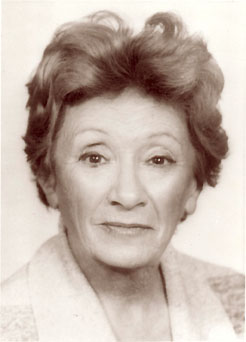
Helen
Airoff in the 1970s.
(Picture, courtesy Dr. Marco J. de Vries).
Francine
Trachier - member of Orchestre Regional de Basse Normandie - studied with Helen
Airoff. She remembers the significance of Helen Airoff as a teacher and as a human
being:
"I
was one of the last students of Mrs. Dowling and I remember in June 1987 I was
studying the Berg Concerto "in the memory of an angel", and her sister,
Mrs. Gregory, was there. Helen wanted me to play this concerto for her and I went
to her flat, a doctor was with Helen in the bedroom, and I was not allowed to
see her. I played the concerto in the living-room for Mrs. Gregory and the door
of the bedroom was opened. After Mrs. Dowling's death, her sister told me that
she was proud of my work and that she wanted to listen to me for the last time.
Every day I think of Mrs. D. and if I have any doubt about the violin or about
my life, I know she is still around and things become more clear." - Francine
Trachier
In
1988 Professor Dr. Marco J. de Vries founded the Helen Dowling Institute
in Rotterdam, The Netherlands. Aim initially was the research of psychological
factors that could possibly play a role in the onset and the development of cancer.
Yehudi Menuhin came to Rotterdam to perform with other musicians in memory
of Helen Dowling-Airoff in De Doelen Concert Hall, to the benefit of the
newly founded institute. The institute is subsidized by the Dutch government.
Helen Airoff, born in 1916
in Russia (some sources mention New York City as place of birth), died on July
12, 1987, in London.
Research
and text Rudolf A. Bruil. Page first published on June 3, 2005.
Images
of Helen Airoff, of Yehudi Menuhin's letter, the details about the visit of Prof.
Dr. Marco J. de Vries to London courtesy
Professor Dr. Marco J. de Vries (1927-2009). The Helen Dowling Institute
has since left its initial theoritical basis and objective and now focuses on
psychological care for cancer patients. See the Dutch website of the Helen
Dowling Institute.
Helen
Dowling devised together with Yehudi Menuhin the Menuhin-Dowling Music Program
which is part of the education at The
Nueva School in Hillsborough, California, which has established the Yehudi
Menuhin-Helen Dowling Competition for Young Musicians.