

Dvorak's
4th (8th) Symphony performed by the Cincinnati Symphony Orchestra conducted by
Thor Johnson.
The
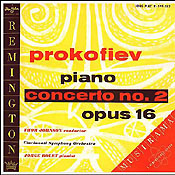
cover of Remington R-199-182: Jorge Bolet, piano, playing Prokofiev's 2nd Concerto

Alec Templeton
is the soloist in Gershwin's Concerto in F

Arias, Antherms
and Chorales of the American Moravians, performed by the Moravian festival Chorus
and Orchestra conducted by Thor Johnson, Columbia Stereo MS 6102.

Sigurd Jorsalfar Suite Op. 56 - incidental music to the play by Bjørnstjerne
Bjørnson
- composed by Edvard Grieg, was released on Decca LXT 2630
in December 1951, coupled with Vigil by Hugo Alfven.
In
1954 the Sigurd Jorsalfar Suite was issued on a single 10 inch Decca LP with reference
LW 5124.

Symphony
No. 3 by Robert Ward and "Three Hassidic Dances" by Leon Stein. From
the same plates the release in the Webster Living Sound Series was pressed.
 
Symphony
No. 2 of Tchaikovsky

"The
Origin of Fire" and "Pojohla's Daughter" coupled with Glazunov's
Violin Concerto 
Decca
LW 5328:
Symphony No. 3 (Schubert) 
Henry Brant's
Saxophone Concerto - coupled with Sinfonietta (Rudhyar)
and Gymnopedia (Glanville-Hicks) with Jonel Perlea conducting the RIAS Symphony
Orchestra 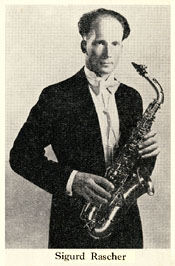
Saxophone
player Sigurd Rascher around 1949.


| By
asking Laszlo Halasz to join Remington Records as Recording Director, in 1952,
after Edward Kilenyi had left for Florida, Don Gabor brought the classical catalog
to a higher level. Gabor always had excellent contacts with artists of ethnic
popular music, and with local jazz musicians. Through conductor Laszlo Halasz,
Gabor had access to many more artists and musicians, orchestras of quality, and
conductors. One of the conductors was the eminent Thor Johnson in Cincinnati. In
1947 Thor Johnson had become music director of the Cincinnati Symphony
Orchestra, a quality ensemble, disciplined in the classical repertory and also
in the music of modern composers. Thanks to the new conductor, the orchestra's
signature was becoming more modern than it had been before under Fritz Reiner
and Eugene Goossens. Now under Thor Johnson the Cincinnati Symphony not only performed
existing compositions of many a modern American composer, but Thor Johnson did
commission many works himself to be premiered by the orchestra. The current website
of the orchestra states that during his 11 years in Cincinnati, Johnson conducted
the premieres of 120 American and European works, half of which were commissioned
by him!
The liner notes of Remington R-199-168 with Antonin Dvorak's Symphony No. 4 (No.
8) from 1953 read:
The
Cincinnati Symphony Orchestra has been one of the top ranking symphonic ensembles
in the country since its inception in 1895. That year it presented three series
of three concerts each, with an orchestral unit of 48 players. Today, this 85-members
organization of virtuoso players gives approximately a hundred concerts each season.
Through the years seven men have held the post of music director: Frank van der
Stucken; Leopold Stokowski; Ernst Kunwald; Eugene Ysaye; Fritz Reiner and Eugene
Goossens. In the 1947-1948 season, the young American conductor, Thor Johnson,
was appointed director. Under his brilliant direction, the Cincinnati Symphony
Orchestra has attained even greater recognition than at any time in the past.
Aside from its crowded schedule of concert giving in Cincinnati - a schedule which
includes regular subscription concerts with world famous soloists, young people's
and junior high school series, popular concerts and others - the orchestra tours
each season throughout a large part of the country.
The Cincinnati Symphony
Orchestra has been a pioneer in the recording industry. Beginning in 1917, records
have been made for Columbia, RCA Victor, London ffrr and now Remington. - Arthur
Darack, music critic of the Cincinnati Enquirer (1952-1967) and program annotator
for the Cincinnati Symphony Orchestra.
|
Thor
Johnson of course did inherit from his predecessors a well trained ensemble, but
by the very nature of his character, he continued to improve and perfect the playing
of the orchestra. He was a good organizer and leader, two assets which a conductor
needs. Practically every recording of the orchestra under his baton is the sonic
realization of a precise concept. It is probably this strictness and seriousness
which Sergei Koussevitzky did like less if compared to the more playful, "musical"
attitude of a Leonard Bernstein; Thor Johnson was picked on by Koussevitzky during
a course in 1940. True, in Johnson's performances beauty for the sake of beauty
is in conflict with the organization of the execution of the music. In his music
making beauty stands for construction, for architecture and dynamics. Nevertheless
a great intuitive feeling can be noticed at times.
All these qualities made
him not only a good classical conductor but rather the man to perform often complicated
modern scores as his discography shows.
| |
| Picture
edited by R.A.B., taken from the cover of Remington R-199-168. |
Thor Martin Johnson
was born in Wisconsin Rapids (Wisconsin) on June 10th, 1913 in a religious family.
His father, Herbert Bernharth Johnson, was of Norwegian descent. He was minister
of the Moravian church which originated in that part of Europe what is the Czech
republic today. His mother, Anna Josephine Reussnig, was born in a family of German
immigrants. When Thor was seven years old his parents took him to a concert of
violinist Efraim Zimbalist. This left a great impression on the kid as
the day after the concert he was imitating the violinist and taking his bow before
an imaginary audience. By the time he was 13 he conducted a choral group and a
few years later small ensembles when studying at the University of North Carolina
(UNC) and  later
at the Universitty of Michigan. later
at the Universitty of Michigan.
In June 1936 he traveled to Europe to attend courses at the Mozarteum in Salzburg
and later in Vienna given by Bruno Walter, and courses by Nikolai Malko
(Prague), Bernhard Paumgartner (Salzburg), and Felix Weingartner
(Vienna). Thor decided to study for a longer period with Malko and spent several
months studying in Prague, early in 1937. All
these famous names were investing in the younger generation by giving instruction
for hours at length. Also significant was attending performances by Arturo
Toscanini, Volkmar Andreae, and Max Reinhardt. He met Eugene
Ormandy during the Salzburg Mozarteum Festival, and Max Reinhard in
person. Ormandy was conductor of the Minneapolis Symphony at the time. When following
courses in Leipzig with Herman Abendroth, 23 year old Thor also met with
Richard Strauss. In Budapest he met the great Béla Bartók.
When Thor visited the Ferenc Liszt Conservatory he was introduced to the head
of the academy, Ernö Dohnányi, who asked him about the reception
of his compositions in the USA.
The many teachings he received from these
great names in music, before the Second World War broke out, must have impressed
the young student. Traveling to Europe, in fact to the region where his religious
beliefs found their origin, is of significance too. In
a letter to his parents Johnson described the prewar situation in Austria:
"Austria is one
of the poorest countries of Europe. The streets are filled with cripples and beggars
and Vienna is considerably run down. The war (WW I, ed.) certainly took its toll.
The only man who seems to have had any ability to do anything for Austria was
Dollfuss and the Nazis took his life because they realized his importance."
- Thor Johnson in a letter to his parents dated May 23, 1937. (Thor Johnson,
American Conductor, by Louis Nicholas, 1982.)
|
And
another witness,  Kitty
Werthmann,
an Austrian World War II survivor, explained that there was 30 percent
unemployment, 25 percent inflation, 25 percent interest on loans.
There were winers in the streets and housing blocks had been burned
down obviously by lack of funds to repair or to rebuild. All because
of the reparations payments Austria had to make after loosing World
War I.
Kitty
Werthmann,
an Austrian World War II survivor, explained that there was 30 percent
unemployment, 25 percent inflation, 25 percent interest on loans.
There were winers in the streets and housing blocks had been burned
down obviously by lack of funds to repair or to rebuild. All because
of the reparations payments Austria had to make after loosing World
War I.
Johnson
returned home to conduct the North Carolina Symphony Orchestra. He went
to Chicago to teach at the University of Michgan and led a variety of orchestras
and bands, a.o. TheWorld Youth Orchestra. In 1940 he took up the post of
conductor of the Grand Rapids Symphony, but after the attack on Pearl
Harbor in 1941, he (like so many other musicians) left the orchestra and enlisted
in the US army in 1942 where he became a band leader and performed with pianist
Eugene List and Australian composer/pianist Percy Grainger. They
also had enlisted.
On
leave one day he visited Eugene Ormandy, now conductor of the Philadelphia
Orchestra. Arturo Toscanini was not well to conduct a planned concert and
Ormandy proposed that Thor Johnson would conduct the program which listed Symphony
No. 5 of Jean Sibelius, and Tchaikovsky's Piano Concerto Op. 23 which
he performed with pianist Eugene List. As army band leader he was eventually
sent to Great Britain. There he had the opportunity to meet with important people
from the music scene there. When
after World War Two things were gradually getting back to normal, Thor Johnson
was offered the post of music director of the Cincinnati Symphony Orchestra
which he accepted in 1947, a post which he held for more than ten years, until
1958.
From 1967 until his death in 1975 he was music director of the Nashville
Symphony Orchestra.
Johnson was a man of discipline and he also was a
man of faith. He founded the Peninsula Music Festival and led the Moravian
Music Festivals. He did so for the first time in 1950 and for the last time
in the summer of 1974, the season prior to his death.
When
he became music director of the Cincinnati Symphony, he was announced as "the
youngest native born American to lead a major American orchestra". This fact
may have incited English Decca through their American branch, London
Records, to make recordings with this relative young conductor and the orchestra
of Cincinnati which had of course a great reputation. This resulted in the recordings
of five works with which his discography begins. London
LL 405/Decca LXT 2604 -
Johann Christian Bach: Sinfonia, coupled with Franz Schubert's Third Symphony
(1951). Schubert's 3rd was later also available on a 10" Decca LW5328.
London
LL 406/Decca LXT 2630 - Alfven: Midsommervaka, coupled with Sigurd Jorsalvar
by Edward Grieg (1951). Sigurd Jorsalfar was reissued on a 10" Decca LW 5124
in 1954.
London
5355/Decca LXT 2605 - Berlioz: Nuits d'été, with Suzanne Danco
(released in the nineteen nineties on CD together with recordings by Ernest Ansermet
entitled "French Vocal Music"). The
recording project was probably not what the sales department had in mind and by
the time conductor Laszlo Halasz had joined Remington Records as Recording
Director, Johnson and his orchestra were free to record for Don Gabor.
The knowledge Laszlo Halasz had not only about music but about the American and
European music scenes was a great asset for the Remington label and by the cooperation
with the ACA, American Composers Association, Remington Records could gain in
importance. In this context the choice for Thor Johnson and his orchestra was
a logical consequence. Both Halasz, Gabor and Johnson may have conferred and made
suggestions for the repertory to be recorded. Thor
Johnson's Remington recordings (1953-1954): R-199-168
- Antonin Dvorak: Symphony No. 4 (8) in G
Major Op. 88.
|

At
the time when the 8th Symphony of Dvorak was issued, in a Dvorak Discography,
Harold Schonberg reviewed the available performances of this Symphony. He found
the Wolfgang Sawallisch (Angel), George Szell (London/Decca), and Bruno Walter
(Columbia) discs the best performances. Rafael Kubelik (RCA) and Gerhard Pflüger
(Urania) came second so to speak. And he bluntly stated at the end of the review
without further ado: "The Remington disk is outclassed". Schonberg was
apparently allergic to the label and would not bother much. That is probably why
he did not mention Jorge Bolet's Remington recordings in the chapter about Jorge
Bolet in his book "The Great Pianists". Bolet recorded the Four Scherzi
of Chopin and Prokofiev's 2nd Piano Concerto.
Warren DeMotte wrote in his Long Playing Record Guide published in 1955: "Johnson
is direct and lacking in tonal warmth".
That could well have been because
of the odd practice of Remington to use the cheap vinyl mix, not adhering to a
normalized frequency curve, and that less care was taken when lacquer and matrix
were produced. Nevertheless
Thor Johnson's musicianship was appreciated by many and his Remington recordings
with the Cincinnati Symphony Orchestra were generally well received. His approach
of whatever score he interpreted with his orchestra was individualistic and surely
could have lacked some subtlety here and there, but his recordings show that he
had a firm hand, that he had insight in the overall structure of a work, that
he knew what the music was about, and that he was well in command of his orchestra.
A
good example is exactly his recording of Dvorak's 4th Symphony (No. 8 today) in
G Major Op. 88 which shows at several instances beautiful melodic lines and phrasing,
and sometimes prominent brass which may be less appreciated by some but is well
a part of this score and may have been emphasized somewhat by the microphone placement
used by Remington at the time.
The
original Musirama pressing of this symphony does not completely reveal the merits
of this performance. The Remington disk is not very detailed in clusters and sudden
outbursts, and it is easy to say that the performance of Johnson is not precise
and would lack the right intensity. Right, the orchestra of Cincinnati is of course
in a different league if compared to the orchestras of Philadelphia, Cleveland,
Boston, New York, etc. And we should not expect the level of Rafael Kubelik's
8th recorded for Deutsche Grammophon many years later or Karajan's for Decca/London. However
there is more to Johnson's performance and that can be heard in its full glory,
strength, assertiveness, nervousness, power, suspense and - yes - nuances as the
signal of the Varèse-Sarabande Stereo LP reveals.
Varèse-Sarabande
VC 81044 is cut from the original sound recording which was taped in stereo
by engineer Robert Blake way back in the fall of 1953; the production was supervised
by Don Gabor and Laszlo Halasz. The Varèse LP was prepared for release
by Tom Null, Dub Taylor, and Chris Kuchler and was issued in 1979 in  The Remington Series.
Thanks to Robert Blake and of course to Tom Null c.s., it has magnificent sound
for a 1953 stereo recording, and it lets us hear also the virtuoso side of the
members of the Cincinnati Symphony.
The Remington Series.
Thanks to Robert Blake and of course to Tom Null c.s., it has magnificent sound
for a 1953 stereo recording, and it lets us hear also the virtuoso side of the
members of the Cincinnati Symphony.
 Most
of us do agree that Johnson did so very well in the performances of the Gershwin
Concerto with Alec Templeton and in Jorge Bolet's performance of Prokofiev's Opus
16. He brings exitement and passion to the Sibelius recordings, specifically to
Pohjolah's daughter. The Varèse-Sarabande disc of Dvorak's Symphony No.
8 shows once more that Thor Johnson was a good conductor and this is particularly
illustrated in the impressive and emotional rendering of the symphony's Second
Movement (a reminiscence of a hardanger fiddle - hardingfele as they call the
instrument in Norway - included). No doubt that attending courses given by Bruno
Walter in Austria, Nicolai Malko in Prague, and Hermann Abendroth in Leipzig,
did form the conductor. Most
of us do agree that Johnson did so very well in the performances of the Gershwin
Concerto with Alec Templeton and in Jorge Bolet's performance of Prokofiev's Opus
16. He brings exitement and passion to the Sibelius recordings, specifically to
Pohjolah's daughter. The Varèse-Sarabande disc of Dvorak's Symphony No.
8 shows once more that Thor Johnson was a good conductor and this is particularly
illustrated in the impressive and emotional rendering of the symphony's Second
Movement (a reminiscence of a hardanger fiddle - hardingfele as they call the
instrument in Norway - included). No doubt that attending courses given by Bruno
Walter in Austria, Nicolai Malko in Prague, and Hermann Abendroth in Leipzig,
did form the conductor.
On
top of that, while comparing the old mono from the early 1950s to the modern Varèse
stereo disc, one gets another proof how important the technical aspects of lacquer
cutting, matrix production and finally vinyl pressing are, be it in its original
form or in a more modern release - even if some inconstancy of speed can be noticed
(whether it originates from the tape or the pressing is not sure). The quality
of the technique can make or break a performance. It
is evident that many reviewers are constantly overloaded with discs and if they
are not captivated right after the needle has been dropped in the groove or after
the play-button has been pressed on the CD-player, they mentally discard a release.
Whatever may be the case, the Varèse LP is revealing the truth about Thor
Johnson's artistry in a beautiful way, as did the 1955 A-V Tape Library edition,
reviewed by Charles
D. Sigsbee
in Tape Recording Magazine, March-April issue of 1955 (see below). - R.A.B.
| 
| |
Click here
for a Sound Clip of the Second Movement of Dvorak's 4th (8th) Symphony conducted
by Thor Johnson recorded with the Cincinnati Symphony in 1953. |
|
  The
arrival of the tape recorder - the German invention brought back from Europe by
Jack Mullin, after World War Two had ended, and which was first built by Ampex,
in 1947 - inspired many a company to design recorders for use by audiophiles and
amateurs in and outside the home. The tape recorder became a popular medium on
both sides of the Atlantic, but the simultaneous release of music on disk and
pre-recorded tape belonged more to the American way if compared to the European
practice.
The
arrival of the tape recorder - the German invention brought back from Europe by
Jack Mullin, after World War Two had ended, and which was first built by Ampex,
in 1947 - inspired many a company to design recorders for use by audiophiles and
amateurs in and outside the home. The tape recorder became a popular medium on
both sides of the Atlantic, but the simultaneous release of music on disk and
pre-recorded tape belonged more to the American way if compared to the European
practice.
Soon
systems, also suited for the playback of binaural tapes (in
fact 2-track tapes with material recorded in stereo or quasi
stereo) became available as well, long before the actual stereo
record was launched.

A-V
Tape Libraries, located at 730, Fifth Avenue, New York 19, was a pioneer
in the field of pre-recorded reel-to-reel tape. The company offered a vast catalog
of titels originating from various record companies that licensed their recordings
to be issued. 
The
recording of Dvorak's 8th Symphony with the Cincinnati Symphony under Johnson,
became available on A-V Tape Libraries (sound recording tape) in the Spring of
1954. The recording was not yet released by Remington on disk in the R-199 Series.
The Sibelius program recorded by Remington with the Helsinki University Chorus
and the orchestra from Cincinnati became available on A-V Tape at the same time.
Also this recording was only released on disk much later. Both tape issues were
reviewed by John M. Conly in High Fidelity Magazine of May, 1954. Conly was less
positive (to put it mildly) about the Dvorak performance than about the recording
of the works of Sibelius. However he found that the microphone placement in the
Dvorak was much better. Mr. Conly listened to the mono tape issues of A-V Tape
Libraries and not to the binaural (stereo) tapes which became available sometime
later. This may have well influenced his more or less negative opinion. We
should also bear in mind that Don Gabor's technician, Robert Blake, was pioneering
in the domain of stereo recording and that he may not have established a definitive
technique yet, so it seems. Or the combination of chorus and orchestra may have
been a challenge. About Thor Johnson's artistry M. Conly wrote in his review:
"Thor Johnson is completely over his head and this is no foul blow to him".
If Mr. Conly could have heard the stereo tape or the transfer of the original
tape to a modern medium, he would have been more positive about the performance
no doubt. Remington
was the first company to tape performances in stereo. The Remington stereo recordings
were issued on mono disks at the time, naturally. Possibly Emory Cook made his
first binaural recordings in Boston around the same time for release on his Binaural
records which had to be played back by a special arm with two cartridges.
The stereo LP record with the two signals engraved in one single groove, the technique
invented by Alan Blumlein in the 1930s, came into being in 1958 and was officially
launched in September of that year. - R.A.B. See
also
Helsinki
University Chorus ,
the elaborate page published by
Bob Furmanek
about the history of stereo recordings on tape and disk in the 1950s and the page
about Raymond
Cook.
|
R-199-173
- Ulysses Kay: Concerto for Orchestra. Norman Lockwood: Concerto for Organ and
Brasses; Quiet Design.
Marilyn Mason (Organ), brass ensemble, Thor Johnson conducting. Recorded in St.
Paul's Chapel, Columbia University.
|
|
| Photograph
by Frank Donato. | Alfred
Frankenstein reviewed this Remington release in High Fidelity, July, 1954:
Ulysses
Kay's Concerto for Orchestra is a robuts, vivid, intensely polyphonic composition
that fills one's ear, entraps one's mind, and lifts one's spirits in a fashion
not unlike that of Hindemith, with whom this composer has studied. Norman Lockwood's
Concerto for Organ and Brasses is a bold, monumental baroque inspired work
written in honor of the celebrated organist, E. Power Biggs, and well worthy of
the purpose for which it was created.The Lockwood side is filled with a Quiet
Design for organ solo composed expressly with the concerto on this record.
The Kay performance is excellent and the Lockwood performance is superb; both
recordings are first rate, with sonorous organ and clangerous brasses. - Alfred
Frankenstein, High Fidelity, July, 1954.
|
R-199-182
- Sergei Prokofiev: Piano Concerto No. 2
with pianist Jorge
Bolet (reissued in 1974 in simulated stereo on Turnabout TV-S 34543).
R-199-184
- George Gershwin: Concerto in F
with pianist Alec
Templeton.
Johnson's leading the orchestra in
Gershwin's Concerto in F played by pianist Alec Templeton has style
and the structure is well balanced, this certainly also being the result of the
chemistry between Templeton and Johnson. That
things could be different is illustrated by the performances of Oscar Levant
with Thor Johnson given in Chicago Orchestra Hall in the 1952-53 season.
Tchaikovsky's First and Gershwin's Concerto in F were on the program.
There was no rehearsal time and Oscar Levant complained that Johnson's tempi were
too fast. At the end of the Tchaikovsky, irritated Levant dragged Johnson with
such a firm hand to the grand piano in front of the stage that Thor Johnson almost
fell face flat on the stage.
Afterwards critic Irvin Sablosky reported
in the Chicago Times that the Cincinnati Orchestra "is not a good
orchestra. Thor Johnson is not a very good conductor." Another critic wrote
that Johnson did not have the feeling for Gershwin's music. It must be said however
that R-199-184 with the recording of Gershwin's Concerto in F clearly demonstrates
the opposite.
The ill behavior of Oscar
Levant resulted in a letter from the Union to Columbia Records who managed
Levant, to forbid Oscar Levant to perform again with whatever orchestra, because
Levant did not honor contracts. R-199-185
- Robert Ward: Third Symphony;
Leon Stein: Three Hassidic Dances.
The record was reviewed in High Fidelity Magazine, August 1955 edition, by
Alfred Frankenstein.
Robert Ward's Symphony is a work of large, full bodied sonorities and a generally
philosophic cast; it is ingenious in form and highly typical of the contemporary
American symphonic style. Leon Stein's Hassidic Dances may be roughly characterized
as somewhat labored studies in the higher Ippolitov-Ivanov steppes. Excellent
recording and presumably authorative interpretations. - Alfred Frankenstein
| It
is also interesting to read what Warren DeMotte wrote about Ward's Symphony.
This is a symphony of satisfying proportions, skillful in construction, deep in
emotional content, unmistakably American in character. Thor Johnson is at home
in this contemporay music, more so it seems than in the older music he conducts.
His performance is lyrical, supple, and assured, and variegated in color and dynamics.
The orchestra plays with enthusiasm and finish; and the recording stands high
in the scale of Remington achievement. - Warren DeMotte
|
 R-199-187
- Peter Tchaikovsky: Symphony No. 2. R-199-187
- Peter Tchaikovsky: Symphony No. 2.
It is true that Thor Johnson had his own style. In a review from 1955 the
recording of Tchaikovsky's Second Symphony was compared to the performance
by Sir Thomas Beecham released on Columbia (USA and Great Britain), and on Philips
A 01130 L (Europe). However the reviewer preferred the pace of Johnson rather
than the slow tempi of Beecham. Only in the Andantino Johnson's concept did not
work too well.
Another trait of Thor Johnson - so the reviewer noted - was
that he could make climaxes and tutti sound rather loud. Nevertheless the technical
quality of the Remington recording was judged the equal of the Columbia/Philips
Minigroove with Beecham in those early mono days.
R-199-188
- Henry Brant: Concerto for Alto Saxophone.
Sigurd Rascher, saxophone (coupled with Glanville-Hicks:
Gymnopedies 1, 2 and 3; Rudhyar: Sinfonietta; performed by the RIAS Symphony Orchestra
conducted by Jonel
Perlea). The
recordings of works by Ward, Stein, Brant (and of course those of Glanville-Hicks
and Rudhyar led by Jonel Perlea) were all done in cooperation with the
American Composer's Alliance (ACA). It is not sure who came up with the
idea to make recordings of modern music, Halasz, Gabor or Johnson, but in view
of Johnson's interest it is suspected that he proposed to record from the vast
reservoir of compositions of modern American composers.
The cooperation with
the ACA resulted in a few more records in the Remington catalog of modern
American music, performed by other artists, like the Musirama edition of Ulysses
Kay's Concerto for orchestra and Concerto for Organ and Brass, Lockwood's Quiet
design (organ solo), cello music of Harrison Kerr, and violin music of Otto Luening.
In
this context of making recordings in cooperation with ACA there was
a unique recording made in Berlin of String Quartet No. 1 composed
by John W. Freeman (reviewer of Opera News and author of many liner
notes). It was performed by the Koeckert Quartet (Rudolf Koeckert,
Willi Büchner, Oskar Riedl and Josef Merz). The Koeckert Quartet
recorded for Deutsche Grammophon and the name Koeckert was therefor
not mentioned in the original documents from 1954. So the name of
violinist Klaus Schlupp was borrowed for the occasion. However Freeman's
Quartet was never issued on a Remington disc. The tape was found and
selected by Tom Null and issued on
Varèse-Sarabande
VC 81046.
 Unfortunately
the cooperation between Remington and ACA (and Thor Johnson for that matter) was
not continued. When Remington Records ceased to exist, Composers Recordings
Inc. from New York continued making recordings of modern American music. One
of the releases was CRI 122 with works performed at the Peninsula Music
Festival in Fish Creek, Wisconsin, in 1957, with music of four composers: Unfortunately
the cooperation between Remington and ACA (and Thor Johnson for that matter) was
not continued. When Remington Records ceased to exist, Composers Recordings
Inc. from New York continued making recordings of modern American music. One
of the releases was CRI 122 with works performed at the Peninsula Music
Festival in Fish Creek, Wisconsin, in 1957, with music of four composers:
*
Hungarian Set for Strings and Celeste by Irvin Fischer who had studied
with Zoltan Kodaly in Budapest in 1936.
* Concerto for Trumpet and Strings,
Op. 8 by Robert Nagel.
* Landscapes by Chou Wen-Chung who initially
studied to be an engineer but later studied composition and devoted himself completely
to music.
* Concerto for Flute, Clarinet, Bassoon, String Quartet and String
Orchestra by John Lessard who, like Hine Arthur Brown and many other Americans
studied at one time with Nadia Boulanger in Paris. 
Members
of the Helsinki University Chorus in front of Cincinnati's Music Hall in November
1953, while taking a break during the rehearsals of the recording of works by
Jean Sibelius.
Image
courtesy The Helsinki University Chorus - Ylioppilaskunnan Laulajat - edited by
R.A.B. R-199-191
- Jean Sibelius: The
Origin of Fire
with the Helsinki
University Chorus and soloist Sulus Saarits,
baritone, and Pohjola’s Daughter,
Op. 49 (coupled with Glazunov's Violin Concerto, played
by André Gabriel (Roman Totenberg) with the
RIAS Symphony Orchestra conducted by Georg Ludwig
Jochum).
The Sibelius recordings were issued for the first time in stereo
by Tom Null on Varèse-Sarabande VC 81941. See
The Remington Series.

Conductor
Thor Johnson and baritone Sulus Saarits.
Image courtesy The Helsinki University Chorus - Ylioppilaskunnan Laulajat - edited
by R.A.B.  "The
Origin of Fire" was in good hands with Thor Johnson leading the musicians
of Cincinnati and the Helsinki University Chorus. Thor Johnson was a great admirer
of the music of Jean Sibelius. When two years earlier, in 1951, a festival
was scheduled in Helsinki devoted entirely to the music of Sibelius, Thor Johnson
flew to Finland to attend the seven concerts. But Jean Sibelius himself was not
present, this to the disappointment of Johnson. Luckily he met Mrs. Eva Palleheimo,
oldest daughter of Sibelius, and met with Sibelius. He was also introduced to
Mrs. Jussi Jalas, youngest sister of Eva Palleheimo and wife of conductor Jussi
Jalas (who also recorded for Remington conducting the RIAS Symphony). In a telephone
conversation with their father the daughters arranged that Thor Johnson would
join them and their children to visit Jean Sibelius to say goodbye for the summer.
That was one of Johnson's most cherished encounters. "The
Origin of Fire" was in good hands with Thor Johnson leading the musicians
of Cincinnati and the Helsinki University Chorus. Thor Johnson was a great admirer
of the music of Jean Sibelius. When two years earlier, in 1951, a festival
was scheduled in Helsinki devoted entirely to the music of Sibelius, Thor Johnson
flew to Finland to attend the seven concerts. But Jean Sibelius himself was not
present, this to the disappointment of Johnson. Luckily he met Mrs. Eva Palleheimo,
oldest daughter of Sibelius, and met with Sibelius. He was also introduced to
Mrs. Jussi Jalas, youngest sister of Eva Palleheimo and wife of conductor Jussi
Jalas (who also recorded for Remington conducting the RIAS Symphony). In a telephone
conversation with their father the daughters arranged that Thor Johnson would
join them and their children to visit Jean Sibelius to say goodbye for the summer.
That was one of Johnson's most cherished encounters.
Johnson
commissioned many compositions. For example: Lord of the Ascendant (Ellis
B. Kohs; 1955). Henry Cowell wrote Variations for Orchestra for Thor Johnson
and his orchestra (1956, revised in 1959). Johnson commissioned and first performed
T.J. Anderson's Chamber Symphony with the Nashville Chamber Orchestra (1969).
Ulysses Simpson Kay wrote the overture "Of New Horizons", commissioned
already in 1944 by Thor Johnson.
Johnson himself arranged Georg Frederick
Handel's Music for the Royal Firework.
He gave the first performance
of William Schuman's Credendum-Article of Faith (1955) and with the Cincinnati
Symphony in 1951 the American premiere of Schoenberg's Gurrelieder, not
sung in English as Schoenberg had asked, but in the original German text. When
rehearsing with cellist Zara Nelzova in November 1974, all of a sudden Thor Johnson
had difficulty turning the pages. On December 8, 1974, a brain tumor was diagnosed
which was operated upon on December 24. But Thor Johnson never regained strength
and mental alertness. On January 16, 1975, he passed away. On the same evening
it was Thomas Schippers who conducted in memory of Thor Johnson a Bruckner Mass
which Johnson himself had planned and prepared with the orchestra. Page
written by Rudolf A. Bruil and first published in March 2004. (c) Rudolf A. Bruil Data
about Thor Johnson's studies in Europe, the period prior to his appointment in
Cincinnati, the Oscar Levant incident, and his visit to Finland can be found in
"Thor Johnson - American Conductor" written by Louis Nicholas, published
in 1982 by The Music Festival Committee of the Peninsula Arts Association, Ephraim,
Wisconsin. )*
Watch
YouTube
|


