Margaret
Humphrey, a piano teacher in Newport near Cardiff (Wales, Great Britain)
had many pupils. One day, in the early nineteen twenties, a small,
blind boy was presented to her. He came from a deprived background.
Margaret immediately recognized his talent, took him under her wing
and gave him lessons for free. The young boy's name was Alec Templeton.
|
|
|
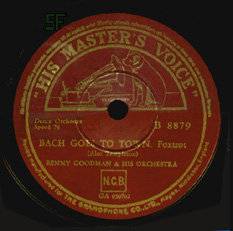
Benny
Goodman and His Orchestra play Bach Goes To Town.
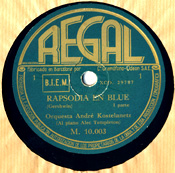
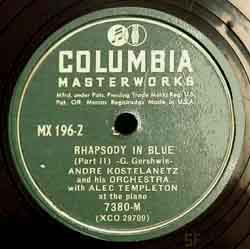
Alec Templeton is soloist in Gershwin's Rhapsody in Blue with
Andre Kostelanetz conducting.
|
|
|
Some
music lovers know Alec Templeton as the composer of "Bach
Goes To Town". And if their knowledge goes a bit further
they also may recall "Mozart Matriculates" and even
"Scarlatti Stoops to Conga", but they may not be
aware that he composed serious music also.
Templeton
was known as the radio and TV celebrity who, in the nineteen forties
and fifties, regularly appeared on shows hosted by Bing Crosby, and
who later had his own show called "It's Alec Templeton Time"
(June 3rd - August 8th, 1955).
The
more serious collector, while consulting a record catalog for references
of specific recordings, may have seen the entry under Gershwin of
blind Alec Templeton's recording of "Rhapsody in Blue"
with Andre Kostelanetz for Columbia first listed in the 1942 edition
of The Gramophone Shop Encyclopedia of Recorded Music. The recording
was issued on two 12" shellac discs (CX-196; C-DX1045/6)
and later dubbed to vinyl LP ML-4455 and was listed in Columbia's
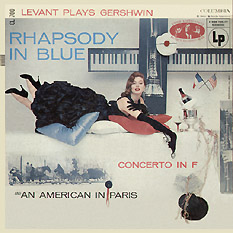
catalog next to the famous recording of Oscar Levant with the Philadelphia
Orchestra and conductor Eugene Ormandy.
 The
recording by George Gershwin himself with Paul Whiteman and his orchestra
on one Victor 12" disc (V-35822) and on Columbia in Great Britain
(C-1395), was the abridged version.
The
recording by George Gershwin himself with Paul Whiteman and his orchestra
on one Victor 12" disc (V-35822) and on Columbia in Great Britain
(C-1395), was the abridged version.
Although
Levant mastered both the "Rhapsody" and the "Concerto
in F" with insight and skill as hardly anybody else did, Templeton
- being a talented improviser also - had a good rhythmic feeling for
Gershwin's syncopated music, while his Rhapsody in Blue clearly shows
that his technical skill was somewhat limited.
|
|
|
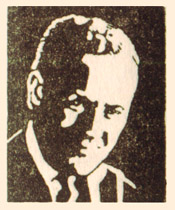
Alec
Templeton at the time of his NBC radio broadcasts for Alka Seltzer.
Postcard
image editied by R.A.B.
(From the SoundFountain Archive)
|
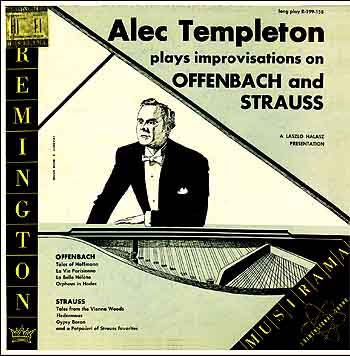
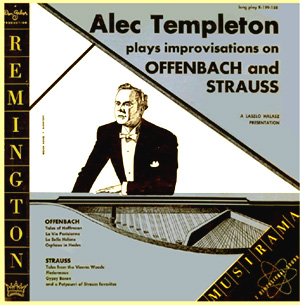
Templeton's
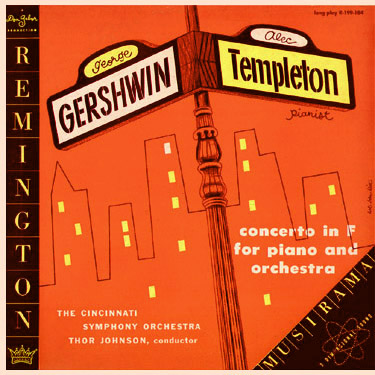
radio and TV fame was a good reason for Don Gabor to have a recording
made of the improviser which was released on Remington R-199-158
- Alec Templeton plays improvisations on Offenbach and Strauss.
Alec
Templeton was a popular artist and known by many Americans who had
heard the radio shows or were watching his TV appearances. There was
a market for one more important recording by legendary Alec Templeton
with orchestra. Despite the fact that he is not a virtuoso and does
not play the demanding - and at times highly complex piano style -
impeccably, Templeton's is an outstanding interpretation. The treatment
of the rhythmic sections are very original, his phrasing is beautiful,
and the accentuation is well chosen. The blues in the second movement
(Andante con moto) is soulful, foreboding the dramatic, expressive
lamentation at the end of the movement.
Warren
De Motte evaluated Templeton's playing and Johnson's conducting
in  The
Long Playing Record Guide where it was listed next to the
Leonard Pennario (Capitol) and Oscar Levant (Columbia) discs. About
Levant's performance Demotte wrote: "Levant has lived with this concerto
for many years, and he does it full justice, even if Kostelanetz is
a trifle overwhelmed by the splendors of the New York Philharmonic."
The
Long Playing Record Guide where it was listed next to the
Leonard Pennario (Capitol) and Oscar Levant (Columbia) discs. About
Levant's performance Demotte wrote: "Levant has lived with this concerto
for many years, and he does it full justice, even if Kostelanetz is
a trifle overwhelmed by the splendors of the New York Philharmonic."
In many instances in the score Oscar Levant may well be the better
pianist, also because he had known Gershwin personally and may have
discussed the work with George and certainly knew out of first hand
what Gershwin was expressing and how it should be played. Though the
Levant Kostelanetz performance has its own greatness, it seems that
Johnson lifts the score to a more serious level and puts it in the
category of classical piano concertos.
Many
were convinced that Templeton and Johnson turned Gershwin's composition
into a piano concerto, exempt of the sentimentality brought
in by some performers who want to show us that they have feeling for
jazz but at the same time want to remind us too much of the showbizz
aspect of most - but not all - of Gershwin's music. Those performances
may be witty, yet most of the time they are false.
In
the Remington recording there is the fact of Alec Templeton's blindness.
You have to be a very good pianist to play this concerto. But you
also have to be a very good conductor to cooperate and make it all
happen. One could easily say that the synergy between Templeton and
Johnson is perfect. If Templeton was more following Johnson, or Templeton
indicated at certain instances to Johnson what to do (he may have
lifted a hand, or just may have nodded his head), there is an understanding
that pulsates in the right direction, in every movement.
It
is sure that after one has grown accustomed to a specific recording
and has played it many times, it is not easy to let it be replaced
by another, possibly better rendering of the same work. But even after
listening to many, many recordings, it is difficult to deny the qualities
of the first recording one got to know. Thor Johnson and Alec Templeton
never will fail to let the listener enjoy the music. That is certainly
what Warren De Motte meant when he evaluated the Remington recording
in The Long Playing Record Guide in a single phrase: "Templeton-Johnson
enjoy their musical romp and are well recorded."
Dutch
critic Ralph N. Degens mentioned Templeton's somewhat restricted
technique, but praised the outstanding musicality of Templeton and
he wrote: "...his interpretation as well as the orchestral part are
very compelling." He also referred to Robert Blake's successful sound
recording: "The sound transmitted by this record has a flabbergasting
clarity and naturalness; especially the sound of the piano is a surprise."
That review was written in 1955.
As
with the recording of the Prokofiev concerto played by Jorge Bolet
and the same orchestra, here too the grand piano was most certainly
a Baldwin.
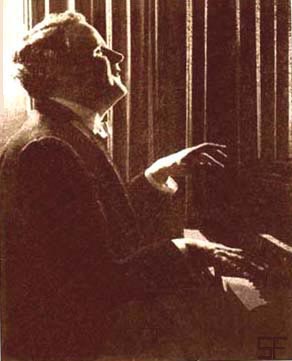
Alec
Templeton around 1953.
(Picture taken from R-199-158. Edited by R.A.B.)
Alec
Andrew Templeton was
born on July 4th, 1909 in Cardiff (Wales, UK). Dutch "Encyclopedie
van de Muziek" published by Elsevier in 1959, mentions 1910 as
his year of birth.
Alec Templeton was blessed with absolute pitch. At the age of four,
he composed his first piano composition and earned his first money
when playing at a children's concert. He began his musical studies
at an early age in his hometown and as a teenager auditioned for the
British Broadcasting Corporation (BBC) and played for them
until 1935. Meanwhile he studied at the Royal Academy of Music
and the Royal College of Music, both in London. He held
degrees for both institutions.
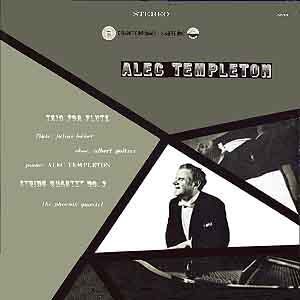
At
eighteen he composed "Trio for flute, oboe and piano"
for which he was complimented by composer Ralph Vaughan Williams.
On Counterpoint/Esoteric 5533 Alec Templeton plays his "Trio"
together with Julius Baker (flute) and Albert Goltzer (oboe) and on
side two The Phoenix Quartet plays Templeton's "Quartet Pastorale"
which is his Quartet No. 2. The Trio was recorded by Robert E. Blake
Jr., Don Gabor's recording engineer.
One
trait of Templeton was his English humor. That is why his compositions
have such witty names as "You and I On Our Lanai", a Hawaiian
song, or - on the more serious side - one can but smile at the title
"Pocketsize Sonata" for clarinet and piano. (He wrote a No.
1 and a No. 2).
Templeton's compositions are available as sheet music and can be found
on the web, and are also appreciated by music students who are constantly
searching for uncommon repertory.

|
|
|
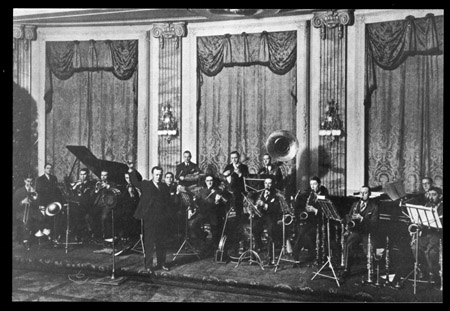
Jack
Hylton and His Orchestra. He took his vocalists and arrangers
to the United States, formed an American Orchestra and played
at the Drake Hotel, Chicago and also for Commercial Radio.
Image from
the cover of Joy Records D 267/Decca Eclipse ECM 2046.
|
Jack
Hylton,
British bandleader, who with his jazz orchestra had played in the
Paris Opera, brought Alec Templeton to the United States when Hylton
was to broadcast a series of radio programs for the Standard Oil
Company. The liner notes of Remington R-199-158 state that
"Templeton soon established himself as an incomparable and sincere
artist."
In addition to his imaginative creativity when 'modernizing' the classical
masters, Alec Templeton composed serious works for piano, for orchestra,
string quartet, and for voice. Templeton: "Good music need not be
ponderous to be good. It can be everything from Bach to jazz." His
style of composition is close to the idiom of British folk songs.
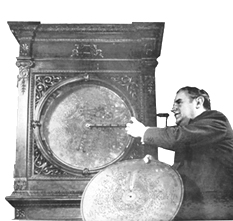
For many years
Alec Templeton and his wife Julie lived in Greenwich (Connecticut).
In the house was a large collection of musical boxes which made music
by means of perforated steel discs. Chimes were hanging from trees
in their garden and, when moved by the wind, made music. Even their
limousine had a license plate 'MUSIC'. Several records were issued
with the sound of Alec Templeton's mechanical music boxes and chimes.
Dr.
John Bertalot,
Cathedral Organist Emeritus (UK), told me about the role of Margaret
Humphrey and when she celebrated her jubilee as a music teacher in
1949, Alec traveled to South Wales (Great Britain) to give a recital
in her honor. Alec Templeton also invited her to spend a holiday in
America as a thank you. Because of personal circumstances, Margaret
Humphrey was unable to make the visit, but of course she appreciated
the generous invitation very much.
It
was in Connecticut where Alec Templeton died, only 52 years of age,
on March 28th, 1963.
Rudolf A. Bruil, page first published fall 2001
This article - as all of my articles - is
copyrighted.
Please do not reproduce this article in whole or part, in any form,
without obtaining my written permission.