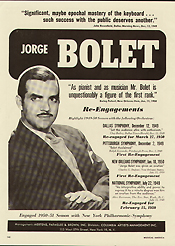
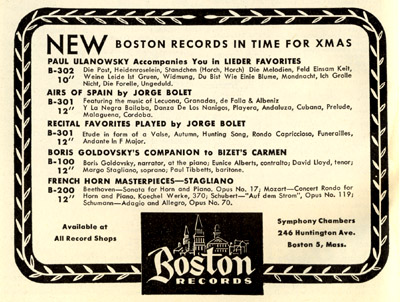
Jorge Bolet's booking ad from 1950 mentioning his engagements with the
orchestras of Dallas, Pittsburgh and New Orleans, and with the New York
Philharmonic and the National Symphony.
(From the SoundFountain Archive)
Gabor
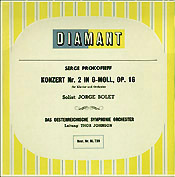
issued Remington recordings in Germany on the Diamant label. Curiously
enough record and label of release No. 739 with Prokofiev's Piano
Concerto with Jorge Bolet mentions the Austrian Symphony Orchestra
instead of the Cincinnati Symphony.
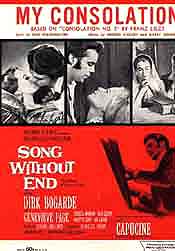
Jorge Bolet at the
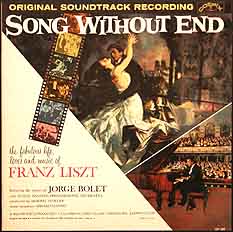
time of the recording of the soundtrack for 'Song without End'
Everest SDBR 3064
with Liszt's Sonata
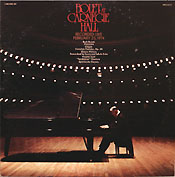
Jorge
Bolet at Carnegie Hall, recorded live February 25, 1974 (RCA ARL2-0512)
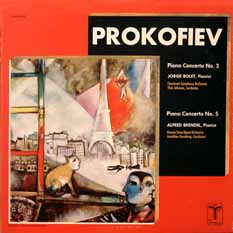
Turnabout
TV-S34543 with the transfer of the 1953 Remington tape that contained
Concerto No. 2.
Jorge
Bolet was not so much the pianist to play a Bach Partita, a refined
Mozart Adagio or a dramatic Beethoven Sonata. He may have played Bach
in an adaptation by Busoni, and he may have exemplified Beethoven
and Mozart when he was teaching - Bolet was a much-loved teacher.
But if he played these great composers, then most likely in his own
private atmosphere for friends and rarely in a concert hall.
Indeed,
rare were his Beethoven performances. He had performed Beethoven's
Concerto No. 4, Op. 58, with Thor Johnson on May 4th, 1954. )¹
Later in his career he played ‘Les Adieux’ at the Edinburgh
Festival, the 'Moonlight Sonata' at the Barbican Hall in London; and
there was a ‘Moonlight Sonata', in which he achieved a marvelous
simplicity and limpid sound in the first movement, but he kept the
last movement curiously small in scale, though wonderfully fleet.
However there was an unfortunate performance of the ‘Appassionata’,
a recording made on the continent and relayed by the BBC.
Yet Bolet gave a wonderful performance of Op. 110. )²
Above
all, Jorge Bolet was the man of the complexity of Liszt, Chopin,
Godowsky and Rachmaninoff - however diverse the styles in which
these composers may have written for the mighty concert grand
- and of Prokofiev, as he did materialize on Remington
R-199-182 playing the Second Piano Concerto in G minor,
Op. 16, with the Cincinnati Symphony under Thor Johnson.
This performance - recorded in the fall of 1953 - was immediately
noted and qualified as remarkable when the recording was released
in December 1954 - and it still is today.
Bolet's concept of Prokofiev is broad and moving. He has
a great feeling for the varying moods ranging from the subtleness
in phrasing to the distressing virtuosity, from the bombastic
allure to the sensitive melody and to the diabolic passages. His
empathy is great. His is a Prokofiev in optima forma, despite
the fact that there is a cut in the cadenza. The cooperation of
Thor Johnson is exemplary. Consequently many came to liken the
Second Concerto Op. 16 even more than the over popular Third.
(The Second had actually been revised by Prokofiev in the period
when he wrote his most famous Third Piano Concerto Op. 26.)
The recording made in Cincinnati's Music Hall was supervised by
Laszlo Halasz and the engineer was Robert E. Blake,
who experimented recording in stereo and like the other recordings
with Thor Johnson, this concerto must have been taped in stereo
as well, though the tapes were lost or could not be used because
they were deteriorated. The liner notes for this release were
written by Irving Kolodin.
(Bolet's later recording with the Nürnberg Symphony Orchestra
and conductor Ainslee Cox for the Colosseum label did not meet
the same balance and intensity.) - R.A.B.
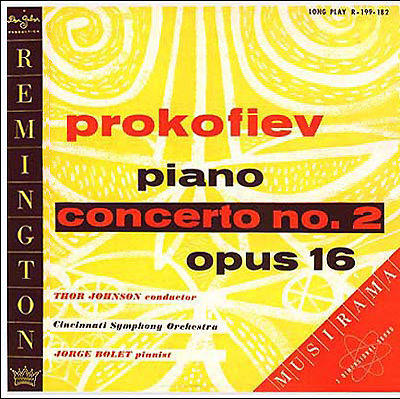
The
cover of Remington R-199-182: Jorge Bolet, piano, playing Sergei
Prokofiev's 2nd Concerto with the Cincinnati Symphony conducted
by Thor Johnson. The recording was made in November 1953, and
released one year later in the fall of 1954.
Click
here
for a Sound Clip from the 4th movement.
Jorge
Bolet (born
in Havana, Cuba, on November 15, 1914) had studied under Josef
Hofmann and Leopold Godowsky when he attended the Curtis
Institute in Philadelphia from 1927 till 1935. He had appeared
as a soloist with the Curtis Symphony Orchestra under Fritz Reiner
in Carnegie Hall, and had toured in Europe with success. However for
long he did not have the chance to really break through. One reason
for his late start was World War II. His biography states that he
was sent to the USA by the Cuban government as an assistant military
attaché at the Cuban Embassy in Washington, but in 1942 he
resigned and enlisted in the US Army which took him all the
way to Japan where he entertained the troops. (He led a performance
of Gilbert & Sullivan's 'The Mikado'!)
After World War Two Jorge Bolet concertized again. His booking ads
tell that he appeared with the important orchestras in the United
States and also in Europe, and that he received much recognition.
He did not yet make a name as a recording artist, not in the late
nineteen forties that is. His name cannot be found in the 'Gramophone
Shop Encyclopedia of Recorded Music' from 1948. And Irving Kolodin
does not mention Bolet in his "The New Guide To Recorded Music",
published in 1950.
Bolet's
first recordings were not on 78 RPM shellac records, but on LP, and
for the Boston label which introduced its first releases in
December of 1952. The company was based in Boston. The label existed
until 1966.
Boston
B 300 has the title "Airs of
Spain" and entails compositions by Isaac Albeniz (Prelude, Malagueña,
Cordoba); Manuel de Falla (Andaluza, Cubana); Ernesto Lecuona (Y La
Negra Bailaba, Danza De Los Nanigos); and Enrique Granados (Playera).
This release was announced in the Schwann Long Playing Record Catalog
of December 1952. In an advertisement this release was by mistake
also listed as B 301.
On
Boston B 301 Bolet plays "Favorites": by Camille
Saint-Saens (Etude in the Form of a Waltz / en forme de Valse), Moritz
Moszkowski (Autumn), Felix Mendelssohn-Bartholdy (Hunting Song, Rondo
Capriccioso), Franz Liszt (Funérailles), and Ludwig van Beethoven
(Andante). Disk first listed in Schwann edition of January, 1953.
These recordings of the thirty nine year old artist and the many appearances
in concert halls may well have been noticed by Don Gabor and Laszlo
Halasz and in the summer of 1953 it was officially announced that
Jorge Bolet was added to Remington's artist roster.
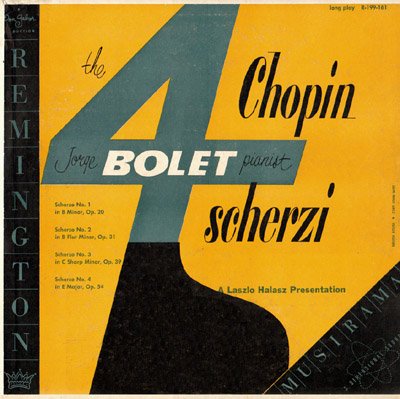
Remington
R-199-161 with The Four Scherzi - A Laszlo Halasz Production. Cover
by Curt John Witt Design House.
Bolet's
Remington debut was on R-199-161 with the performances
of the Four (4) Scherzi (Scherzos) of Chopin - No. 1 in B minor,
Op. 20, No. 2 in B Flat minor, Op. 31, No. 3 in C Sharp minor, Op.
39, and No. 4 in E major, Op. 54. Bolet's was a Chopin with a very
personal, yet captivating virtuoso-approach, showing energy and strong
dynamics. He plays with youthful drive. The sound recording was probably
also made in Cincinnati and if not most likely in the Mastertone
Recording Studio in New York. The best way to play back this record
and other Remington dics is to use the variable treble and bass on
the amplifier as was done in those days. Here a little bass boost
helps to fully enjoy Bolet's performance.
The recording of the Four Scherzos was supervised by Laszlo
Halasz as the cover clearly indicates 'A Laszlo Halasz Presentation'.
It is not known who the recording engineer was, probably Robert Blake.
This disc was already available in the spring of 1955 as it is mentioned
in an advertisement in Dutch monthly '...Luister'. Oddly enough Schwann
mentions the recording for the first time in the summer of 1956. It
must have been an administrative mistake that R-199-161 was not listed
one year earlier and thus record collectors would resort to the only
available recording by Arthur Rubinstein.
Jorge
Bolet at the piano.
(Picture
taken from Everest LP SDBR 3062.)
The
two Remington recordings put Bolet's artistry on the map of
the connoisseur, but seven years later his performances for the soundtrack
of the biopic about the life of Franz Liszt, 'Song Without End',
brought him much wider recognition and resulted in several recordings
for the Everest label, followed later with a few recordings
for RCA Victor.
Yet
Bolet's great fame came in the late nineteen-seventies when he was
contracted by English Decca (London, USA). This resulted in
the series of recordings of works by Liszt, of several concertos (Chopin,
Rachmaninoff, Schumann and Grieg), and of solo pieces by Brahms, Debussy
and Reger.
Very enlightening was his in-depth master class of Rachmaninoff's
3rd Concerto for BBC-television entitled 'Bolet Meets Rachmaninoff'
(1983), at the time when he recorded Rachmaninoff's Op. 30 for Decca
with Ivan Fischer (SXDL 7609).
The
liner notes on Remington R-199-182 with the Prokofiev Concerto read:
Jorge
Bolet was born in Havana, Cuba. He received his early training
at the Curtis Institute in Philadelphia. Returning to the USA
after his European tour he won the coveted Naumburg and Joseph
Hofmann Awards.
Following his debut with the New York Symphony under Mitropoulos,
which the press hailed as "the most outstanding concerto reading
of the season", he made equally successful appearances with
the Philadelphia Orchestra and the Boston Symphony at Tanglewood.
He has since toured extensively in North America and Central
and South Americas.
On the West Coast, the noted critic of the San Francisco Chronicle,
Albert Frankenstein, summed up the 1952-53 season with, "Of
all the soloists who appeared here during this season the ones
we most would like to have return are Serkin and Bolet." - and
Gerald Ashford of the San Antonio Express writes, "There are
but few great pianists living today, and Bolet is sure one of
them." The Baldwin Piano Company has awarded Jorge Bolet a special
concert grand that travels in a custom build trailer to all
his engagements.
The
concert grand piano that accompanied Jorge Bolet his entire life was
a Baldwin SD-10.l
The handsome custombuilt trailer carries Bolet's BALDWIN grand
over the nation's highways as the pianist fulfills transcontinental
dates.
Regrettably
Jorge Bolet only made two recordings for the Remington-catalogue.
There certainly would have been room for transcriptions by Liszt or
a concerto if there had not been the historic performances of Liszt
by Simon Barere and the recordings by Edward Kilenyi already available
on Remington.
The
recording of Prokofiev's Piano Concerto No. 2 in G minor, Op. 16,
with the Cincinnati Symphony and conductor Thor Johnson
was re-released in 1974 on Turnabout TV-S34543 in electronic
stereo (coupled with Prokofiev's 5th Concerto played by Alfred Brendel
and the Vienna State Opera Orchestra conducted by Jonathan Sternberg).
The engineers did a fine job, but of course the recording lacks the
impetus of the original. The original monaural tapes were licensed
from Tapeworld Inc. which was the company of Don Gabor's who then
released recordings on cassette tapes.
Jorge
Bolet was born on November 15th, 1914, in Havana, Cuba. He died
October 16th, 1990, in Mountain View, California, USA.
In 1998 his performances of Liszt's "Liebesträume"
were heard in the soundtrack of the movie "A la place du coeur"
(1998).
)¹
"Thor Johnson - American Conductor" written by Louis Nicholas
and published in 1982 by The Music Festival Committee of the Peninsula
Arts Association, Ephraim, Wisconsin.