|

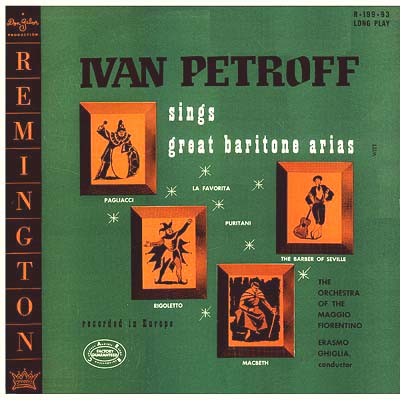
Ivan
Petroff sings great baritone arias: Pagliacci, La Favorita,
I Puritani, Rigoletto,
The Barber of Seville, Macbeth.

Excerpts
from the complete Rigoletto recording.

 Click
here for more opera on Remington. Click
here for more opera on Remington.
|
It
was originally intended that Ivan Petroff should become a lawyer and
initially he carried out his father's wish. Petroff studied law in
Vienna. At one time however, he persuaded his parents to allow him
to travel to Naples under the pretext of taking a 3-month course in
Italian law. While there he met with the great Neapolitan tenor Fernando
de Lucia (October 11, 1860 - February 23, 1925). That encounter marked
the beginning of his carreer.
Fernando de Lucia had sung in the premiere of Mascagni's Amico Fritz
(1891) and Iris (1898), and he had been the first Canio in I Pagliacci
(Leoncavallo) in London. He was a man of the belcanto. His most famous
pupils were Gianna Pederzini and Enzo de Muro. But as he was most
impressed with the baritone voice of 19 year old Petroff and with
his eagerness to study, he gave him lessons too.
This
short period of study was certainly most significant for Petroff's
development. When it was time for him to return to Vienna, Petroff
first traveled to his homeland Bulgaria and interrupted his journey
and gave a recital in Sofia. His parents were so astounded with his
success and obvious talent, that they agreed to allow him to return
to Naples to continue his musical studies.
|
|
|
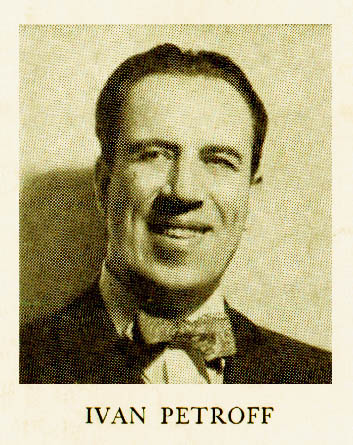
Ivan
Petroff (sometimes spelled Petrov).
Picture taken from the cover of Remington
R-199-93 and edited.
|
In
1928 Petroff made a successful debut in Bologna, Italy, in the opera
The Barber of Seville. Basso profundo Feodor Chaliapin
(February 13, 1873 - April 4, 1938), heard this performance and engaged
him as principal baritone in his opera company for a number of years.
For Ivan Petroff this was a most valuable experience as during
this period he sang and acted in over 50 roles.
 After
the death of Chaliapin in 1938, Petroff sought refuge in the United
States and eventually became an American citizen. For 5 years he toured
with the San Francisco Opera Company and toured in the United States,
Canada and South America. From 1943 till 1946 he sang at the San Francisco
Opera House and from 1946 on he was engaged by Laszlo Halasz to
join the New York City Centre Opera Company, hence the link with Don
Gabor and Remington. After his appearances at the Maggio Musicale
of Florence he returned to the US and was until his death a member
of the Pacific Opera Company, again in San Francisco. After
the death of Chaliapin in 1938, Petroff sought refuge in the United
States and eventually became an American citizen. For 5 years he toured
with the San Francisco Opera Company and toured in the United States,
Canada and South America. From 1943 till 1946 he sang at the San Francisco
Opera House and from 1946 on he was engaged by Laszlo Halasz to
join the New York City Centre Opera Company, hence the link with Don
Gabor and Remington. After his appearances at the Maggio Musicale
of Florence he returned to the US and was until his death a member
of the Pacific Opera Company, again in San Francisco.
Ivan
Petroff on Remington:
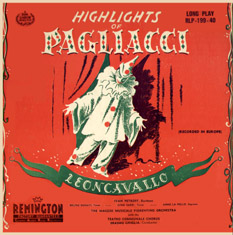
R-199-40:
Il Pagliacci (Leoncavallo) - Vocal Highlights with Anne La Pollo,
Ivan Petroff, Gino Sarri, Bruno Donati, Orchestra of the Maggio Musiale
Fiorentino, the chorus of Teatro Communale, conducted by Erasmo Giglia.
This recording was later issued on the Masque label (M 10013).

Remington
RLP-199-58/60:
Rigoletto with Orlandina Orlandini, Ivan Petroff, Gino Sarri and Mario
Frosini, and conductor Erasmo Ghiglia.
RLP-199-58/60:
Rigoletto (Verdi)
with Orlandina Orlandini, Ivan Petroff, Gino Sarri and Mario Frosini
and conductor Erasmo Ghiglia. Released in 1952.
Warren De Motte says in his
Long
Playing Record Guide: "Remington's forces know their way
around this score. They perform without distinction, albeit with competence
and the recording is fair."
There
is mention that Don Gabor travelled to Italy at several occasions.
At one of those early visits he may have negotiated the release of
the performances of Petroff and others on the Remington label. The
Rigoletto recording was made when Petroff made many guest appearances
at the Maggio Musicale Fiorentino. He sang there with other famous
opera singers like Astrid Varnay in the role of Macbeth.

Preiser
records has transferred this performance to Compact Disc. The reviewer
states that the sound is far beyond an acceptable level. The reason
is that the transfer of the original tape to the matrices for the
Remington discs was not too successful. Don Gabor often made a copy
of the original tapes, using a less sophisticated tape recorder, and
the tape with the dubbed recording was the source for cutting the
lacquer as
Tom Null told me. So one could
agree if the Preiser CD was done from those tapes. But Preiser states
that the recording was transferred to CD using the original
tapes. Original can mean either tape of course.
Remington
discs do have less harshness if played back using a moving magnet
cartridge with a spherical diamond tip instead of an elliptical. For
private use it may even be better to use a ceramic or crystal mono
pick up cartridge as they were generally used in the nineteen fifties.
When transferring old tapes to CD, be it of a piano, a violin, an
orchestra or a complete opera cast, many technicians are too eager
to completely clean up the signal, and often to such an extend that
there is not much naturalness left. They are afraid that hiss and
other noise may keep the collector from buying the discs. The signal
may be clean, but the music may have lost much of its warmth and harmony
and the performance loses much of its original charm and emotion.
Laura
Homonnay-Demilio writes about Ivan Petroff's Highlights of
Pagliacci (R-199-40, released 1951) and about Excerpts from the complete
recording of Rigoletto (R-199-103, released 1953). She dedicates this
review to her father who certainly loved classical and operatic music
and recognized Remington records as a popular budget brand in his
youth, and as an inexpensive way to amass a record collection and
find some real treasures.
Once
more the allure of an earthy performance compensates for the
frankly terrible recording quality of Remington’s offering
of Pagliacci highlights, heralding from that very early 1950’s
market of cheap Long-Play record labels. The ambience is, as
usual, tinny and with too much treble, and only the use of the
amplifier's tone controls will somewhat help the (alarmingly
so, for its reputation) thin and scrappy-sounding Maggio Musicale
Fiorentino orchestra somewhat perfunctorily led by Erasmo Ghiglia.
But here we have a featured baritone in Ivan Petroff, gamely
taking on and succeeding in portraying two characters within
the same opera, which was one of the perks of the recording
industry; not least for the money it saved, although almost
always this device was applied to very minor, bit-part roles
and never leads. Petroff, however, portrays the bitterly scheming
hunchback Tonio, and Nedda’s clandestine lover from the
village, Silvio.
The Prologo is tuneful and characterful, with a fast vibrato,
and none of the lachrymose affectations many Tonios assume in
their starring solo opening the opera. Reflective at the right
moments, Petroff nevertheless “gets on with it” and
announces the command to ring up the curtain without the stagey
bray some Tonios feel compelled to call for.
Selections
on any Pagliacci recording are considerably less truncated than
other “highlights” albums because it is a short opera,
but still there has to be some abbreviation to accommodate one
budget-quality LP disc. Gino Sarri’s Canio seems a little
thin for a tenor on his Un tal Gioco, yet he is adept and musical,
with good high notes, only a little noticeably below the stave
in his later Vesti la Giubba, and unfortunately giving way to
the campy sobbing of Canios the world over.
Anne Lo Pollo’s Nedda is interesting – she sounds
like Carla Gavazzi, a star soprano of Italy’s Cetra records,
but without the shimmering vibrato, and admittedly there is
little bottom to her voice, as well as obvious strain during
her Bird Song. She comports herself with satisfactory drama
when it comes to the love duet with Petroff, and now, instead
of the frustrated, thwarted clown he is the ardent lover. Somehow
the Maggio Musicale Fiorentino Orchestra wakes up and remembers
they are an outfit with some merit, and not a fistful of exhausted
post war musicians holding forth on cheap shellac and vinyl.
Through the raspy, muddy blur of low-quality manufacture and
acidic indifference of instruments suddenly comes music to match
the drenched heat -- more romantic than libidinous - -of adulterers
on a summer afternoon, and Petroff’s voice is quite beautiful
here.
Bruno Donati portrays a youthful, strong Beppe – I so like
his voice, with its prominent Florentine pronounciation, that
I wish he’d been cast as the Canio, but he’s certainly
affective and one can picture this Beppe as a strapping post-teen
who would have been just as useful a stage hand as he is the
comedic performer in the play.
Fortunately for listeners, the action doesn’t crumble into
a mélange of they’ve-just-been-stabbed screams when
Canio confronts the cheaters. The opera ends on a blast of cheap-LP
shrillness but the point has come across.
In
Rigoletto, Petroff leads as the gruff hunchback. Although this
recording in its complete form has been complimented as being
a very serviceable “despite” – despite harsh
recording sound, a couple of less-than-starring principals,
and sometimes live-performance-level acoustics, it can be rated
up there as acquitting itself passably with big-name labels.
However, Petroff seems to give a slightly more heartfelt and
warmer manner of singing in the mixed-bag notoriety of Remington’s
editions of Cavalleria Rusticana and Tosca. His Cortigiani tends
to heavy breathing in some spots and he even labors a bit in
his “Piangii” duet with Gilda – perhaps running
out of a little steam?
Gino Sarri is more refulgent in this recording as the Duke of
Mantua – some now-expected strain, but no hamminess. Orlandina
Orlandini (WHAT a name!) is an adequate if somewhat vinegary
Gilda, sometimes quavering off the staff and not quite tuneful.
I very much like the basso. Perhaps when I obtain a copy of
the complete recording , and with less surface scratch and the
distracting clicks and crackles of a much-played, inexpensive
early-50’s LP, I can more thoroughly review this recording.
- Laura Homonnay-Demilio, February 2011.
(Laura Homonnay-Demilio is a member of the Advisory Committee
of the
Jussi
Björling Society USA)
|
R-199-74/2
(2
LP) Cavalleria Rusticana (Mascagni) with Vassilka Petrova, Eddy Ruhl,
Ivan Petroff, Rina Benucci, Lidia Malani. Orchestra of the Maggio
Fiorentino and Chorus of the Teatro Communale and conductor Erasmo
Ghiglia. Released in May 1952.
R-199-93:
Ivan Petroff sings great baritone arias. The orchestra of the
Maggio Fiorentino is conducted by Erasmo Ghiglia. These performances
were previously released on Continental 107 and is listed as such
in Schwann Long Playing Record Catalog, September 1950 edition.
R-199-103:
Excerpts from the complete Rigoletto recording. Released in 1953.
Preiser
20017 CD contains the Rigoletto recording and the recording of the
arias.
Ivan
Petroff performed with Maria Callas, Kurt Baum and Giulietta
Simionato in 'Il Trovatore' in Mexico in 1950. And there is a
recording of him in 'Macbeth' with
Astrid Varnay and conductor Vittorio
Gui taped in 1951.
|
|
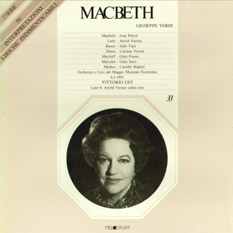
At
left is the front of the Melodram 3 LP set with the performance
of Macbeth from 1951 with Vittorio Gui conducting the Orchestra
and Chorus of the Maggio Musicale Fiorentino with Ivan Petroff
(Macbeth), Astrid Varnay (Lady Macbeth), Italo Tajo (Banco), Gino
Penno (Macduff), Gino Sarri (Malcolm), Luciana Veroni (Dama),
Camello Righini (Medico). Melodram 335.
|
Ivan
Petrov, was born in 1899 in Tarnovo, Bulgaria. He died in Los Angeles,
19 September, 1963.
Rudolf
A Bruil - February 2002
 Baritone Ivan Petroff should not be confounded with the Russian basso
Ivan Petrov who was born in 1920 in Irkutsk (Siberia) and is known
for his outstanding performance of Boris Godunov.
Baritone Ivan Petroff should not be confounded with the Russian basso
Ivan Petrov who was born in 1920 in Irkutsk (Siberia) and is known
for his outstanding performance of Boris Godunov.
|