|


Label
and Album of Wagner's Lohengrin on Polydor PD-27395/8 conducted by Hermann
Weigert.
Images
courtesy Schellacksammlung
- Walter Schwanzer,
Austria.


|
When
looking at a specific listing in an old long playing gramophone record
catalog, in hindsight, one often tends to think that a recording was
made accidentally, or incidentally if you wish, as if there were no
significant events leading up to the release, as if there was no context.
In
the case of the two early Remington recordings of Astrid Varnay there
is the important fact that this soprano had captured the attention
of the audience in the New York MET as well as the listeners to the
radio broadcast of that performance of Wagner's Die Walküre in
which she sang Sieglinde, replacing an indisposed Lotte Lehmann.
That Saterday, December 6, 1941, kept resounding. Since that afternoon
Astrid Varnay was going to establish herself at the Metropolitan Opera
as one of the great Wagner singers and was going to conquer New York,
and not just New York.
Don
Gabor may have been aware of the impact she made. Or maybe not because
of the Japanese attack on Pearl Harbor the following Sunday
morning which overshadowed Varnay's performance and eventually made
Donald Gabor enlist in the Navy on June 8, 1943. The year before
he joined the Navy Don Gabor
founded Continental Records Inc.
When
ten years after that memorable MET debut, Astrid Varnay was performing
in Bayreuth and was singing in Vienna as well, it was then that Gabor
asked producer Marcel Prawy to send tapes of the soprano to New York
to be issued on Gabor's newly founded Remington label.
|
|
|
The
Remington discs with operatic arias were released in the early
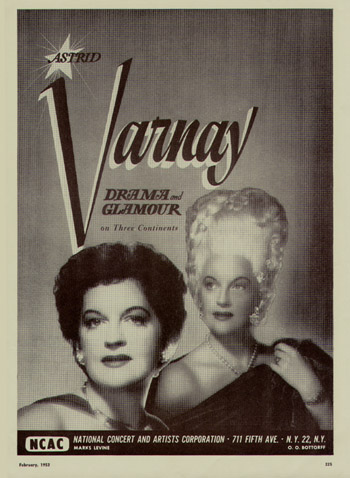
nineteen fifties. This is a booking ad of Astrid Varnay from
the National Concert and Artists Corporation in New York from
1953.
(From the SoundFountain Archive)
|
Marcel
Prawy, who in 1941 was a New York resident,
also must have heard Astrid Varnay sing prior to his leaving for Europe
as an instruction officer in the US Army. Later he witnessed her singing
in Vienna in the early nineteen fifties and he could have attended
the Bayreuth Festival in 1951 when it had reopened on July 19, and
was trying to shed the tainted reputation it had accumulated during
Hitler's Thousand Year Emporium. (The Third Reich lasted only twelve
years, from 1933 till 1945).
|
|
The
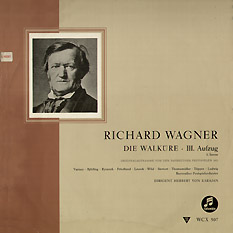
cover of one of the two records with Act III of Die Walküre
with Sigurd Björling, Astrid Varnay, Lyonie Rysanek, Brünnhild
Friedland, Eleanor Lausch, Elfriede Wild, Ruth Siewert, Liselotte
Thomamüller, Hertha Töpper, conducted by Herbert von
Karajan at the Bayreuther Festspiele, 1951 (on German Columbia
33 WCX 507).
|
The
entry in an old music encyclopedia says that "Astrid Varnay
was a Hungarian-Swedish-American soprano. She was born Ibolyka
Astrid Maria Varnay on April 25th, 1918, in Stockholm, and made her
debut in 1941 at the Metropolitan Opera in New York as Sieglinde in
Wagner's Die Walküre and from then on was immediately
considered as one of the most prominent young Wagner singers. She
performed in London, Vienna and Bayreuth."
In 1944 she married Hermann Weigert (1890-1955) who was her
senior by some twenty eight years. In 1934 he had left Nazi Germany
and went to live in South Africa but eventually found his niche in
New York as rehearsal director for the German language at the Metropolitan
Opera. In Germany he had been director of the Berlin State Opera and
had conducted a variety of operas in the early nineteen thirties.
He also had earned his laurels making recordings for Deutsche Grammophon's
Polydor label.
Recordings
of Hermann Weigert with the Berlin State Opera Orchestra:
Georges
Bizet: Entr'acte and Prélude Act 4 from 'Carmen'
- PD-27190/1.
Georges Bizet: 'Danse bohémienne' from La jolie
fille de Perth - PD-27191.
Georges Bizet: Carmen, abridged recording sung in German,
conducted by Hermann Weigert and singers E. Ruziszka, E. Marherr,
E. Stutz-Budde, L. Citana, H. Roswaenge, K. Amsterd, W. Domgraf-Fassbaender,
G. Witting, W. Hencke, E. Kandl. - PD-95337/41

That
same arrangement was used for the French version for Polydor
with singers and chorus of the Opéra-Comique and the
Orchestre des concerts Lamoureux conducted by Albert Wolff.
- PD-566033/7.
Charles
Gounod: 'Faust' (abridged version, sung in German) with
Hedwiga von Debicka, Helge Roswaenge and Heinrich Schlusnus
- PD-27377/81.
Engelbert Humperdinck: 'Hansel und Gretel' (sung in German,
arranged by Hermann Weigert and Hans Maeder) with - Else Ruzicka,
Tilly de Garmo, Marie Schultz-Dornburg, Thelma Votipka, John
Brownlee, Claramae Turner, Lillian Raymondi - PD-27891/4.
Albert Lortzing: 'Zar und Zimmermann' with Willy Domgraf-Fassbaender,
Waldemar Henke, Eduard Kandl, Tilly de Garmo, Felix Fleischer-Janczak,
Deszö-Ernster, Willy Frey, Ida von Scheele-Müller-
PD-27407/10.
Carl Millöcker: 'Der Bettelstudent' with Ida Perry,
Eduard Kandl, Julius Patzak, Else Ruzicka - PD-27411/4
Otto Nicolai: 'Die lustigen Weiber von Windsor' (The
Merry Wives of Windsor - arranged by Weigert) with Else Ruziczka,
Elfriede Maherr-Wagner, Eduard Kandl, Armin Weltner - PD-27399/102.
Giacomo Puccini: 'La bohème' (abridged recording,
sung in German) with Felicie Hünl-Mihacsek, Hedwig Jungkurth,
Helge Roswaenge, Armin Weltner, Edwin Heyer, Gerald Kasenow,
Waldemar Henke - PD-27357/61.
Giacomo Rossini: 'The Barber of Seville' (abridged recording
in German) with Armin Weltner, Sabine Meyen, Julius Patzak,
Martin Abendroth, Eduard Kandl, Ida von Scheele-Müller,
Karl Anders, Waldemar Henke, Carl Walter - PD-27353/6.

Guiseppe
Verdi:
'Il trovatore' (abridged recording sung in German) with Hella
Toros, Lotte Dörwald, Franz Völker, Armin Weltner,
Felix Fleisher-Janczak, Herta Klust, Waldemar Henke - PD-27403/6.
Richard Wagner: 'Lohengrin' with Otto Helgers, Fritz
Wolff, Beate Malkin, Rudolf Watzke, Henriette Gottlieb, Armin
Weltner - PD-27395/8.
Carl Maria von Weber: 'Der Freischütz' (arranged
by Hermann Weigert and Hans Maeder) with Armin Weltner, Deszö
Ernster, Elfriede Marherr, Tilly de Garmo, Eduard Kandl, Fritz
Soot - PD-27387/90 - Individual excerpts on PD-27153
Source:
The Gramophone Shop Encyclopedia of Recorded Music.
|
Before
returning to Europe and finally choosing Munich as her residence,
Astrid Varnay made guest appearances in Chicago, San Francisco, Los
Angeles, and in Buenos Aires.
Varnay's European debut was when she sang Brünhilde and
Isolde at Coventgarden, London, in 1948. In 1951 she
performed at the May Festival in Florence, Italy, as Lady Macbeth
with conductor Vittorio Gui.
In
that same year she was engaged by Wieland Wagner in Bayreuth
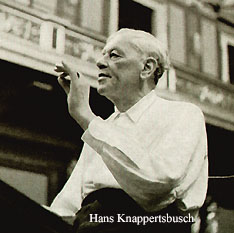
in productions conducted by the Three K's, Hans Knappertsbusch,
Joseph Keilberth and Herbert von Karajan. She remained on the
playbill for many years to come (not so Herbert von Karajan of whom
she did not appreciate the way he conducted during the performance
like "a high priest with eyes closed", she remarked).
Later that year she also appeared at the City Opera of Berlin (Städtische
Oper Berlin).
|
|
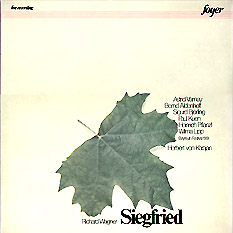
The
box with the live performance at the Bayreuth Festival 1951
of Siegfried with Astrid Varnay, Bernd Aldenhoff, Sigurd Björling,
Paul Kuen, Heinrich Pflanzl, Wilma Lipp, and Herbert von Karajan
conducting. Foyer PO 1004 from Italy.
|
It
was in Bayreuth in 1951 that John Culshaw put his first step
on the road to a complete Ring des Nibelungen when he heard
Astrid Varnay there during the rehearsals for the performance of Götterdämmerung
conducted by Hans Knappertsbusch. In 'Ring Resounding'
Culshaw writes that this recorded performance was not suitable for
release on LP because there were too many flaws and irregularities,
yet he mentions his admiration for Astrid Varnay's voice.

In
the edition of music magazine Etude of May, 1952, the
above images were published together with an article with the title
Hear Yourself As Others Hear You in which Astrid Varnay
gives advice to aspiring singers (as told to Annabel Comfort of Etude
Magazine). The caption of the pictures says: Astrid Varnay, the
first American to sing Bruenhilde in Götterdämmerung at
the Wagner Festival in Bayreuth last summer. Her performance was a
brilliant highlight of the festival.
|
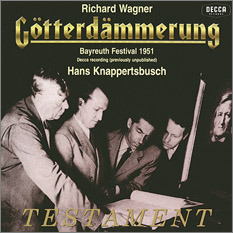
John Culshaw decided
that the recordings of the 1951 Bayreuth performances conducted
by Hans Knappertsbusch were not suitable for release at the time.
Testament issued for the first time
the Decca recording from 1951 of Götterdämmerung
(Wagner).
|
|
Hermann
Uhde (Baritone) - Astrid Varnay (Soprano) - Elisabeth Höngen
(Mezzo Soprano) - Hertha Topper (Voice) - Bernd Aldenhoff (Tenor)
- Ludwig Weber (Bass) - Heinrich Pflanzl (Voice)
Martha Mödl (Mezzo Soprano)
Ruth Siewert (Alto) - Ira Malaniuk (Mezzo Soprano) - Hanna Ludwig
(Soprano) - Elisabeth Schwarzkopf (Soprano), Hans Knappertsbusch
conducting.
|
|
|
|
|
|
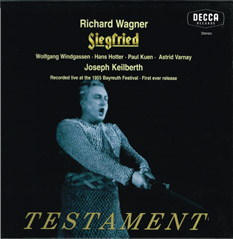
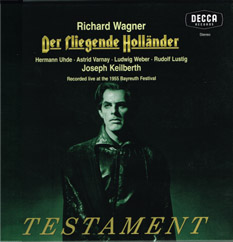
Testament also released the complete Ring des Niebelungen conducted
by Joseph Keilberth recorded in 1955.
|
Above
the editions of Siegfried and The Flying Dutchman.
|
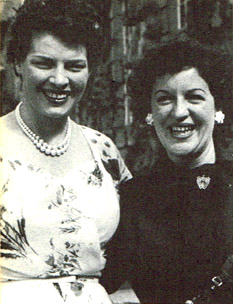
Astrid
Varnay with Gré Brouwenstijn in Bayreuth in 1954 when
they performed in Die Walküre with Hans Hotter, Ramon Vinay,
Josef Greindl, Georgine von Milinkovic, and conductor Joseph
Keilbert.
Photo
taken from 'Gré Brouwenstijn met en zonder make-up',
Teleboek, Bussum 1971.
|
|
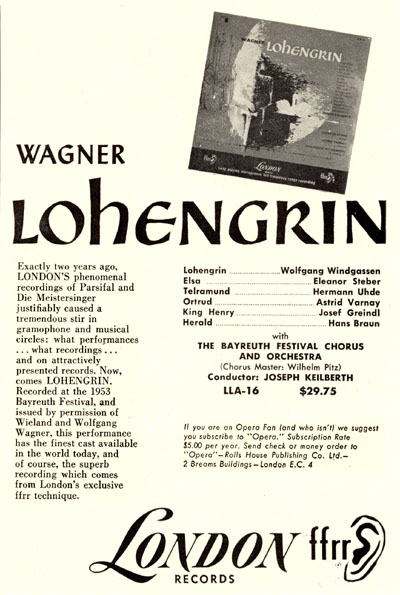
In
1953 Wagner's Lohengrin performed at Bayreuth was recorded
by Decca with Wolfgang Windgassen in the leading role. Elsa was performed
by Eleanor Steber; Hermann Uhde was Telramund; Astrid Varnay was cast
as Ortrud; King Henry was sung by Josef Greindl; Herald by Hans Braun.
A
complete Lohengrin with conductor Wilhelm Schüchter had
been released in 1953 on His Master's Voice ALP1095-98 (4 LP). The
Decca edition on 5 discs was conducted by Prof. Joseph Keilberth and
was released in February 1954 on LXT 2880-84 (London LLA-16). At the
same time a complete recording with conductor Rudolf Kempe was issued
on Nixa ULP 9225. Recording Lohengrin was apparently en vogue.
|
|
|
The
advertisement for the release of the
Lohengrin performance on the US London label
LLA-16 (High Fidelity Magazine).
|
When
John Culshaw made a detour to try his luck with Capitol Europe, the
Decca recording team (Peter Andry, engineers Kenneth Wilkinson and
Roy Wallace, and assistant Gordon Parry) went to Bayreuth to record
Wagner's Ring des Niebelungen with Astrid Varnay, Elisabeth Schartel,
Georgine von Milinkovic, Gré Brouwenstijn, Gustav Neidlinger,
Hermann Uhde , Josef Greindl, Jutta Vulpius, Maria Graf, Maria von
Ilosvay, Mina Bolotine, and Wolfgang Windgassen, conducted by Joseph
Keilberth.
Peter
Andry and his engineers were quite happy with the results they had
achieved. But John Culshaw returned to Decca in 1955 as senior producer
and subsequently Classical Artist & Repertoire (A&R) Manager.
Culshaw did not approve of the release on disc of these live recordings.
The many imperfections, he said, were also caused by the less than
favorable acoustics in the hall and the orchestra in the pit. Obviously
Culshaw had a completely different 'Ring' in mind and had already
plans for his own cycle. He was well aware of the fact that the release
of the "1955 Stereo Ring" would be quite expensive and would
jeopardize his own plans for an extensive project. An interesting
note is that in 1956 Decca (UK) had a Götterdämmerung in
their catalog with Flagstad and Norwegian singers, the Norwegian Radio
Orchestra and Chorus, conducted by Øivin Fjeldstad (LXT 5205-10).
When
in 1957 John Culshaw was going to record Das Rheingold with
Sir Georg Solti, the first opera in Decca's Der Ring des Nibelungen
which would eventually be regarded as the most famous Ring ever recorded,
he wanted Astrid Varnay to sing the role of Brünnhilde (or of
Ortrud and/or Kundry in other productions). But the people of Decca
thought that only Kirsten Flagstad's name was commercially
right and Culshaw's proposition was declined. Astrid Varnay was told
that she would not be hired for the production. After Flagstad's death
in 1962, Culshaw cautiously approached Astrid Varnay again
and asked her to take part in the recordings. But now it was Astrid
Varnay who declined.
This
not only shows Varnay's independence and her strong character, but
it also explains why there are not too many commercial recordings
of complete operas, studio recordings and recitals with the soprano
made by the leading record companies of the world. Taking part in
Decca's Stereo Ring could have been a prelude to even more Decca recordings.
Apparently
Astrid Varnay was a performing artist in the opera theatre, more so
than a studio recording artist, and by the mid nineteen sixties she
may have been aware that she was no longer at the height of her powers.
Living in the shadow of Kirsten Flagstad - who actually had been instrumental
in the start of her career and who had recommended her to be coached
by Hermann Weigert, the educator she had married - and also living
somewhat in the loom of Birgit Nilsson, had not been easy. Another
reason to decline could be that she than started recording for Deutsche
Grammophon. Much later, in the 1970s, recordings were issued on private
labels of live performances and an occasional recital.
The
Remington records were genuine recordings made in Vienna and were
apparently obtained by Marcel Prawy from the Austrian Broadcasting
Corporation (ORF). There were several releases and compilations on
the Remington and Diamant labels, issued at various dates.
|
|
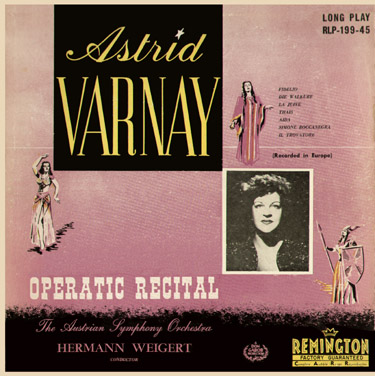
Soprano
Astrid Varnay's Operatic Recital on Remington RLP-199-45: Fidelio,
Die Walküre, La juive, Thais, Aida, Simon Boccanegra, Il
trovatore. The Austrian Symphony Orchestra is conducted by Hermann
Weigert.
|
The Remington
recordings of Astrid Varnay:
Remington
R-199-45 - Astrid Varnay Operatic Recital
(released December 1951).
"Abscheulicher Wo Eilst Du Hin" from "Fidelio"
(Beethoven)
"Der Männer Sippe" from "Die Walküre"
(Wagner)
"Il Va Venir" from "La Juive" "(Halévy)
"Ah! Je suis belle" from "Thais"(Massenet)
"Ritorno Vincitor" from "Aida" (Verdi)
Amelia Grinaldi's Aria from "Simon Boccanegra" (Verdi)
"D'Amor sull all rose e vanne" from "Il Trovatore"
(Verdi)
Austrian Symphony Orchestra / Hermann Weigert
Remington
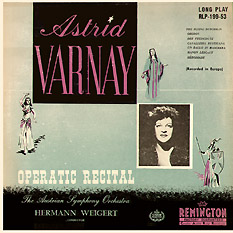
R-199-53 - Astrid Varnay Recital (released
in the Fall of 1952)
"Senta's Balad" from "The Flying Dutchman" (Der
fliegende Holländer) (Wagner)
"Ocean Aria" from "Oberon" (Weber)
"Agatha's Cavatina" from "Der Freischütz"
(Weber)
"Voi Lo Sapete" from "Cavaleria Rusticana (Mascagni)
"Ecco Lorido" from "Un Ballo in Maschera" (Verdi)
"In Quelle Trine Morbide" from "Manon Lescaut"
(Puccini)
"Il est doux" from "Herodiade" (Massenet)
Austrian Symphony Orchestra / Hermann Weigert
|
|
|
|
The
second Remington album was
RLP-199-53.
|
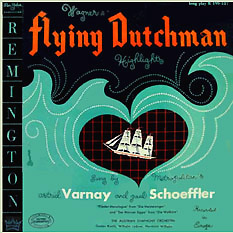
Astrid
Varnay and Paul Schoeffler sing Wagner Arias on Remington R-199-137.
Cover by Alex Steinweiss.
|
Remington
R-199-137 - Highlights sung by Metropolitan's Astrid Varnay and Paul
Schoeffler (released by
the end of 1954)
The Flying Dutchman
 Overture
- Austrian Symphony Orchestra, Gustav Koslik conducting Overture
- Austrian Symphony Orchestra, Gustav Koslik conducting
"Die Frist ist um" - Paul Schoeffler, baritone and the Austrian
Symphony Orchestra with Wilhelm Loibner conducting
"Ballade der Senta" - Astrid Varnay, soprano and the Austrian
Symphony Orchestra, Wilhelm Loibner, conductor.
Die
Meistersinger
"Was duftet doch der Flieder" - Paul Schoeffler, baritone
and the Austrian Symphony Orchestra, Hermann Weigert, conductor
Die
Walküre
"Der Männer Sippe" - Astrid Varnay, soprano, and the
Austrian Symphony Orchestra, Hermann Weigert conducting
This record is apparently a compilation of selections from R-199-45,
R-199-53 and earlier Masterseal recordings of Paul Schoeffler plus
unpublished material from the 1951 radio broadcasts. Some of the same
material can be found on the 2 compilations discs released by BASF,
reference 22 22645-3 on which she is accompanied by "Das
Niederöstereichische Tonkünstler-Orchester" conducted
by Herman Weigert.
R-199-137
was later also presented as a recording made according to the Musirama
microphone placement technique, but like a few other recordings (Gustav
Koslik's Polovetsian Dances and Night on Bold Mountain, and Zoltan
Fekete´s Bruckner 3rd) it was not.
Diamant
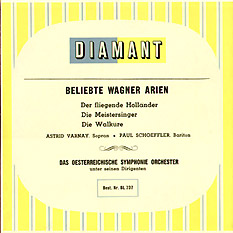
BL 737 - Beliebte Wagner Arien
This is the German release with the same material
from R-199-137 pressed from Remington plates.
|
|
Paul
Schoeffler and Astrid Varnay sing beloved Wagner Arias on Diamant
BL 737.
|
|
|
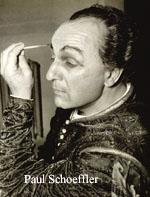
Paul
Schoeffler as Hans Sachs in the Knappertsbusch recording of Die
Meistersinger von Nürnberg by Richard Wagner in 1951.
|
|
|
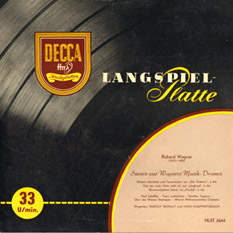
Scenes
from Wagner's Music Dramas are performed by Paul Schoeffler, Franz
Lechleitner, Günther Treptow, the Chorus of the Vienna State Opera,
and the Vienna Philharmonic Orchestra conducted by Rudolf Moralt
and Hans Knappertsbusch - Wotan's Farewell and Magic Fire (Die
Walküre) - That he is not my father (Siegfried) - Flower Maidens
Scene (Parsifal) - 1951 - German DECCA NLXT 2566, pressed from
the plates of British Decca, LXT 2566.
|
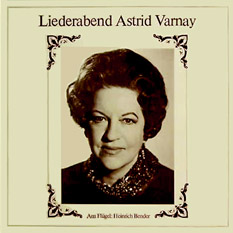
An
uncommon performance: "An Evening of Song". Astrid
Varnay sings Dors mon enfant, and Attente (Richard Wagner),
Deita Silvane (Ottorini Respighi), Gypsy Melodies/ Zigeunermelodien
(Antonin Dvorak) all accompanied by Heinrich Bender at the piano,
recorded in Munich in 1961. With Hermann Weigert conducting
the Niederöstereichische Tonkünster-Orchester: Ah
perfido (Ludwig van Beethoven) - recorded in Vienna 1951.
|
|
|
|
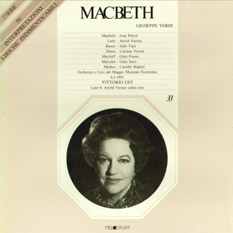
At
left is the front of the Melodram 3 LP set with the performance
of Macbeth in 1951 with Vittorio Gui conducting the Orchestra
and Chorus of the Maggio Musicale Fiorentino with Ivan Petroff
(Macbeth), Astrid Varnay (Lady Macbeth), Italo Tajo (Banco), Gino
Penno (Macduff), Gino Sarri (Malcolm), Luciana Veroni (Dama),
Camello Righini (Medico). Melodram 335.
|
|
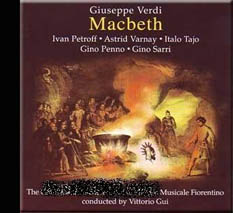
The
performance with Vittorio Gui at the May Festival in Florence
was issued on CD by Preiser Records.
|
|
|
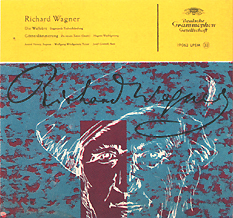
Astrid
Varnay and Wolfgang Windgassen sang Richard Wagner on Deutsche
Grammophon LEPM 19063. The Bavarian Radio Orchestra was conducted
by Hermann Weigert.
|
|
|
|
|
|
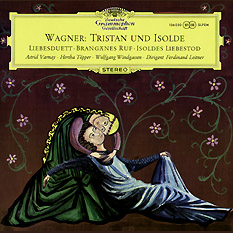
Astrid
Varnay (soprano), Hertha Töpper (alto), Wolfgang Windgassen
(tenor), and the Bamberger Symphoniker (Bamberg Symphony) wirh
Ferdinand Leitner conducting: Liebesduett and Liebestod on Deutsche
Grammophon SLPM 136030.
|
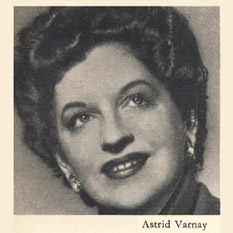
Astrid
Varnay at the time when she recorded for Deutsche Grammophon
Gesellschaft. Image taken from the 1958 DGG record catalogue.
|
In
1962 Astrid Varnay sang in Bayreuth under Wolfgang Sawallisch.
By
the end of the 1960s she did no longer sing the heavy and dramatic
roles and continued as a mezzo-soprano.
On
September 4, 2006, Astrid Varnay died in Munich.
Research and
Text by Rudolf A. Bruil. Page first published January 19th, 2010.
|