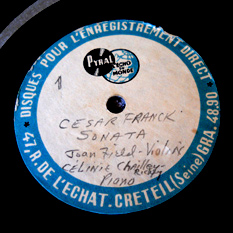
French
pianist Céliny Chailley-Richez accompanied violinist Georges Enesco
and played under his direction concertos of J.S. Bach. She also accompanied
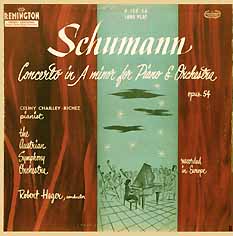
violinist Helen Airoff, and recorded Schumann's Piano Concerto in
A, Op. 54, in Vienna for Remington Records.
Céliny
Richez
- in some publications her first name is spelled Céline - was
born on May 15, 1884 in Lille, in the north of France. Her father,
Emile Richez, was a head teacher and her mother, Léonie Galle, was
from a musical family.
After her talent had been discovered, already at the age of ten Céliny
started her studies at the Lille Conservatory (Conservatoire de Lille).
After winning first prize for piano and solfège the following summer,
the young pianist was admitted at the 'Conservatoire de Paris' (Paris
Conservatory) where she studied with Stéphane Raoul Pugno
(Paris, 1852 - Moscow, 1914), composer and famous Mozart pianist at
the time.
In
1898 Céliny won first prize again and it is probable that she already
met violinist Georges Enesco - whom she became to admire so
much - in that same year or in the following year (1899) when the
young Romanian won his first prize himself. This despite the fact
that she only formed a duo with the famous violinist much later, from
1926 on.
She
then studied harmony with professor Samuel Alexandre Rousseau
(1853-1904). In order to be able to continue the studies, she took
up teaching. Fortunately the city of Lille - as her biography tells
us - gave her a yearly allowance of 1000 francs for a period of three
years, which made studying easier.
|
|
|
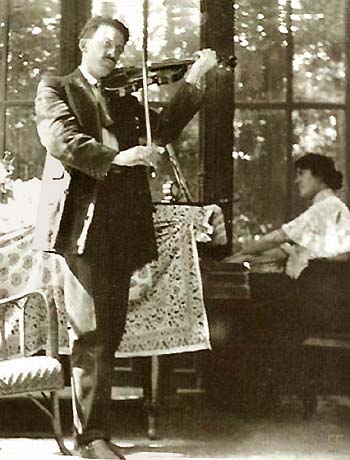
Marcel
and Céliny in the early years of their marriage.
Image courtesy Musica et
Memoria/The Chailley Family (Edited by R.A.B.)
|
In
1907 Céliny met Marcel Chailley, the young violinist, who a
few years earlier (in 1902), had won "Second Prize of the Paris
Conservatory" and played next to Jacques Thibaud in the
Concerts Colonne Orchestra.
Céliny and Marcel married in 1908. They had five children. Two of
them - Jacques and Marie-Thérèse - became excellent musicians. Marie-Thérèse
(1921-2001) was a violist.
Jacques Chailley (1910-1999) studied composition with Nadia
Boulanger, Claude Delvincourt and Henri Büsser, and musicology with
André Pirro, organist Yvonne Rokseth and - during his stay in Amsterdam
at 'La Maison Descartes', the French cultural institute - he studied
with Dutch musicologist Albertus A. Smijers (an expert on Dutch
early music), and with Willem Mengelberg, conductor of the
Amsterdam Concertgebouw Orchestra. Chailley is the author of 40,000
Years of Music which was published in 1961 at the time when
he was a professor in musicology at the Sorbonne University (Paris).
Marcel
Chailley had formed his own string quartet in 1905 with a.o.
Armenian violoncellist Diran Alexanian. With Céliny at the
piano the quartet became the Chailley-Richez Quintet. Céliny
herself founded a Quintet of Strings and Piano of exclusively female
performers which she led until 1947. And she often was a soloist with
the Lamoureux and Concerts Colonne orchestras.
Although
Marcel and Céliny both were performing artists - they both
knew Camille Saint-Saëns and Céliny had played 'à quatre
mains' on two pianos with the composer in Manchester in 1908 - they
also were dedicated teachers. They took part in the cultural and musical
life in Paris and during the years 1918/1919 in Brazil.
|
|
|
Céliny
Chailley-Richez
Image courtesy Musica et Memoria/The Chailley Family (Edited
by R.A.B.)
|
In
their home in Paris they entertained the musicians and composers of
the time and upcoming talents: violinist Ginette Neveu (1919-1949),
pianist and composer Sviatoslav Stravinsky (1910-1994; "the
son of Prince Igor" as he was referred to), violinist  Giorgio
Ciompi
(1918-1983), Lola Bobesco (1920-2003).
Giorgio
Ciompi
(1918-1983), Lola Bobesco (1920-2003).
There
was also Daniel Guilet (original name Dodka Guilevitch) who
at first pursued a solo career and later founded the Guilet String
Quartet with Henry Siegl, William Schoen and David Soyer and in 1955
founded The Beaux Arts Trio with pianist Menahem Pressler and
cellist Bernard Greenhouse (the trio started recording for
the Philips label in 1967; after Guilet retired in 1969 he was replaced
by Isidore Cohen).
Among the visitors to the Chailley house were also violinist  Serge Blanc, and violinist
Denise Soriano (1916-2006) who married famous teacher Jules
Boucherit; she made various recordings with pianist Magda Tagliaferro
(who founded a piano school in Brazil).
Serge Blanc, and violinist
Denise Soriano (1916-2006) who married famous teacher Jules
Boucherit; she made various recordings with pianist Magda Tagliaferro
(who founded a piano school in Brazil).
For
health reasons Marcel retired from his career as performer in 1926.
In that same year Céliny started performing with Georges Enesco
while Marcel dedicated himself now solely to teaching, he worked with
Jacques Thibaud, and he assisted violin pedagogue Jules Boucherit.
Marcel, who had been suffering from chronic asthma, died in 1936.
Céliny, an independent spirit, now more often performed with George
Enesco with whom she formed a duo. (Near the end of her life she donated
from her personal possession various scores with the maestro's annotations,
and several photographs and documents to the Georges Enesco Museum
in Bucarest.)
It
is not for every musician to have an international career. Céliny
Chailley-Richez was an eloquent performer, yet she preferred to determine
her own life and destiny and did not pursue a career with a record
company for which she had to sacrifice part of her family life.
There are not too many recordings left of her artistry. Recordings
she made in the shellac era are practically forgotten. As for so many
artists, the advent of the LP record presented new possibilities.
As for Clara Haskil also the recording career of Céliny Chailley-Richez
came rather late in life when she was in her sixties.

Around
1951 the recording of Schumann's Piano Concerto in A, Op. 54,
was made in Vienna were her performance was probably broadcast by
the ORF (Austrian Broadcasting Corporation - Oesterreichisher Rundfunk).
It is probable that Marcel Prawy obtained the tape from the radio
station. Conductor Robert Heger was not on the list of artists Prawy
was working with. If the recording was a 'studio recording' produced
by him, there would not have been time and money available to make
more takes. Splicing was practically out of the question.
The
performance of the Schumann Concerto with Mme Chailley-Richez and
conductor Robert Heger shows fine music making. The dynamic contrasts
suggesting drama and the varying tempi, do fully illustrate the art
of the pianist. And she is quite Schumannesque in tempo and articulation.
Céliny Chailley-Richez reveals clearly the different moods of Schumann
and she distinguishes herself with some beautiful phrasing and 'jeu
perlé'. Furthermore the second movement is poetic and well
structured, while the finale has strength. And Robert Heger is an
able conductor. The atmosphere is of a live performance. Remington
R-199-65 was released in the month of May, 1952.
|
|
|
Céliny
Chailley-Richez and Georges Enesco at the time when they did
the recordings of the Concertos of Johann Sebastian Bach in
the early nineteen fifties.
Image courtesy Musica et Memoria/The
Chailley Family (Edited by R.A.B.).
|
Examples
of her qualities are technically much better recorded by Decca in
a studio recording of works by César Franck and of work of
her son Jacques Chailley. And there are the performances of
the Piano Concertos of J.S. Bach conducted by Georges Enesco.
Enesco had taught in the USA and had performed and recorded in New
York at various occasions before returning to Paris for good. He had
recorded the Bach Sonatas and Partitas in New York. The recording
of the Violin Sonatas of Schumann and Enesco's Second Sonata, with
Céliny Chailley-Richez at the the piano, were probably made in Paris
at the time when Enesco recorded his Octuor (Octet for Strings) for
Remington Records. Violist Marie-Thérèse Chailley-Guiard,
Céliny's and Marcel's daughter, was a member of the ensemble.
The other players were violinists Robert Gendre, M.L.Ricros, F.Geyre,
and D. Marchand; violist Colette Lequien; and cellists A. Remond and
J. Brizard.
Both Céliny
Chailley-Richez and
Georges Enesco were independent
artists, each choosing to go an individual way, rebellious in the
sense of not accepting reigning standards beforehand, but always staying
in the context of the classical domain. There were similarities between
these individuals, even competitive traits in their characters which
made their music making an experience but stood a deeper personal
relationship in the way. They always met on the artistic level.
After the recordings of the Concertos for Clavier (Piano) and Orchestra
of Johann Sebastian Bach with Enesco conducting 'L association des
concerts de chambre de Paris', and after Georges Enesco had died in
1955, Céliny retired completely from public life. It was some twenty
years later, in 1973, that Céliny Chailley-Richez passed away
at the age of 88.
Recordings
by Céliny Chailley-Richez on other labels:
Decca
FST 153.640 - Franck: Prélude, Choral et Fugue, Chopin: Sonata
No. 2. Céliny Chailley-Richez, piano.
Franck's Prelude, Choral and Fugue appeared on London TW 91145, USA
and on Decca-Telefunken TW 91145 in Great Britain, but now coupled
with "Missa solemnis a capella", a composition written by her
son Jacques Chailley in 1947 and first performed at the Besançon
Festival in 1955. The Decca TW 91145 was first released in the fall
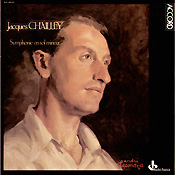
of 1956. Jacques Chailley's Symphony in G
Decca
FAT-173053 - Bach: Concertos for Piano and Orchestra No. 1 &
5
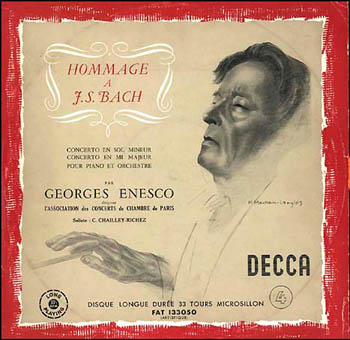
Decca FAT-173050 - Bach: Concertos for Piano and Orchestra
No. 2 & 7
Decca
FAT-173119
- Bach: Concerto for Piano and Orchestra No. 3 and Concerto for Two
Pianos and Orchestra No. 3 with Françoise Le Gonidec
Decca
FAT-173068 - Bach: Concertos for Piano and Orchestra No. 4 &
6
Decca
FAT-173530 - Bach: Concerto for Piano and Orchestra No. 8 coupled
with Brandenburg Concerto No. 5 with Jean-Pierre Rampal, flute, and
Christian Ferras, violin
Decca FAT-173094 - Bach: Concertos for Two Pianos and Orchestra
Nos. 1 & 2
Decca
FAT-173097 - Bach: Concertos for Three Pianos and Orchestra No.
1 & 2 with Françoise Le Gonidec and Jean-Jacques Painchaud
Decca
FAT-143.538 - Bach: Concerto for Four Pianos and Orchestra with
Françoise Le Gonidec, Jean-Jacques Painchaud and Hélène Grimaud; a
10" record.
Symphonium
45 SV 67 (7" record) - Schumann: Scènes d'enfants (Kinderszenen)
Decca
FM 133.705 (10") - Schumann: Kreisleriana (recorded around 1954)
Columbia
GFX 121/3 (3 - 12" 78 RPM) - Enesco: Third Sonata
for Violin and Piano ('dans le caractère roumain') with the
composer at the piano. Later released on (Pathé-Marconi C 061-11637).
See
Neal's
Historical
Recordings.
There
is also a private recording of works by Liadow and Biroulski (Jeux
d'enfants), and there is a private recording made in 1952 and released
by French Columbia in 1957 with Céliny Chailley-Richez and Georges
Enesco performing Beethoven's Sonata for Piano and Violin No. 9, "Kreutzer"
(Columbia FC1058).
In
the years before World War II many Americans traveled to Europe to
get the best possible musical education.
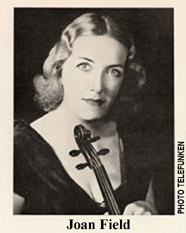
Violinist Joan Field (who, in the 1960s, recorded Violin Concertos
by Bruch, Dvorak and Spohr for Telefunken), studied as a teenager
at the Ecole Normale de Musique in Paris with Marcel Chailley and
Jacques Thibaud, and attended master classes given by Georges Enesco.