|
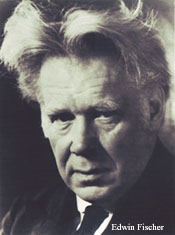
Edwin
Fischer, Conrad Hansen's teacher.
Picture taken from French EMI LP PM322 with
Beethoven's Fifth Concerto with Wilhelm Furtwangler conducting. 


Electrola
E 70 039 /
WBLP 1063 
Wilhelm
Furtwängler conducting in the Old Philharmonic Hall (Alte Philharmonie) which
was destroyed in 1944. Picture taken from the Unicorn release of Beethoven's Symphony
No. 9, 'Choral' - UNI. 100/101. 


The
Masterseal release of Tchaikovsky's Op. 23 with conductor Wolfgang Sawallisch. 
4
x 78 rpm records: Tchaikovsky's 1st Concerto on the original Telefunken label. 


The
release of the Tchaikovsky Concerto with the RIAS Symphony and Wolfgang Sawallisch
on a 10" Deutscher Schallplattenclub record, reference DSC C-67. 


Visit
also the interesting Furtwangler page published by Jimbob. See
also Youngrok Lee's Wilhelm Furtwangler discography |
Already
at a very young age Conrad Hansen performed with conductor Eugen Jochum and from
1927 on he often concertized with Wilhelm Furtwängler as well. With Furtwängler
he performed Beethoven's Piano Concerto No. 4 Op. 56, in 1943, which was to become
Conrad Hansen's most famous recording. But he also made a recording for Remington
Records.
Conrad
Hansen was born on the 24th of November, 1906, in Lippstadt in Westphalia. According
to Robert Nemecek (who in 1999 interviewed pianist
 Gisela
Sott) wrote that Hansen was discovered by Fritz Volbach when the
latter was 'Generalmusikdirektor' in Münster. It was in 1920 that young Conrad
Hansen came to Berlin. Two years later he was accepted as a student by the great
Edwin Fischer. He
studied with Fischer until 1930. Later Hansen became an adept of the Cortot-school
of piano playing. He knew Cortot well and every time the French maestro was in
Berlin, the two pianists met, despite great differences in the style of piano
playing.
Gisela
Sott) wrote that Hansen was discovered by Fritz Volbach when the
latter was 'Generalmusikdirektor' in Münster. It was in 1920 that young Conrad
Hansen came to Berlin. Two years later he was accepted as a student by the great
Edwin Fischer. He
studied with Fischer until 1930. Later Hansen became an adept of the Cortot-school
of piano playing. He knew Cortot well and every time the French maestro was in
Berlin, the two pianists met, despite great differences in the style of piano
playing.
Edwin
Fischer, who had a busy concert schedule, asked Hansen to be his assistant and
to teach Fischer's students when the great performer was on tour. So from 1935
on Hansen taught at the Berlin Municipal Conservatory (Berliner Musikhochschule,
formerly 'Sternsches Konservatorium').
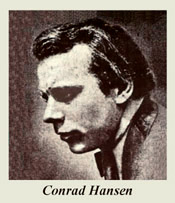 After
a successful concert performance with Wilhelm Mengelberg playing Tchaikovsky's
Piano Concerto No. 1 in B-flat minor, Op. 23, commemorating the composer's
100th birthday (April 25th, 1940), Hansen was asked to play the popular concerto
one more time with famous Dutch conductor
Willem Mengelberg
and the Berlin Philharmonic Orchestra, but now for a recording. Hansen told Hans-Heinrich
Raab during a conversation on July 24, 1996 (later broadcast by Nordeutscher
Rundfunk) how the recording was made. After
a successful concert performance with Wilhelm Mengelberg playing Tchaikovsky's
Piano Concerto No. 1 in B-flat minor, Op. 23, commemorating the composer's
100th birthday (April 25th, 1940), Hansen was asked to play the popular concerto
one more time with famous Dutch conductor
Willem Mengelberg
and the Berlin Philharmonic Orchestra, but now for a recording. Hansen told Hans-Heinrich
Raab during a conversation on July 24, 1996 (later broadcast by Nordeutscher
Rundfunk) how the recording was made.

The
Telefunken Gesellschaft had acquired the new Magnetophon (Tonbandgerät =
tape recorder) which was developped by the German firm AEG and had been on display
at the Radio Exposition in Berlin in 1935. Now the recording team aproached the
artists and managers with the wish to use the Magnetophon for the recording of
the Tchaikovsky Concerto. Mengelberg and Hansen were asked to play the Piano Concerto
not in subsequent parts of the score to be engraved on the spot in the lacquer
discs that were prepared on the many lathes. Now the Telefunken people asked to
play the movements of the concerto without interruption. Mengelberg and Hansen
agreed. And that made Hansen's Tchaikovsky recording one of the first - if not
the first ever - of a classical work done on tape. The
Tchaikovsky recording was made in July of 1940 just about two months after the
Netherlands had been invaded by the Nazis on May 10th, 1940. The Dutch army was
defeated at Grebbeberg. Furthermore the center of the city of Rotterdam was severely
bombed by the Germans on May 14th. Traveling in Germany just a few weeks after
one's country has been attacked and after it had to surrender to Hitler's army,
shows what Willem Mengelberg's position was. In short: life must go on and music
is more important than politics. The political, social and humanitarian consequences
of Germany's War were generally not fully understood by everebody at the time,
or the meaning of being occupied by the Germans was deliberately neglected by
many, and specifically by such a celebrity as
Willem
Mengelberg.
The cooperation between Hansen (25) and Mengelberg (69) resulted in a balanced
performance. Mengelberg did not put his personal stamp on the music and let Hansen
be his own self. It is known that Mengelberg did not "interpret" specific
popular works like the Tchaikovsky B Flat. The Berlin Philharmonic plays the part
as probably any good orchestra led by a first class conductor would have. A Mengelberg
approach would be in great contrast with Conrad Hansen's pure pianistic style.
In this recording, Hansen - in the first movement - plays the shortest cadenza
ever, skipping several bars and proceeding practically immediately to the end
of the cadenza.
Despite the convenience of the tape recorder, the performance had to be timed
to a certain number of discs as was the custom in those days. In this performance
the emphasis is on precision. It is also a performance without much passion.
"Mengelberg was very happy with my playing", Hansen later said.
As so many Mengelberg recordings also this performance was released not only on
the Telefunken label but also on the Czech label Ultraphon which
had been acquired by Telefunken in 1932 after it filed for bankruptcy.

4
x 12" 78 RPM records with Tchaikovsky's 1st Piano Concerto in B Flat, Op.
23, performed by Conrad Hansen and Willem Mengelberg on the Ultraphon label. Ref.U-G14273/6
(Telefunken SK3092/5)
In
the early 1920s Berlin inventor Heinrich J. Küchenmeister (*1893, Berlin, †1971,
Bremen) developed "the
Ultraphon", a player for records in a round housing with 2 sound boxes, 2
arms and 2 rectangular offset sound openings. Both needles run at a fixed distance
through the same groove, whereby during playback a small time difference in the
audio signal was achieved. As a result there is a gain in volume and because of
the time difference a "surround sound" or pseudo-stereo effect was created. The
sound reproduction may have been enhanced but the record wear was doubled as was
the amount of money spent on needles. The
"German Ultraphon AG", whose purpose was the production of these talking machines,
was founded on August 13, 1925 in Berlin-Lichtenberg when the electrical recording
process was introduced. Naturally the commercial success did not meet the expectations
and it was soon decided to build conventional devices with a single tonearm and
soundbox. In
1928, the company "BERTONA" (Berliner Tonapparate-Fabrik GmbH"), took
over the production. In
May, 1929, a new company, "N.V. Küchenmeister's Internationale Maatschappij voor
Accoustiek" was founded with predominantly Dutch capital. The company included
"N.V. Küchenmeister's Internationale Maatschappij voor Sprekende Films", established
in December 1927, which later became "Internationale Tobis Maatschappij N.V."
See also Willem
Mengelberg filmed at the Tobis Studio, Epinay sur Seine, 1931. The
radio department was another division named "N.V. Küchenmeister's Internationale
Radio Maatschappij" which only reached the planning stage. As
of October, 1928, "N.V. Küchenmeister's International Ultraphoon Maatschappij"
was responsible for the record and talking machine sector. In early 1929, the
"German Ultraphon AG" from Berlin merged with "Küchenmeisters Internationale
Ultraphoon" from Amsterdam. The goal was to build up their own record production
in Germany. The first records became available in the Fall of 1929. Within a short
period of time record producer Herbert Grenzebach (*1897 Berlin, †1992 Mallorca)
created a wide repertory. Among the artists were Marlene Dietrich, Joseph Schmidt
and Erich Kleiber. (Retreived in April, 2018, from
Wikipedia.de)
The
Ultraphon label ceased to exist in France, Germany and Holland. But not in Czechoslovakia.
In November, 1931, Ultraphon was acquired by
Ravitas
and the labelname continued to exist. Hence the appearance of the Hansen/Mengelberg
recording pressed on the Ultraphon label, licensed by Telefunken.
|
During the period of the Third Reich, the artists who had specialized in
performing modern repertory, had difficulty in keeping their positions as the
modern repertory soon was declared to be 'entartete Musik' (degenerated music).
Others felt that the spiritual freedom was restricted. Many performing artists,
composers and conductors fled the country. Among these was
conductor
Fritz Busch.
Those who stayed just kept a low profile and tried to come by. Not all musicians
and especially the performers of the classical repertory did have too much to
fear. Conductors Wilhelm Furtwängler, Herbert von Karajan, Karl Böhm,
Carl Schuricht, Richard Strauss, Willem van Hoogstraten, and pianists Elly
Ney and Wilhelm Backhaus, and singer Elisabeth Schwarzkopf (and
others) could continue their careers. Some because they sympathized more or less
with the Nazis, others despite of the Nazi regime as in the case of conductor
Günther Wandt who had a narrow escape after he had been arrested.
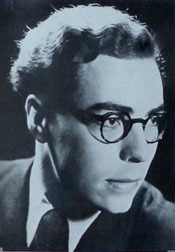 These
were dangerous times as is illustrated by the arrest, trial and execution in September
1943 in Berlin of young concert pianist of Dutch origin, Karlrobert Kreiten
(1916-1943) who as a young man was careless when he expressed his views on
Adolf Hitler and said that the Führer was merely a mad man and that the Third
Reich would soon end. He said this during an afternoon tea at the home of a friend
of his mother in Berlin. Two women who were present informed the Secret Police
(Gestapo) about Karlrobert's views and when after a couple of weeks there had
been no action by the Nazis, they went to the Police a second time. Now Karlrobert
was arrested. These
were dangerous times as is illustrated by the arrest, trial and execution in September
1943 in Berlin of young concert pianist of Dutch origin, Karlrobert Kreiten
(1916-1943) who as a young man was careless when he expressed his views on
Adolf Hitler and said that the Führer was merely a mad man and that the Third
Reich would soon end. He said this during an afternoon tea at the home of a friend
of his mother in Berlin. Two women who were present informed the Secret Police
(Gestapo) about Karlrobert's views and when after a couple of weeks there had
been no action by the Nazis, they went to the Police a second time. Now Karlrobert
was arrested. Wilhelm
Furtwangler was asked to intervene, but the conductor merely wrote a note thinking
that this was sufficient to free young Kreiten. Furtwängler's intervention
was ineffective right from the start. Kreiten was executed. See the German website
about the young pianist
Karlrobert
Kreiten in Berlin in 1943. Another Reference is
Wikipedia.
Many artists in Germany and other European countries did not flee. Also Conrad
Hansen continued to perform. After World War II had ended Wilhelm Furtwangler's
behavior was under scrutiny and he could not perform for two years until 1947.
Conrad Hansen was not banned for two years, the general verdict for those who
had been working close to the Nazis.
| |
| Conrad
Hansen in the mid nineteen fifties.
Image taken from the 1958 Tefi catalog,
photo copy of original picture submitted by Dr. Klaus Holzapfel (Germany) and
edited and artistically rendered by R.A.B. |
Immediately
after World War Two in 1945 (as his biography tells), Hansen founded his own trio,
The Conrad Hansen Trio, together with Arthur Troester (cello) and
Erich Röhn (violin). But he always remained a devoted teacher. He
also was one of the founders of the Detmold Music Academy. The idea for
this music college had come up already in 1944, near the end of the war, but the
realization of the project started in 1946. In
1960 Conrad Hansen moved to Hamburg to teach at the Hamburger Musikhochschule
as a successor to Eduard Erdmann (who had first taught at the Cologne Conservatory
from 1925 till 1935, then followed exclusively a career as concert pianist, and
in 1950 had become a professor in Hamburg). At the same time Hansen continued
teaching in Lübeck.
As so many pianists have done and still do, also
Hansen edited Beethoven's original manuscripts (Urtext) of the Piano Sonatas and
prepared this edition for publication.
For many years he continued to teach
and many young students from all over the world, in his later years many students
from the Far East, came to Hamburg to have lessons with the professor. Professor
Hansen always stressed that it is important to be able to play legato. He also
said that the intrinsic value of the interpretation is the highest goal to be
reached. To play brilliantly is easy, but to perform the inner truth of the music
is quite something else.
This adage is a trait of his performances of several Mozart Sonatas which he recorded
for Deutsche Grammophon. Sure, he is a creative performer who analyses any composition
he is going to play thoroughly. But his sense for detail can easily temper passion.
The intrinsic value is a subjective notion of course. There is a large difference
between the intrinsic value of Mozart Sonatas and the recorded live performance
of Beethoven's 4th Concerto (Klavierkonzert Nr. 4) together with conductor Wilhelm
Furtwaengler in 1943. This compelling performance was the result of Furftwangler's
views which must have inspired the pianist to a large extend. But the influence
of Edwin Fischer, the teacher, is also evident. It suffice to listen to the recording
of Fischer's performance of Beethoven's Piano Concerto No. 3 and then specifically
the Second Movement. Conrad
Hansen also found that the Compact Disc is inadequate to store the many dynamic
variations, the impact and depth of the sound of musical instruments, and because
of that, the CD is incapable to fully convey the interpretation of the artist. 
Laszlo Halasz supervised the Remington MUSIRAMA recordings in Berlin (at times
together with Don Gabor himself who then traveled to Berlin). The project started
in the Fall of 1953. A new recording of Tchaikovsky's Piano Concerto Op. 23 in
B flat minor was on the list. It should replace the early recording on Remington
R-199-76 of pianist Hermann
Schwertmann and conductor Alexander Paulmüller with the Austrian
Symphony Orchestra (Oesterreichisches Sinfonieorchester). That
is when Conrad Hansen was asked to be the soloist in a new LP recording
of Tchaikovsky's popular work for Remington Records Inc. In this recording Hansen
illustrates what he preaches. It is a very articulate performance, conducted very
ably by 30 year old Wolfgang Sawallisch. Hansen scarcely uses the pedal and plays
legato and staccato were appropriate and never gets sentimental or romantic. His
approach is merely classical and has a beautiful lightness. Hansen gives precise
passage work and also his "jeu perlé" can be witnessed in this
recording. His interpretation has great purity and perfect timing.
 This
performance is above all about esthetics. Only in the cadenzas Hansen is more
telling. This
performance is above all about esthetics. Only in the cadenzas Hansen is more
telling. The
cooperation between any conductor and any artist is significant for the interpretation
of a composition. Hansen and Sawallisch go well together as they have more or
less the same strict ideas. Yet one cannot fail to notice that Hansen is very
conscious about his art as he also illustrates in his other recordings, for example
Beethoven's Piano Concerto No. 5 with Eugen Jochum, and in the performance of
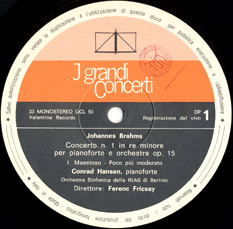
Piano Concerto No. 1 of Johannes Brahms with Ferenc Fricsay and the RIAS Symphonieorchester
dated April 19, 1953, a performance with all the advantages and disadvantages
of a live recording (available on I grandi Concerti, Longanesi Periodici No.
50).  If you are looking for humanity in the Tchaikovsky, there are other recordings
to go for. Witold Malcuzynski, together with conductor Witold Rowicki, gave a
compelling virtuoso performance, dynamic and passionate, on Muza SX 0123 (stereo).
Or you may even try out of curiosity the old imperfectly recorded Remington disc
of pianist
Hermann Schwertmann for a change,
who interestingly takes all the time he needs and has moments of fine phrasing
and timing, but did not have the same quality of orchestra mostly due to a bad
recording technique with a more or less altered frequency characteristic, and
there was practically no possibility for more takes and splicing. But his performance
is right from the heart and has no pretense!
If you are looking for humanity in the Tchaikovsky, there are other recordings
to go for. Witold Malcuzynski, together with conductor Witold Rowicki, gave a
compelling virtuoso performance, dynamic and passionate, on Muza SX 0123 (stereo).
Or you may even try out of curiosity the old imperfectly recorded Remington disc
of pianist
Hermann Schwertmann for a change,
who interestingly takes all the time he needs and has moments of fine phrasing
and timing, but did not have the same quality of orchestra mostly due to a bad
recording technique with a more or less altered frequency characteristic, and
there was practically no possibility for more takes and splicing. But his performance
is right from the heart and has no pretense!
Hansen's recording on Remington R-199-197 was later released on Don Gabor's
Masterseal label (MSLP 5006). There is no information about Conrad Hansen
on the Remington Musirama cover. But on the later Masterseal release the liner
notes state this simple phrase:
"Conrad
Hansen is one of Europe's most gifted and upcoming young pianists, whose sensitive
interpretations have established him along the top rated European pianists."
| This
of course was advertising talk as Hansen had recorded the work when he was 48
and the Masterseal was released a few years later, around 1957/1958, when Hansen
was about 52. He hardly could have been an "upcoming young pianist".
Much later there was a release of Tchaikovsky's 1st Concerto on Don Gabor's Masterseal
label in stereo which mentions Conrad Hansen as being the soloist, but this is
definitely not Conrad Hansen, as producer Tom Null told me in 2001. (The same
could be true for the Webster Continental LP with reference number St-12-2.) D
I S C O G R A P H Y Conrad
Hansen did not make too many recordings. Of the recordings he made there are a
few cherished by connoisseurs.
On the recordings
of Mozart's Piano Sonatas and Fantasy K475.
Hansen's cycle of Mozart Sonatas on the Hammerklavier (pianoforte) for
Deutsche Grammophon was started in 1956 and was not completed when in 1958 the
stereo format arrived. Although
admired by a few purists, the recordings apparently did not sell in quantities
high enough to justify the continuation of the project.
About the recording
of Beethoven's Fourth Piano Concerto
This performance with Wilhelm Furtwängler is -as said earlier- very
compelling. It was a live performance, probably recorded on acetates (as far as
I can judge), although the tape recorder, the Magnetophon (which had been presented
in 1936 at the Berlin Radio Fair) was already in use by the RRG (Reichs Rundfunk
Gesellschaft, the Third Reich Radio Broadcast Corporation) in those days.
I
advise you to look for the Italian Ariston LP release which has the concerto
spread over the two LP sides. It is the same as the release on Unicorn UNI 106
in the UK, although the latter also contains the Fifth Symphony, more or less
to the detriment of the sound of both the Concerto and the Symphony. The Ariston
edition, made in Italy, indicates that the record is playable on mono and stereo
equipment. The transfer is done in electronic stereo, but this time in
a rather unobtrusive way and is really well done. And if your
speakers
are well positioned, this really is enjoyable. It has the beautiful harmonic
sound of ancient tube gear with all the distortion, the coughing and door slamming
included, while the Deutsche Grammophon release in the 2000 Series (2535
807) has been filtered and restored a bit too much to my taste, and thus does
not convey the atmosphere and does not have that same intensity. The Melodiya
Lp (M10 46067 003 GOST 5289-80) is a somewhat less clean version if compared
to to the Deutsche Grammophon effort, but done Melodiya style with bright dynamics.
| |
Click
here
for a Sound Clip of the Second Movement from Piano Concerto No. 4 of Ludwig van
Beethoven with Conrad Hansen and Wilhelm Furtwängler. |
|
The
Unicorn UNI 106 and Deutsche Grammophon releases are of course worthwhile
alternatives if you do not find the Ariston release or the cheaper Super Oscar
SPO 1001 release which is pressed from the same plates as the Ariston. I cannot
judge about the quality of the various CD-transfers, because I do not own one
of them. But generally these transfers have often been cleaned up so severely
that they lack the naturalness, plasticity of the piano tone and miss the atmosphere
of the old transfers to analog LP. So when I made a transfer to CD I found an
acceptable balance between hiss and distortion on the one hand and on the other
hand musical and relatively clean sound. And then there is the influence of the
hifi set.
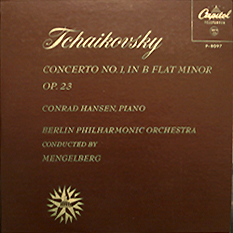 Tchaikovsky:
Concerto No. 1 Tchaikovsky:
Concerto No. 1
in B Flat Op. 23, with the Berlin Philharmonic Orchestra, Willem Mengelberg
(recorded July 9, 1940)
ULTRAPHON U 14273/6
TELEFUNKEN SK 3092/5
Dubbed to Long Playing record by Capitol and first released in September 1950
on P 8097
Later issued as PAST MASTERS PM-18
Irving
Kolodin reviewed
the 1940 performance on Ultraphon 78s in 'The New Guide of Recorded Music' (Doubleday
and Company, New York, 1950):
"Should the Mengelberg
version appear here in a reasonable pressing, or an LP transfer, it can be noted
in advance as an imperious statement of the orchestral score, with facile assistance
from Hansen. It is also a better recording than any of the domestic ones."
(Rubinstein-Mitropoulos, Levant-Ormandy, Horowitz-Toscanini.)
- Irving Kolodin, 1950
| In
this recording the full cadenza was not played as was often the case in the 78
RPM era. Reasons could be:
a) the pianist finds the cadenza too difficult
to perform impeccably in a direct-to-disc recording session;
b) it saves a
minute or two and that section of the movement can be accommodated on one specific
side. No matter if the lacquers were cut during the performance or the lacquers
were cut from a tape. 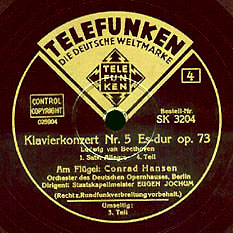 Beethoven:
Concerto No. 5 Beethoven:
Concerto No. 5
with the Orchestra of the Deutsches Opernhaus, Eugen Jochum (recorded June
22 + 23, 1941)
TELEFUNKEN SK 3203/7 (also referred to as TSK 3203/7)
Mozart:
Concerto No. 26 KV 537
Berlin State Opera House Orchestra, Arthur Rother
(recorded June 27, 1941)
TELEFUNKEN SK 3734/37
LP: CAPITOL P 8109
Liszt:
Concerto No. 1
with Berlin State Opera Orchestra, Arthur Rother
(recorded July 4,
1941)
TELEFUNKEN, not issued Beethoven:
Concerto No. 4
with the Berlin Philharmonic Orchestra, Wilhelm Furtwängler
(recorded live 31 October - 3 November 1943). This performance was never
issued on 78 RPM but was later transferred to LP in the nineteen seventies. The
Melodiya transfer apparently was made much earlier from the original Reichs-Rundfunk-Gesellschaft
tape which was cofiscated by the Russians and returned when Gorbachev was in power.
Melodiya M 10 49721
UNICORN UNI 106
ARISTON ARCL 13028
Super Oscar
SPO 1001 (pressed from the plates of Ariston ARCL 13028)
DEUTSCHE GRAMMOPHON
2535 807
(Mike Gray, in his excellent Berlin Philharmonic discography, gives
only October 31, 1943, as recording date) (see the NOTE above).
The
pitch of the Italian Ariston and Super Oscar editions is not correct and differ
at least one note if compared to the other releases. The technicians who cut the
matrix from the tape supplied by Unicorn had not checked their machines! Those
who have a variable pitch on their turntables can easily adjust to the right speed
by comparing it to a modern edition of Beethoven's 4th Piano Concerto. Frank:
Prelude, Fugue and Variations
(recorded July 20, 1942)
TELEFUNKEN SK 3741
+ Brahms: Ballade Op. 118,
No.5
(recorded July 20, 1942)
TELEFUNKEN SK 3741/42 Mozart:
Rondo D Major KV 485
(recorded July 20, 1942)
TELEFUNKEN SK 3725 Mozart:
Piano Sonata G Major KV 283
(recorded July 21, 1942)
TELEFUNKEN SK
3724/25 Brahms:
Intermezzo Op. 117, No. 2
(recorded July 21, 1942)
TELEFUNKEN not
issued Chopin:
Nocturne E Flat Major Op. 9, No. 2
(recorded July 21, 1942)
TELEFUNKEN
not issued Recordings
made in the LP era: 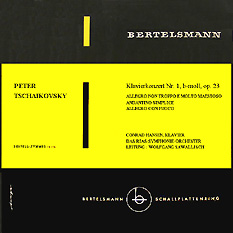 Tchaikovsky:
Concerto No. 1 Tchaikovsky:
Concerto No. 1
with the
RIAS
Symphony Orchestra and conductor
Wolfgang
Sawallisch
REMINGTON R-199-197
Released in Germany on the Bertelsmann
label, 'Bestell-Nummer' 13 174.
Released in 1955 and reissued around 1958
as MASTERSEAL MSLP 5006
Beethoven:
Trio for Piano, Clarinet and Violoncello Op. 11
Conrad Hansen (Piano), Erich Röhn (Violin), Arthur Troester
(Cello) Brahms: Trio for Clarinet Op. 114
Conrad Hansen (Piano),
Heinrich Geuser (clarinet), Arthur Troester (Cello)
ELECTROLA/COLUMBIA
SMC 80902. Later reissued on Mace.
Brahms:
Piano Concerto No. 1
with the RIAS Symphony Orchestra conducted by Ferenc Fricsay (live recording
April 19, 1953)
LONGANESI I grandi Concerti No. 50
NOMOS 9.809212 Schubert:
Trio Op. 100
Conrad Hansen (Piano), Erich Röhn (Violin),
Arthur Troester (Cello) (recorded September 14-16, 1954 Hamburg)
TELEFUNKEN
LE 6525 / LGX 66039
Dvorak:
Trio E minor, op. 90
Conrad Hansen (Piano), Erich Röhn
(Violin), Arthur Troester (Cello) (recorded December 8-11, 1954 Berlin)
TELEFUNKEN LB 6122 Mozart:
Trio B Flat major, KV 502
Conrad Hansen (Piano), Erich Röhn
(Violin), Arthur Troester (Cello) (recorded December 8-11, 1954 Berlin)
TELEFUNKEN issued ?? Schubert:
Trio Op. 100
Conrad Hansen (Piano), Erich Röhn (Violin),
Arthur Troester (Cello) (recorded June, 12-14, 1956)
TELEFUNKEN BLE
14131 Schubert:
Forellenquintett (Trout Quintet)
with Max Strub (Violin), Walter
Müller (Viola), Irene Güdel (Cello), Rolf Heister,
(Contrabass)
BERTELSMANN Schallplattenring 13353 P10
Brahms:
Trio in A minor Op. 114, Beethoven trio in B Flat Op. 11
with Heinrich Geuser (clarinet) and Arthur Troester (cello)
MACE MS/MCS-9038 (a Electrola GmbH recording) Mozart:
Sonatas Nos. 1 (K279), 2 (K280), 3 (K281) and 4 (K282)
performed on Hammerklavier
DEUTSCHE GRAMMOPHON LPM 18320 Mozart:
Sonatas Nos. 5 (K283), 11 (K331) and 15 (K545)
performed on Hammerklavier
DEUTSCHE GRAMMOPHON LPM 18322 Mozart:
Sonatas Nos. 6 (K284) and 8 (K310)
performed on Hammerklavier
DEUTSCHE GRAMMOPHON LPM 18505 Mozart:
Sonatas Nos. 7 (K309) and 11 (K331)
performed on Hammerklavier
DEUTSCHE GRAMMOPHON LPM 18321 Mozart:
Fantasie (Fantasy) K 475 and Sonata K 457, and Sonatas K533-494
DEUTSCHE GRAMMOPHON LPM 18479
Beethoven:
Piano Concerto No. 1
with the Bamberg Symphony Orchestra/Heinz Wallberg
OPERA 3959 (Stereo). Later reissued on Eurodisc 70296. Beethoven:
Piano Concerto No. 3
with the Bamberg Symphony Orchestra/Istvan Kertesz OPERA/Europäischer
Phonoklub 3269
Later reissued on PARNASS S 61 425 (Stereo) Discographer
Ernst Lumpe - known for his research on the
Allegro-Royale
bootlegged recordings - notes that the recording on REGENT MG
5026 of Piano Concerto No. 3 of Beethoven with pianist Franz Schultz
and the Berlin Symphony Orchestra conducted by Gustave Kuntz is actually
the radio recording of the German Reichsrundfunk Gesellschaft (RRG)with
Conrad Hansen and the "Grosses Orchester des Berliner Rundfunks"
(Large Orchestra of the Berlin Radio), Artur Rother conducting. He adds:
I now have definite
proof of the identity of this recording with Hansen's RRG recording. The DRA (Deutsches
Rundfunkarchiv) in Frankfurt still has the first movement of Hansen's recording,
and it is absolutely identical to the movement on Regent. The DRA does not have
movements 2 and 3 which are on the Regent LP. So the complete performance has
only been preserved under pseudonym on the Regent LP. - Ernst Lumpe
| 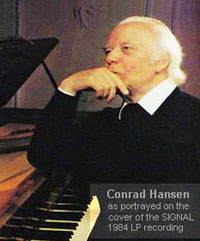 In
his late seventies Conrad Hansen recorded in the newly introduced digital format
a Mozart Program for the SIGNAL record label, issued in 1984. In
his late seventies Conrad Hansen recorded in the newly introduced digital format
a Mozart Program for the SIGNAL record label, issued in 1984.
Mozart: Sonata No. 11 in A major K. 331, Rondo a la Turca,
Rondo D major K. 485, Fantasy in D minor K. 397, Sonata No. 16 in C major K. 545
On
Compact Disc: Beethoven:
Piano Concerto No. 5, Sonata No. 5, Sonata No. 32. Brahms: Piano Quartet Op. 25,
Sonata Op. 5, Intermezzo Op. 119 No. 1. Conrad Hansen with the RIAS Symphony
Orchestra conducted by Karl Böhm, Ernst Doberitz, viola.
MUSICAPHON M 56845 (2 CD) Rudolf
A. Bruil, Page first published in September of 2000. On
Tuesday June 25, 2002 the German newspaper 'Die Welt' announced that "pianist
and pedagogue Conrad Hansen died on Saturday June 22, 2002 at the age of 95."
- R.A.B. |


