The
cover of Bach's Sonata No.1
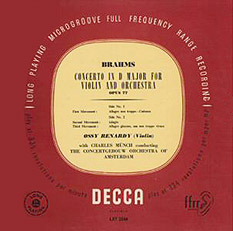
The
cover of the Brahms recording with Charles Munch and the Concertgebouw
Orchestra

The
Decca recording of the Brahms Concerto with Charles Munch and the
Concertgebouw Orchestra on an Everest release in electronic stereo.

The
Bach Sonatas and The Recital on Testament

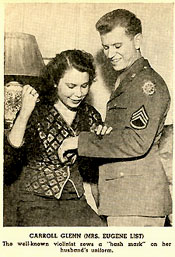
Pianist Eugene List (July 6, 1918 – March 1, 1985)
followed a remarkable career right from the moment he premiered a
Shostakovich Concerto. He enlisted in the US Army in 1942, played
for Franklin Delano Roosevelt, Winston Churchill and Joseph Stalin
in Pozdam in 1945, and toasted with the Russian dictator. In 1953
he accompanied Ossy Renardy in Sonatas by César Franck and
Maurice Ravel on the Remington label. The photo shows sergeant List
with his wife, violinist Carroll Glenn, who sews a "hash mark"
on her husband's uniform.
(Image taken from Etude Magazine, June 1946)


|
Ossy
Renardy's real name was Oskar Reiss, but when touring Italy as a teenager,
he changed his name - on the instigation of his first manager - into
Ossy Renardy. This artist's name should give him more fame than the
serious and stiff Viennese 'Oskar Reiss'.
The
liner notes on Remington R-199-152 give a short biography:
"Ossy
Renardy was born in Vienna, April 26, 1920 and in this city
of music he had an early opportunity to start his career.
Renardy was an accomplished violinist by the time he was eleven
and though he appeared publicly on tour at this age, he returned
to Vienna, completed his studies and made his formal debut
at thirteen. In 1937 he came to America and toured the United
States during the four seasons preceding the war. He was already
playing for the USO (United Service Organization - ed.) in
1941 and the following year he entered the United States Army.
It was two years after the war was over, before Renardy appeared
again in public life. He had spent those two years working
and studying, preparing himself for a return to the concert
stage, and in 1948 he was once more performing throughout
the North American continent, Europe and Israel, appearing
with the Philharmonic, the Boston Symphony, the Chicago, the
St. Louis, Los Angeles, San Francisco Symphony, in fact, all
the major orchestras of the United States, as well as Canada
and Europe.
One of the feats for which Renardy is famous is his playing
of all twenty-four of the Paganini Caprices on the
second half of a recital at Carnegie Hall, after having performed
the Nardini Concerto, a Sonatina of Dvorak and the Lalo Symphony
Espagnole (Symphonie Espagnole) in the first half. Every violinist
in town turned up for the concert. Renardy looks back on this
performance of fourteen years ago and says he would not do
it again. He has however, made available to everyone, his
performance of these twenty-four fabiously difficult and incredibly
beautiful Caprices in recording them for Remington
Records. The last twelve (Nos. 13 to 24) are contained on
this Volume II; the first twelve (Nos. 1 to 12) are in Volume
I (R-199-146)."
|
|
|
|
Ossy
Renardy (26 April 1920 -
3 December 1953)
Picture from Testament CD enhanced and edited
by R.A. Bruil
|
In
New York he studied with the famous pedagogues  Theodore
and Alice Pashkus in order to prepare himself for appearing
anew on the stage after the war.
Theodore
and Alice Pashkus in order to prepare himself for appearing
anew on the stage after the war.
|
|
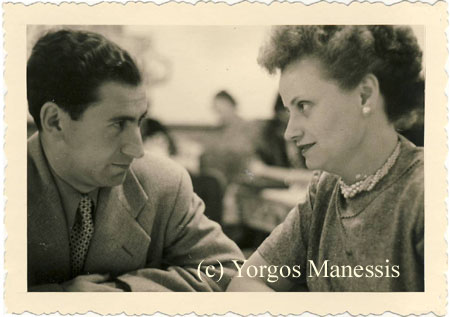
A
unique photograph of Alice Pashkus and Ossy Renardy in the early
nineteen fifties. Alice and Theodore Pashkus treated Renardy
more or less as their son as Stefanos Theodoridis told me. That
is why they were extremely shocked when they received the message
that Ossy Renardy had died.
Copyrighted
image courtesy of Yorgos Manessis. Image submitted by Stéfanos
Theodoridis.
|
The
list of his shellac recordings is quite substanial.
US Columbia (these are from the late 1930s):
* 17119-D Handel-Flesch: Prayer
* 17119-D Vecsey: Caprice No, 2 "Cascade"
* 17132-D Paganini: Sonata No. 12 in E minor
* 17132-D Burmester: Viennese Serenade
* 69152-D Corelli: Sonata in E minor, Op. 5, No. 8 (2 sides)
* 69403-D, 69404-D Schubert: Sonatina No. 1 in D (3 sides)
* 69404-D Schubert: Sonatina No. 3 in G minor - 3rd, 4th movements
* 69543-D, 69544-D Dvorak: Sonatina in G, Op. 100 (3 sides)
* 69544-D Dvorak: Slavonic Dance, Op. 46, No. 8
* 69621-D Sarasate: Romanza Andaluza & Jota Navarra
* 69622-D Sarasate: Zapateado & Adios montañas mias
* 69655-D Piatti: Sonata No. 1 in E minor
* Set X-116 Schubert: Sonatinas
* Set X-129 Dvorak: Sonatina & Slavonic Dance No. 8
* Set X-134 Sarasate: 4 pieces.
 Corelli Sonata accompanied by Leo Taubman, all others by Walter
Robert.
Corelli Sonata accompanied by Leo Taubman, all others by Walter
Robert.
Ossy Renardy recorded for RCA-Victor in 1941:
* 16276/8 (Album
M-672) Paganini Caprices Nos. 1 to 12 (6 sides)
* 17479 Saint-Saens: Concertstück, Op. 20 (2 sides) with W. Robert
at the piano
* 17636/8 (Album M-738) Paganini Caprices Nos. 13 to 24 (5 sides)
* 17638-B (in M-738) Paganini: Sonata in A
* 18032-A Mozart: Adagio in E, K. 261
* 18032-B Brahms: Allegro in C minor ("F-A-E" Sonata)
* 18294-A Dvorak: Ballade in D minor, Op. 15
* 18294-B Zarzycki: Mazurka, Op. 26
* 11-8113 Ernst: Hungarian Airs, Op. 22 (2 sides)
All
the above, including Paganini Caprices, accompanied by Walter Robert.
Several of these 78 RPM recordings were released on CD on the Biddulph
label. The 78 RPM discographies from the nineteen thirties and the
1941 recordings were submitted by Bryan Bishop.
By
1948 these recordings were out of print. The Gramophone Shop Encyclopeadia
of Recorded Music lists just one 78 RPM recordset: Columbia CX 134
on which Renardy plays Pablo de Sarasate: 'Adios montañias mias',
'Jota Navarra', 'Zapateado' and 'Romanza Andaluza'.
English
Decca made several Lp recordings (the month and year of release
are in brackets):
*
LM 4542 Solo Sonata No. 1 (Bach) (1/52)
* LM 4536 Solo Sonata No. 3 (Bach) (5/51)
* LXT 2685 Violin Concerto (Brahms) (recorded at Amsterdam Concertgebouw
on 13-14 September 1948, released on Lp 7/51)
* LK 4024 Popular Recital: Le streghe - Witches' Dance, Caprices
17 and 24 (Paganini); Liebeslied, Liebesfreud, Caprice Viennois
and Tambourin Chinois (Kreisler); Scherzo tarentelle (Wieniawski);
Ave Maria (Schubert).
The dates of release are taken from the Gramophone Long Playing
Classical Record Catalogue, December 1954.
The
releases on the London label (USA):
*
LS 423 Solo Sonata No. 1 (Bach) LS 259 Solo Sonata No. 3 (Bach)
* LL 1 Violin Concerto (Brahms) (recorded 13-14 September 1948,
released on Lp 7/51)
* LL 159 Violin Recital: Le streghe witches' dance; Caprices 17
and 24 (Paganini); Liebeslied, Liebesfreud, Caprice Viennois and
Tambourin chinois (Kreisler); Scherzo tarentelle (Wieniawski); Ave
Maria (Schubert).
|
|
|
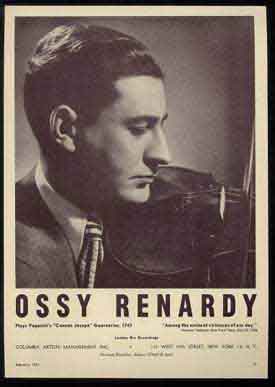
"Among
the eminent of our day" and "plays Paganini's 'Cannon
Joseph' Guarneri, 1743" is printed on his Columbia Artist
Management folder of February 1952.
Note: It is suggested that Renardy's
instrument was not the original del Gesù Cannon made
for Paganini, but a copy of it made by J.B. Vuillaumme of Paris
who in 1834 was asked to repair the Guarnerius del Gesù
Cannon. The opportunity presented itself to take the exact measurements
of the instrument and make a copy.
(Artist Management Folder - the SoundFountain Archive.)
|
|
|
Click
here
for a Sound Clip of Caprice No. 16 in G Minor
|
|
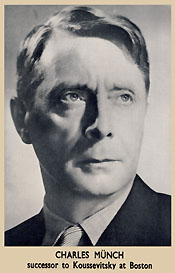
Renardy's
performance of the Brahms Concerto with the Concertgebouw Orchestra
conducted by Charles Munch was not a dramatic one. To a certain
extend the recording technique (dynamics, frequency characteristic)
can be blamed for this. After all the recording was made in 1948 when
the Lp recording technique was new and not refined yet. And the technique
of transferring 78 RPM recordings to Lp was in its infancy.
The
Violin Concerto was originally released on a 5 x 78 RPM set, Decca
L-Set 87, and too late for being listed in The Gramophone Encyclopedia
of Recorded Music from 1948. The recording was made on September 13
and 14, 1948 (ref. Jan van Bart: Discografie van het Concertgebouworkest
- Discography of the Concertgebouw Orchestra - Zutphen, Netherlands,
1989).
Irving Kolodin reviewed the set in "The New Guide To Recorded
Music" (Double Day, New York, 1950):
"There
is no single merit in the Renardy to give it precedence over
the Szigeti or Heifetz or Neveu, save a richer serving of
the colors in the score than previously provided by any source.
However, Renardy's is a very live, youthful, and ingratiating
performance, which has its own authentic alertness, consistently
controlled. The Munch background is extremely good."
- Irving Kolodin, 1950
|
Musicologist
Mark Todd told me:
"(...) according to several reviews in Record Guide and
the EMG Monthly Letter, the sound on the 78s was excellent,
but unfortunately the LP transfer had a very dim sound. Both
Record Guide and EMG's Monthly Letter comment on how the quality
had deteriorated in the transfer. This applies not fully to
the Everest Lp version which is quite palatable. There have
been two CD versions of this performance. One, on a French label,
is of average quality, but the official reissue approved by
Decca is on the Dutton label (CDEA 5024). They have done a wonderful
transfer from the 78s so the sound is revealed as never before.
This reissue was made a year or so before the Testament reissues."
- Mark Todd, 2003
|
The
set of 78s was exactly the basis for a new transfer done by Andrew
Rose from Pristine Audio in July 2005 and was available for several
years. The sound is extremely good and the violin tone is very realistic.
One can hear the very nature of the violin and the way young Renardy
plays, sometimes with uncertainty and hesitation and at times he feels
very secure about what he is doing, but he is always lyrical. In this
transfer the balance of the orchestra is rather well preserved, despite
the cleaning up of the audio signal, with the violin placed close
to the microphone. The dynamics are very good as is partly the benefit
of the Pulse Code Modulation of the linear digital format of the Compact
Disc, but is also the result of Andrew Rose's choice of the appropriate
needle tip and the fact that he took care of many a minute detail.
Nevertheless
the Decca/London Lp is of interest to collectors. And the release
on Everest 3314 remains a very nice item because it is analog, despite
the use of enhancers and despite the simulated stereo (which can be
'by-passed' by summing left and right channels).
Renardy's playing on the Remington discs however is vivid and his
interpretations have energy when required, although the sound recordings
lack warmth and do the violin no justice.
The
Decca recordings of Bach's Solo Sonatas Nos. 1 and 3, the Violin Recital
and other performances can be found on various
Testament
CDs.
Ossy
Renardy on Remington:
R-199-146
Paganini: Caprices 1 - 12 (the accompanied version of Ferdinand David)
with Eugene Helmer, piano.
|
|
|
|
|
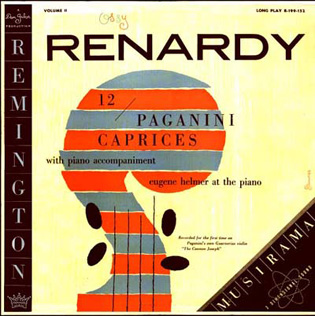
The
covers for Ossy Renardy playing the Caprices of Paganini with
Eugene Helmer, as well as the Violin Sonatas of Cesar Franck and
Maurice Ravel with pianist Eugene List, were designed by Alex
Steinweiss.
|
R-199-148
Ossy Renardy performs Franck's Sonata in A and the Sonata of Ravel
with pianist Eugene List.
This
recording was released in December 1953 (the month of Renardy's death)
together with the recording of the Caprices 13-24. The
first volume of the Caprices had already been released a few months
earlier.
R-199-152
Paganini:
Caprices 13 - 24 (the accompanied version of Ferdinand David) with
Eugene Helmer, piano.
In
those 78 RPM and early LP days a few companies did prefer to make
recordings of these works with piano accompaniament instead of recording
the single soloist, afraid as they may have been not to sell enough
copies. The piano certainly would make the music more accessible.
Zino Francescati had recorded Caprices with pianist Mario Pilati.
However Ruggiero Ricci and Michael Rabin recorded the Caprices for
solo violin.
Don
Gabor, who after he came to the USA worked in the shipping department
at RCA, probably heard about Ossy Renardy when Renardy recorded for
Victor. It is obvious that Laszlo Halasz was instrumental in contracting
Renardy to perform for the Remington label. And Alice and Theodore
Pashkus could have suggested to make recordings with Renardy already
before they began producing the Young Violinist Series for Don Gabor.
Paganini's Caprices with piano accompaniement and the Ravel and Franck
Sonatas were most likely recorded in the Mastertone Recording Studios
Inc. New York City, NY 10036. Specifically the Violin Sonatas
disc shows Renardy's talent to the full. They are played with lyricism
and passion, and with a beautifull sense of detail. The cooperation
with Eugene List is examplary. Especially the Ravel Sonata gets an
in depth performance.
Ossy
Renardy (who had become a US citizen when enlisting in the Army in
1943) was killed in a car accident when on his way to a concert in
Mexico and died on December 3, 1953. His accompanist of the concert,
pianist George Robert, survived the crash and later pursued a successful
career.
Rudolf A. Bruil
- page first published in June, 2003, and updated since.
|