|
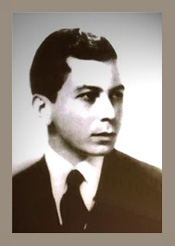
Photo:
APR

The
excellent recording of Liszt's Concerto No. 1 and Totentanz (archaic
Todtentanz), Variations on Dies Irae, played by Edward Kilenyi.

Liszt's
Hungarian Fantasia and Mozarts K488

Edward Kilenyi
and Felix Prohaska on Remington R-199-44.

The
cover of the first issue of R-199-44.
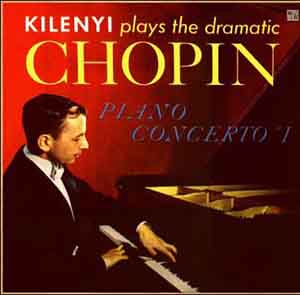
Edward Kilenyi
around 1957 on the cover of the re-release of the Remington recording
of Chopin's 1st Concerto with the Austrian Symphony Orchestra and
Felix Prohaska on Masterseal MS77.
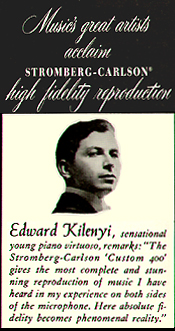
Edward Kilenyi's
popularity is reflected in a testimonial advertisement of Carlson-Stromberg
promoting their reproduction 400 system. In the ad he is in the company
of Ernst von Dohnanyi, Antal Dorati, Leopold Stokowsky, Alexander
Hilsberg and Ellen Ballon. (High Fidelity Magazine, December 1953.)
Kilenyi's statement: The Stromberg Carlson 'Custom 400' gives the
most complete and stunning reproduction of music I have heard in my
experience on both sides of the microphone. Here absolute fidelity
becomes phenomenal reality." Kilenyi refers also to his job as
producer.

Felix
Prohaska
(Image reconstructed by RAB.)

Frederic
Chopin's Waltzes on R-199-82.
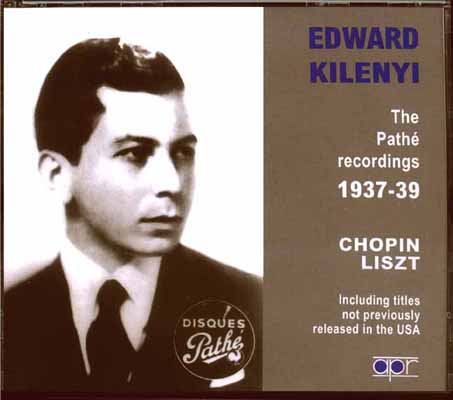
Link to
Edward
Kilenyi's Recordings on the APR label.

|
Edward
Kilenyi was a gifted pianist and above all an admired teacher. He
was the son of violinist-composer Edward Kilenyi Sr. who came from
Hungary (1884, Békés, Hungary - 1968, Tallahassee, Florida)
and who appeared in several movies, mostly uncredited (See the Internet
Movie Data Base - IMDb - web site). From 1919 till around 1923 George
Gershwin studied composition with him.
Edward
jr., born on May 7, 1910, in Philadelphia, showed, already at the
age of three, an exceptional talent for playing musical compositions
by ear.
"His father gave him a thorough musical training, but without
depriving him of the joys of a normal boyhood through premature exploitation
as a child prodigy", according to the liner notes of R-199-166.
|
|
|
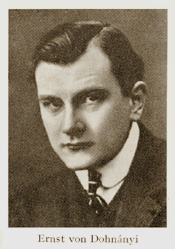
Ernst
von Dohnanyi, teacher of pianist Edward Kilenyi
|
At
the age of 11, young Kilenyi played for  Ernst von Dohnányi when von
Dohnányi visited New York in 1921. The maestro proposed to
take the boy's musical education in hand. So Edward Kilenyi traveled
to his father's native land Hungary, in 1925, and started his studies
in Budapest. A few years later Kilenyi already concertized with his
teacher.
Ernst von Dohnányi when von
Dohnányi visited New York in 1921. The maestro proposed to
take the boy's musical education in hand. So Edward Kilenyi traveled
to his father's native land Hungary, in 1925, and started his studies
in Budapest. A few years later Kilenyi already concertized with his
teacher.
After
receiving his diplome at the Ferenc Liszt Academy in 1930,
he started to perform in Europe. When Thomas Beecham heard
Kilenyi play he remarked: "That's the way to play the piano!" and
booked young Edward on a concert tour to introduce him to the entire
English music loving nation. That was in 1935. Beecham called him
"The true successor of the great Romantics, an artist in the
grand manner of Liszt and Rubinstein." And after having performed
with Willem Mengelberg and the (Royal) Concertgebouw Orchestra
in Amsterdam, Mengelberg said: "There is but one young artist
whom one may compare musically with Kilenyi - that is Menuhin."
This not only showed Mengelberg's esteem for Menuhin's artistry, but
indicated that Edward Kilenyi, a young pianist in his twenties, was
a remarkable talent.
Kilenyi
performed with other great European conductors of that era as well:
Karl Muck (the opposite of Mengelberg), Sir Henry Wood, John Barbirolli,
Paul Paray, Philippe Gaubert, Charles Munch, and also with George
Szell.
His artistry grew in popularity. That was reason enough for the French
record label Pathé to contract him to record works by Liszt:
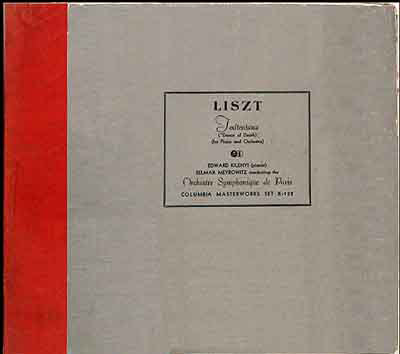
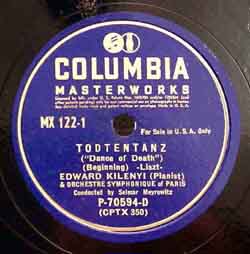
"Hungarian Fantasia" (Pathé PAT 119/20) and "Todtentanz"
(Totentanz; Danse macabre, Pathé PAT 102/3) with conductor
Selmar Meyrowitz . The Todtentanz recording won the Grand
Prix du Disque in 1939. The recordings of these works were released
in the US on the Columbia label (78 RPM). At the time he also recorded
with conductor Meyrowitz Liszt's Fantasia "The Wanderer"
(Pathé PAT 136/8), plus a series of solo works like Mephisto
Waltz and Au bord d'une source (Pathé PAT PG104/5)
when living in Paris.
In
1940 he made his debut in New York's Town Hall and as a consequence
appeared with such prominent conductors as Otto Klemperer, Dimitri
Mitropoulos and Eugene Ormandy. Ormandy said: "It is not easy
to rouse my enthusiasm, but he (Kilenyi) did, the minute he touched
the piano."
For Columbia Kilenyi recorded with the Minneapolis Symphony and conductor
Dimitri Mitropoulos.
|
|
|
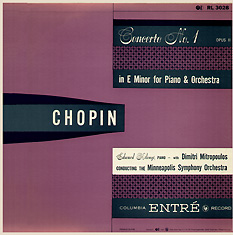
Edward
Kilenyi's recording of Chopin's Concerto No. 1 with the Minneapolis
Symphony Orchestra under Dimitri Mitrropoulos on Columbia's
budget label ENTRE, ref, RL 3028. Recorded in the 78 rpm era:
Columbia CM-515 (4 x 12").
|
Edward
Kilenyi's concert repertory included:
Ludwig
van Beethoven:
Concertos Nos. 1, 3 and 5
Johannes Brahms:
Concerto No. 2
Frederic Chopin: Concertos in E Minor and in F Minor
Frederick Delius: Concerto in C Minor
Ernst von Dohnanyi: Variations on a Nursery Theme
Franz Liszt: Concerto No 1, Hungarian Fantasia, and Todtentanz
(Dance of Death)
Felix Mendelssohn-Bartholdi: Concerto in G Minor
Wolfgang Amadeus Mozart: Concertos K488 and K 467
Franz Schubert-Franz Liszt: Wanderer Fantasia
Robert Schumann: Concerto in A Minor
Peter Iljitch Tchaikovsky: Concerto No. 1 in B Flat Minor,
Op. 23
|
|
|
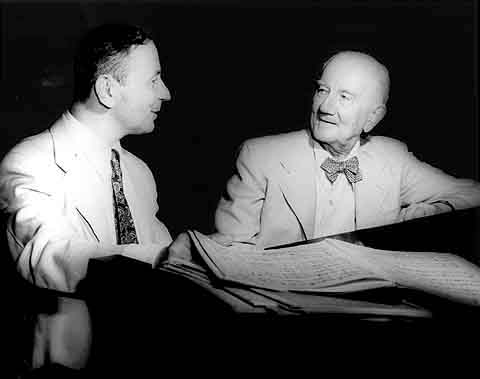
Edward
Kilenyi and his teacher Ernst von Dohnányi around 1955.
Together they had made a recording for Columbia playing on two
pianos 'Suite en valse' coupled with Kilenyi playing Dohnányi's
'Waltz Settings', on a 12 inch Columbia disc (ML-54256).
Picture
courtesy of The Ernst von Dohnányi Collection
at The Florida State University.
|
Kilenyi
was performing in the United States when World War II broke out in
Europe. His career was more or less interrupted by the war. In order
to be able to stay and obtain US citizenship, he enlisted in the US
Army and served for four years as a welfare officer. Sent to Europe
in 1945, he was appointed Music Control Officer for Bavaria (Germany)
in the US Military Government. Germany was completely bankrupt. The
Americans wanted to rebuild the cultural life because music and theatre
are the basic ingedients for building society.
Edward
Kilenyi's task was to reorganize and stimulate the cultural life in
that region. Conductors Hans 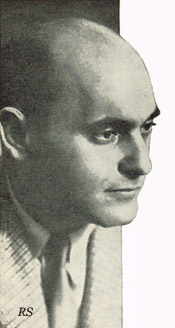 Knappertsbusch,
Herbert von Karajan, Eugen Jochum, and more famous names, were banned
from allowing to perform. It was important that life should get back
to normal. When a conductor had to be hired for the Orchestra of the
Bavarian State Opera in Munich, Edward Kilenyi as music control officer
was able to testify and help clearing any suspicion on the conduct
of Georg Solti. Although Solti had lived in Switzerland, he was Hungarian
and that could probably have meant that he had been on the wrong side
in the war. But thanks to Edward Kilenyi pianist/conductor Georg Solti
- also a pupil of Dohnanyi - was cleared. Kilenyi's intervention became
more or less the basis for Solti's carreer. Knappertsbusch,
Herbert von Karajan, Eugen Jochum, and more famous names, were banned
from allowing to perform. It was important that life should get back
to normal. When a conductor had to be hired for the Orchestra of the
Bavarian State Opera in Munich, Edward Kilenyi as music control officer
was able to testify and help clearing any suspicion on the conduct
of Georg Solti. Although Solti had lived in Switzerland, he was Hungarian
and that could probably have meant that he had been on the wrong side
in the war. But thanks to Edward Kilenyi pianist/conductor Georg Solti
- also a pupil of Dohnanyi - was cleared. Kilenyi's intervention became
more or less the basis for Solti's carreer.
In
those years Edward Kilenyi got to know the German way of life and
made contacts with artists and orchestras. His stay in Europe and
subsequent travels led eventually to his recordings for the Remington
label. In 1950 he recorded Chopin's Concerto No. 1, Debussy's Preludes,
Chopin's Etudes Op. 10, and Liszt Hungarian Fantasy. As Remington's
Music Director he traveled to Europe once again in March 1951 and
visited Vienna, Salzburg, Paris and Milan. Kilenyi's early recordings
for the Remington label were produced by Marcel Prawy, possibly together
with Don Gabor and/or Laszlo Halasz who traveled to Europe at that
time. Laszlo Halasz recorded the Suite from Zoltan Kodaly's
'Hary Janos' in Vienna, released on R-149-44. Halasz
was not yet Recording Director for Remington.
In
1953 Edward Kilenyi took up the post of professor at the Florida State
University of Music in Tallahassee and joined his former teacher Ernst
von Dohnanyi, who had joined the FSU faculty four years earlier, in
1949. Kilenyi taught there for nearly thirty years until 1982.
|
|
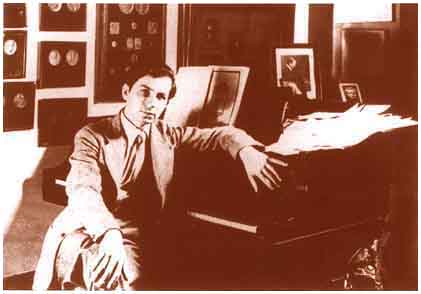
Edward
Kilenyi at the beginning of his carreer
Photograph
taken from the booklet of the Appian 2-CD of the Pathé
recordings. Copyright APR
|
His famous prewar Pathé recordings of Liszt's Todtentanz
(Danse macabre), Hungarian Fantasia for piano and orchestra
and other works by Liszt and Chopin, recorded in the
78 RPM era, have been transferred to CD thanks to the devoted work
of former Kilenyi students Jane Perry-Camp and her husband, the composer
Harold Schiffman. This according to the booklet accompanying the CDs.
It is also mentioned that original matrixes did not exist anymore,
hence it took a lot of effort and time to collect the shellac records
and prepare them for re-recording.
|
|
Many
people have contributed to the project, amongst those Edward Kilenyi
himself, who had several records in his personal collection. The transfers
were done by Bryan Crimp who was already known for his transfers
in the nineteen seventies (e.g. the Felix Weingartner recordings in
the HMV Treasury Series - RLS 717). For the Kilenyi recordings he
succeeded in achieving a distortion free and distinctive sound which
is especially remarkable because in most cases the quality of the
original discs was far from pristine. The recordings were released
on APR (Appian Publications and Recordings), the label from
England that specializes in great performers of the past.
In
1954 Kilenyi recorded Todtentanz once again, coupled with the
Concerto No. 1, but then for the Remington label with the
RIAS Symphony Orchestra and Rumanian conductor Jonel Perlea.
These are structured and balanced performances. They show Kilenyi's
virtuosity and above all his sense for timing, drama and sensitive
poetry and the ability to create the right atmosphere for the individual
movements and variations. These are excellent performances which are
in the same vein as the recordings made in France before the war,
but now in a sound recording of a high standard. This disc not only
ranked high on the list of recordings of these works available in
the early nineteen fifties, they also can withstand fierce competition
of today's pianists. The collaboration of Jonel Perlea is exemplary.
|
|
The
cover for Kilenyi's 1954 Remington MUSIRAMA recording of the
Liszt Concerto and Todtentanz with Jonel Perlea and the RIAS
Symphony Orchestra on R-199-166. Cover by
Kaebitz.
|
A
few years earlier Kilenyi had recorded the Hungarian Fantasia
with the Austrian Symphony Orchestra under Felix Prohaska. This is
a very articulate performance which shows Kilenyi's skill to the full.
His playing is precise and intense. Kilenyi again shows that he is
in command of the keyboard and masters the Hungarian Fantasia the
same way as he mastered the work some fifteen years earlier in the
78 RPM era with conductor Selmar Meyrowitz (Pathé 119/120,
Columbia CX 120 later renamed MX-120). The same is true for Chopin's
Etudes Op. 10 which are performed with an emphasis more on the
pianistic qualities of the compositions, however there are studies
with a deeper, imaginative interpretation. On modern equipment the
recordings do reveal sensitive playing.
These
are the Remington albums of Edward Kilenyi:
R-199-44
Chopin: Concerto
No. 1 with Felix Prohaska conducting the Austrian Symphony Orchestra
(1951)
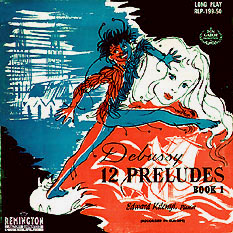
R-199-50
Debussy: Preludes Book 1 (1951)
|
The
cover of an early edition of Twelve Préludes (Debussy)
played by Edward Kilenyi on RLP-199-50:
Delphic Dancers, Soils, Wind in the Plains, The Sounds and Perfumes
turn in the Evening Air, The Hils of Anacapri, Footsteps on Snow,
What the West Wind Saw, The Maiden with the Flexen Hair, The Interrupted
Serenade, The Sunken Cathedral, The Dance of Puck, Minstrels.
A very personal interpretation, yet an impressive performance.
|
|
R-199-57
Chopin: Etudes Op. 10 (released in
the Fall of 1951). While Warren DeMotte was not too positive about
Kilenyi's recordings of the Piano Concerto, either under Dmitri Mitropoulos
or under Felix Prohaska, he was positive about the Etudes Op. 10 and
wrote: 'Kilenyi is at his best in this recording; this is good playing
in a good tradition.'
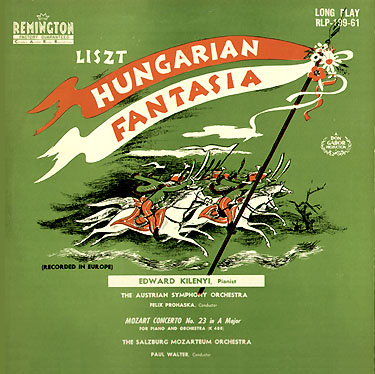
R-199-61
Liszt: Hungarian Fantasia, with Felix Prohaska and the Austrian
Symphony Orchestra - Mozart: Concerto K 488 with Paul Walter
conducting
the Salzburg Mozarteum Orchestra (released in the Fall of 1951)
|
|
The
early, pre-Steinweiss cover of RLP-199-61 with Liszt's Hungarian
Fantasia with a relatively slow pace, and Mozart's Concerto
No. 23, K 488.
|
R-199-82
Chopin:
Waltzes (released
in the Spring of 1952)
R-199-83
Beethoven: Sonata No. 21 (Waldstein) and Sonata 26 (Lebewohl)
(released in the Spring of 1952)
R-199-90
Chopin: Sonatas Nos. 2 & 3. (Released
in November 1952)
R-199-91
Schumann: Symphonic Etudes, Brahms: Variations on a theme
of Handel (released
in the Fall of 1952)
R-199-164
Brahms: Piano Concerto No. 2 with Jonel Perlea conducting the
RIAS Symphony Orchestra (released
1955)

R-199-165
Schumann: Carnaval,
Chopin: Prelude Op. 28, No.16, Berceuse, Etude in F minor (Op.posth.),
Barcarolle
(Released in December 1955). Harold C. Schonberg writes in his discography
of The Piano Music of Robert Schumann, published in High Fidelity
Magazine of September, 1956:
Kilenyi's performance is thoroughly dependable,
save for a lack of flexibility in such finger-twisters as Pantalon
and Columbine, and the recorded sound on his disk is clear though
lacking in color. It is a good buy at the price. I would avoid
the stiff Brailowsky performance and the clumsy, error-laden
one of Cortot. Badura-Skoda is conscientious but not very exciting;
the Sandor version has as much warmth as an icicle; Magaloff
also lacks communicative power; and the Pressler version is
abridged (he plays Nos. I, 4, 11, 12, and 13).
|
On
several of my pages a short file with music automatically starts playing.
However not in a browser like Firefox. If you did not hear music when
opening this page, click on the link below.
|
|
Click here
for a Sound Clip of Chopin's Etude in F minor Op. Posth.
|
|
R-199-166
Liszt: Piano concerto No. 1 and Todtentanz, with the RIAS Symphony
Orchestra conducted by Jonel Perlea. (Released in December 1954)
 A
recording in a slightly different tonal balance and in fake-stereo
appeared on Palace PST-610 and is attributed to the Viennese Symphonic
Orchestra and conductor Kurt Baumann. No mention is made of the pianist.
It is not entirely clear if this is an original recording or a dubbing
of the Kilenyi performance.
A
recording in a slightly different tonal balance and in fake-stereo
appeared on Palace PST-610 and is attributed to the Viennese Symphonic
Orchestra and conductor Kurt Baumann. No mention is made of the pianist.
It is not entirely clear if this is an original recording or a dubbing
of the Kilenyi performance.
|
|
|
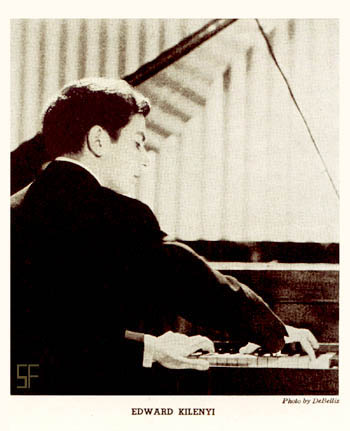
Picture
taken from the November 1942 issue of ETUDE magazine. Edited
by R.A.B. (From the SoundFountain Archive)
|
Kilenyi's
talent and personality, both as a teacher and as a performer, are
profusely illustrated in an article written by Rose Heylbut
for The Etude Magazine, published in November 1942, entitled
"Profitable Piano Practice". Studying scales and practicing the score,
and working on the interpretation from the score, is not enough, the
maestro says. Speaking about studying a composition and the interpretation,
one has to know more about the composer and the composition. Kilenyi
takes Robert Schumann as an example:
"Schumann
must be approached in the world in which he lived; must be
reconstructed and brought to life through his music. Only
then can the student hope to offer an adequate interpretation
of Schumann's work. To achieve this, he must live with Schumann!
He must realize that Schumann was a great intellect; and not
only that his music was 'romantic', but also that it was made
so by the great florescence of romantic literature in Germany
at the time. If the student reads that Schumann was enormously
influenced by Jean-Paul Richter and E.T.A. Hoffmann, he should
be inspired (by enthusiasm as well as by a desire for self-improvement)
to search out the works of those writers and discover for
himself what they had to say. It is quite impossible to play
the "Kreisleriana", for instance, without steeping one's self
in the spirit of Hoffmann's mad Kapelmeister, Johannes Kreisler.
Every composer must be approached, not as an isolated phenomenon,
but as the reflection of the life, the movements, the tastes,
even the fads of the epoch that bred him." - Edward Kilenyi
|
On
January 6, 2000 Edward Kilenyi died at the age of 89 in Tallahassee.
Pianist Deborah Yardley Beers, one of Kilenyi's pupils, described
the qualities of Edward Kilenyi as a teacher:
"At
the heart of the piano lessons I took from Kilenyi were his
wonderful demonstrations at the piano of sections of pieces
on which I was working. With the exception of pieces by Messiaen,
Schoenberg, and Haydn, he could demonstrate by heart from
any point in any piece that I ever studied with him. (...)
Of course he expected me to play correctly (...) and he expected
me to play with some understanding of the historical context
of the pieces (...). Above all, though, I believe his real
goal was for me to find my own voice as a musician, and to
learn to speak with it from the keyboard." - Deborah Yardley
Beers (2001)
Deborah
Yardley Beers can be heard playing Haydn, Brahms and Bartok
and several of her own fascinating compositions, like A Spoonful
of Honey, on  YouTube
(Link added March, 2017.)
YouTube
(Link added March, 2017.)
|
Rudolf A. Bruil,
Page created and published in November 2000
On January 14,
2001, a "Edward Kilenyi Memorial Concert" was given at the
Florida State University, Tallahassee. The noted composer David Ward
Steinman, a former student of Edward Kilenyi, performed a new work
he had composed in Kilenyi's memory, and fourteen of Mr. Kilenyi's
former students came from across the United States to take part and
perform in this program.
R.A.B.
|