R-199-39: Schubert
Piano Sonata in B flat Opus posthumous.
Remington
R-199-108/3 Bach's Six Partitas performed by Sari Biro, Jörg Demus
and John Gillespie
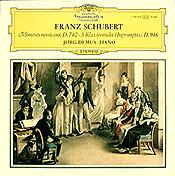
Franz
Schubert's Moments Musicaux Op. 94 revisited in 1958 (together with Impromptus
Op.posthumous) on Deutsche Grammophon SLPM 139 310.
When
Jörg Demus made his debut in New York in the mid nineteen fifties,
his name was not new to the music loving public in America as, from
1950 on, his earliest recordings had been available in the US, and exclusively
on the Remington label of Don Gabor.
Of
course the recordings were made in Austria and were produced by Marcel
Prawy who arranged for the recordings of not only Jörg Demus
but many other pianists, violinists and cellists, and he was responsible
for the recordings with the Viennese Symphonic Orchestra which often
was also mentioned on labels and covers as Niederössterreichisches
Tonkünstler Orchester and Austrian Symphony Orchestra.
Right
from the first releases on Remington, the interpretations of Jörg
Demus were loved because of the sensitivity of playing and the perfect
phrasing, and they were admired because of his superb technique. And
all this despite the often less than perfect (to put it mildly) matrix
production and pressings of so many a Remington disc.
Yet,
one cannot resist being captivated by the spell of Jörg Demus's
playing of Partitas 1 and 6 of J.S. Bach, his equally distinctive rendering
of Ballades Nos. 3 and 4 of Chopin, and his fine performance of the
Schubert Sonata Opus Posthumous. There is no bravura, there is no spectacularity,
but a restrained inner passion. If his interpretations need to be called
spectacular it is because of the complete absence of demonstrative pianism,
overly loud climaxes and the absence of peculiar tempi.
On the contrary. His performances take the listener far beyond the score.
He transcends the music, dematerializes it, while touching the inner
core of the composition, the essence, all shells having been peeled
off.
No
wonder music critic Warren
Demotte characterized several Remington records with performances
of Jörg Demus:
Schubert
Sonata Opus Posthumous:
"Demus
is in excellent form, technically and interpretively; it is a
pleasure to acknowledge the maturity of his playing. This is one
of Remington's best records."
Chopin Ballades:
"Demus
promises much for the future in his sensitive performances of
the Third and Fourth Ballades"
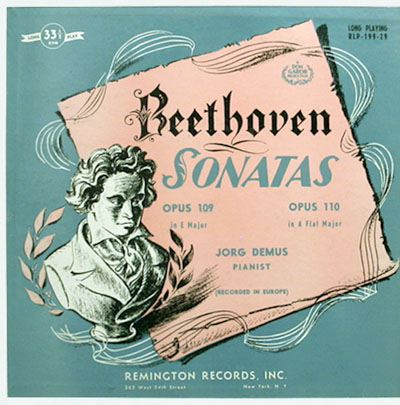
Beethoven Sonatas:
"Demus,
in his early twenties, has astonishing poetic maturity."
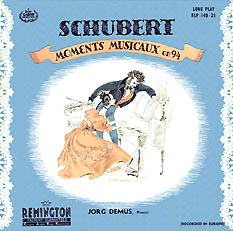
Schubert Moments Musicaux:
"Demus's
playing is warm and caressing, characteristics that are especially
attractive in such a young pianist."
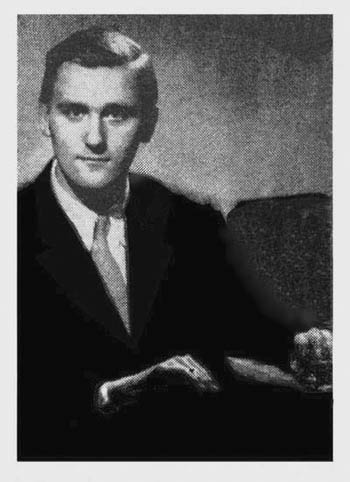
Jorg
Demus at the time when his earliest Remington recordings were
released and when he subsequently recorded for Westminster.
Image taken from the back of the cover of Westminster WN 18044
with Mozart Sonatas and Andante for two pianos/four hands played
with Paul Badura-Skoda which were originally released in 1951
on Westminster WL 5060 and WL 5069 respectively. Image edited
by Rudolf A. Bruil.
Music critic Cecil Smith, wrote in the New Republic of
April 23, 1951:
"Jorg
Demus and Alexander Jenner, neither of whom I ever heard of,
appear to be the best of Remington's pianists. Mr. Demus plays
Schubert's Moments Musicaux, Op. 94, with a buoyant lilt,
and gives musicianly accounts of two Beethoven sonatas, Op.
109 and Op. 110. He plays the Fifth French Suite of Bach with
skill and clarity, though this music sounds much better on
the harpsichord. Mr. Jenner offers sensitive and attractive
performances of the Chopin Etudes Op. 25. In all these records
the piano sounds reasonably well, though not as well as it
can in the best full-price products".
There
is some confusion among biographers and encyclopedists about the actual
date of birth of Jorg Demus. Some state December 2nd 1928. A Dutch encyclopedia
mentions March 2nd 1926 in the short biography. And yet another source
calls March 2nd 1928 as date of birth, while the liner notes of Westminster
WN 18044 mentions February 2nd 1929. Most of these could be caused by
misreading the handwriting of one or more clerks or producers/researcher
preparing the liner notes or the entries in an encyclopedia. This matter
still has to be cleared.
Jörg
Demus
was born in Sankt Pölten in Niederösterreich and at the age
of six he commenced the study of the piano. At the early age of eleven
he was admitted to the "Viennese State Academy for Music and Dramatic
Art" (currently 'Universität für Musik und Darstellende
Kunst'). He made his debut at the "Gesellschaft der Musikfreunde"
(Society of Friends of Music) in Vienna when he was fourteen years old.
He studied composition with composer Joseph Marx, and piano and
theory with Walter Kerschbaumer - significant and familiar names
for so many students of that era. He also studied organ, with Karl
Walter, conducting with no less than Josef Krips and also
composition with Johann Nepomuk David.
He
also studied with Edwin Fischer, Walter Gieseking, Yves Nat and
Arturo Benedetti Michelangeli. He concertized at the Vienna Konzerthaus
and traveled to give performances in the Netherlands, Switzerland, Italy,
England, Germany, and South America. In 1956 he won the "Busoni
Prize" and two years later he was awarded the "Harriet Cohen-Bach
Medal" in London.
The
Remington recordings led to the contract with Westminster and
by 1958 Demus had already a long list of discs to his name with solo
recordings, chamber music and a few concertos. On his repertory: Beethoven,
Franck, Mozart (with Paul Badura-Skoda), Schmidt, and an extensive list
of works by Schubert.
In the nineteen sixties Joerg Demus began recording for Deutsche
Grammophon Gesellschaft as soloist, in chamber music ensembles,
and as an accompanist of a.o. Dietrich Fischer-Dieskau (Schubert).
He
also accompanied Elly Ameling, made recordings on original instruments
for the BASF and Harmonia Mundi labels, accompanied Peter Schreier
(Haydn Songs - Eterna label) on Eurodisk, performed again Bach, and
recorded the complete piano music of Claude Debussy. To hear Beethoven
and Schubert being played on a Hammerklavier is not for everyone
a treat because many pianists do not master the old instruments sufficiently
to perform the music with a large palette of color and dynamics. It
suffice to hear Jörg Demus playing a William Stodart piano
to know that his style is rich in sound and has many nuances.
Jörg
Demus receives The Beethoven Ring, presented to him by Mr. Klemens
Kramert, President of the Viennese Beethoven Society (Wiener Beethoven
Gesellschaft) on 27 March, 1977.
(Picture taken from the Eurodisc 2 LP gatefold, reference
300 054-406, edited by R.A.B.).
A
specific proof of Jörg Demus's art of interpretation was recorded
on March 27th, 1977, when he received The Beethoven Ring (earlier
only presented to pianist Elly Ney and conductor Volkmar Andreae).
Demus performed before a live audience the Sonatas Nos. 8 (Pathétique),
17 (Der Sturm), 26 (Les Adieux) and No. 32. After hearing the first
bars of the Sonata Pathétique, or the introduction of 'Les Adieux'
one realizes how distinguished the approach of the maestro is and that
it is completely in line with his early recordings from the nineteen
fifties: refined phrasing and subtle dynamics. Although a performance
before a live public represents a challenge, it can be said that he
masters the score in an intimate, yet affirmative way.
The
Remington discography of Jörg Demus:
R-149-12 Chopin: Ballades No. 3 in A flat major Op. 47 and No.
4 in F minor Op. 52. Listed in Schwann edition of May, 1951 (also released
on the Merit label: M1-18).
R-149-21
Schubert: Moments Musicaux Op. 94, D 780.
The
Moments musicaux were later released on the Masque label, then coupled
with Felicitas Karrer playing Valses sentimentales and nobles. Masque
M 10.002.
R-199-25
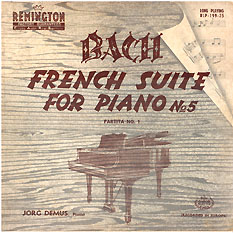
Bach: French Suite No. 5 and Partita No. 1. Released September, 1951.
In France available on Concerteum CR241.
R-199-29
Beethoven: Piano Sonatas Nos. 30 (Op. 109) and 31 (Op. 110). First listed
in July, 1951. In France available on Concerteum CR 239.
R-199-39
Schubert: Piano Sonata Opus Posthumous. First listed December, 1951.
(Concerteum 310)
R-199-92
Bach: Partita No. 6 and Preludes and Fugues in G Major and G Minor from
The Well Tempered Clavier (Das Wohltemperierte Clavier). Available in
July, 1952; in France issued on Concerteum 309.
R-199-108/3
Bach's Six Partitas performed by Jörg Demus on piano (Nos. 1 and
6), Sari Biro on piano (No. 2) and pianist/
harpsichordist John
Gillespie on harpsichord (Nos. 3, 4 and 5). A complete set played
by Paul Badura Skoda had been available already since the Spring of
1952. The complete set of Biro, Demus and Gillespie was released in
1953.
At the end of World War II
harpsichordist John Gillespie spent two years at the "Conservatoire
national de Paris", studying organ with André Marchal and
Marcel Dupré. He later returned to Paris for two years of study
at the Sorbonne. He completed his studies in the US and received a Ph.D.
in musicology in 1951.
Rudolf
A. Bruil, March 17th, 2005
Jörg
Demus passed away on April 16, 2019, at the respectable age of 90, in
Vienna.
This article -
as all of my articles - is copyrighted.
Please do not reproduce this article in whole or part, in any form,
without obtaining my written permission.




.jpg "Jörg Demus honored by the Vienna Beethoven Society - Wiener Beethoven Gesellschaft")
 At the end of World War II
harpsichordist John Gillespie spent two years at the "Conservatoire
national de Paris", studying organ with André Marchal and
Marcel Dupré. He later returned to Paris for two years of study
at the Sorbonne. He completed his studies in the US and received a Ph.D.
in musicology in 1951.
At the end of World War II
harpsichordist John Gillespie spent two years at the "Conservatoire
national de Paris", studying organ with André Marchal and
Marcel Dupré. He later returned to Paris for two years of study
at the Sorbonne. He completed his studies in the US and received a Ph.D.
in musicology in 1951.